Shocking Tesla Flying Car Roadster Unveils 0.81-Second Thrills and Aerial Power in 2026 Demo
In a spectacular demonstration that has captivated the world, Tesla has finally brought the long-promised vision of a Tesla flying car closer to reality. On October 15, 2026, at a SpaceX testing facility in McGregor, Texas, the company unveiled its next-generation Roadster—an electric sports car capable of brief aerial maneuvers using advanced cold-gas thrusters developed in collaboration with SpaceX. Elon Musk, CEO of both Tesla and SpaceX, declared that “flying cars are real,” marking a pivotal moment in automotive and aerospace history. This event, nearly a decade after the second-generation Roadster was first announced in 2017, showcases not just blistering performance but a glimpse into a future where vehicles can briefly defy gravity.
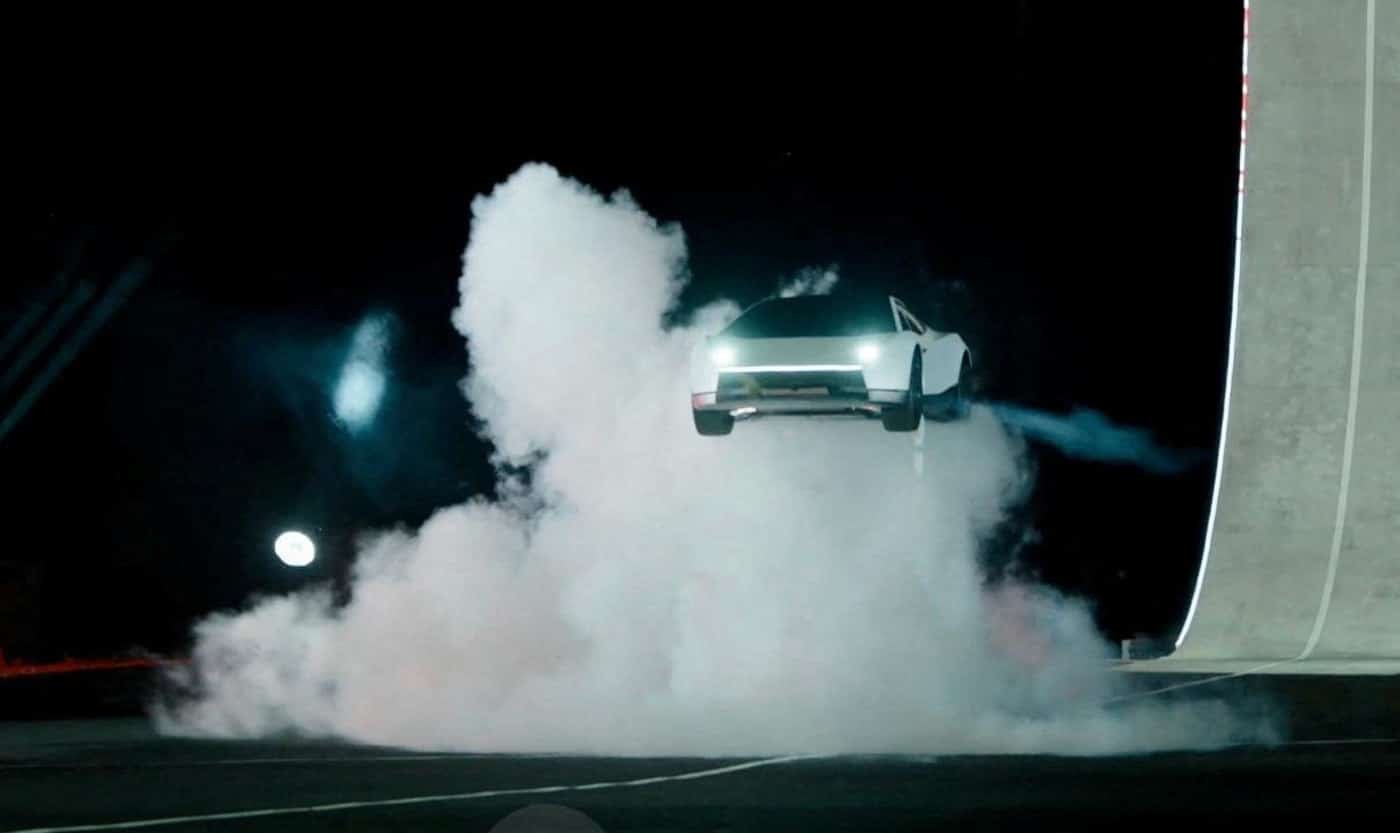
The Tesla flying car demonstration featured the Roadster performing jaw-dropping stunts that blurred the line between automobile and aircraft. In one sequence, the sleek white vehicle drove up a curved ramp, clung upside down using a multi-mode suction system, launched into the air, executed a mid-air roll or “kickflip,” and landed safely on its wheels with the assistance of thrusters. Another highlight saw it leap over a lineup of Tesla vehicles—including a Cybertruck, Model Y, Model 3, Cybercab, and even a tall Tesla Semi—reaching heights of over 26 feet before descending under controlled thrust. These feats were powered by approximately 10 nozzles connected to ultra-high-pressure air tanks holding hundreds of liters of compressed gas, enabling short bursts of lift, rotation, and soft landings without traditional rocket fuel.
Performance claims for the new Roadster are equally astonishing. Tesla executives, including Vice President of Vehicle Engineering Lars Moravy, stated that the car accelerates from 0 to 60 mph in less than one second—specifically around 0.81 seconds under demonstration conditions—with potential for even quicker times in production versions. Top speed is projected above 230 mph (over 370 km/h), with ambitions to eventually approach half the speed of sound. Range is expected to exceed 300 miles (around 480 km). The vehicle incorporates a powerful underbody fan or suction system that enhances ground adhesion, allowing extreme cornering forces claimed to surpass 2g and the ability to drive inverted on specialized surfaces. Musk emphasized that this collaboration between “the world’s best car company and the world’s best rocket company” produces capabilities previously confined to science fiction.
Tesla plans three variants of the Roadster. The standard Performance model focuses on road excellence and is available for reservation with a significant deposit (reported around $50,000 in some channels). A limited “Thrust” edition adds rear cold-gas thrusters for enhanced acceleration and seats two. The ultimate “Rocket” package, the true Tesla flying car configuration, is a one-seater equipped with the full multi-mode suction system and perimeter thrusters for aerial maneuvers; it will be available by invitation only and is not approved for public road use. Production across the lineup is targeted to begin in 2028, following years of delays from the original 2017 unveiling and earlier delivery projections. Pricing has not been officially announced, though earlier estimates hovered near or above $200,000, and reservation deposits signal the exclusivity and cost of these high-performance machines.
While the demonstration was breathtaking, experts and regulators urge caution. The Tesla flying car prototype performed without a driver aboard for safety reasons, as Musk noted the desire to avoid risking lives during the controlled event. Sustained flight, as opposed to brief hops and flips under ideal conditions at a private facility, has not been demonstrated. The Federal Aviation Administration (FAA) has indicated that vehicles leaving the ground fall under its jurisdiction in many scenarios, potentially requiring aircraft certification, pilot licensing for operators, and adherence to national airspace rules—especially for anything exceeding roughly 250 pounds. Musk himself acknowledged that the flying version “is not necessarily a safety-optimized car” and may not be legal in all jurisdictions. Tesla’s own materials clarify that the Rocket package lacks public-road approval. These regulatory, safety, and practical hurdles mean everyday consumers should not expect to pilot a Tesla flying car over city streets anytime soon.
The Roadster’s reveal arrives at a strategic time for Tesla. The company has faced challenges with consecutive sales pressures in its core electric vehicle business and a product lineup that some critics describe as stagnant. By delivering a high-profile demonstration of innovative engineering—tying Tesla’s automotive expertise tightly to SpaceX’s propulsion technology—Musk aims to reinforce the brand’s image as a pioneer of the future. The event generated massive online buzz, with videos of the aerial stunts circulating widely and reactions pouring in from enthusiasts, celebrities, and public figures. Share price movements reflected the excitement in the immediate aftermath, though analysts have tempered expectations about near-term revenue impact from a low-volume, ultra-premium sports car. The real value may lie in storytelling, talent attraction, and long-term technological spillover into other Tesla projects such as autonomy and robotics.
Historically, the dream of flying cars has persisted for decades. Visionaries from the early 20th century onward predicted personal aerial vehicles that combine road and air travel. Numerous startups have pursued eVTOL (electric vertical takeoff and landing) aircraft, yet regulatory complexity, energy density limitations of batteries, noise concerns, infrastructure needs, and safety certification have slowed commercial progress. Tesla’s approach differs: rather than building a dedicated aircraft that can also drive, it has engineered a high-performance sports car that can momentarily leave the ground using cold-gas thrusters. This hybrid philosophy prioritizes the driving experience first—Musk has called the Roadster the “last best driver’s car” designed without primary focus on full autonomy—while adding spectacular secondary capabilities. Whether this model influences broader mobility remains to be seen, but it has undeniably reignited public fascination.
Looking ahead to 2028 and beyond, several questions dominate discussions around the Tesla flying car. Will production timelines hold after previous postponements? How will Tesla address battery, thermal, and structural demands of repeated thruster use? Can the suction and thruster systems scale reliably for production vehicles while meeting automotive safety standards? What insurance, liability, and training frameworks will emerge for any limited aerial use? And will the technology evolve toward more practical short-hop or emergency applications, or remain a thrilling novelty for the ultra-wealthy? Reservations are already open for non-flying variants, giving early interest a concrete path, while the invite-only Rocket edition underscores its exclusivity.
Beyond the hardware, the demonstration highlights the accelerating convergence of industries under Musk’s leadership. Shared engineering talent, materials science, software control systems, and high-pressure fluid dynamics between Tesla and SpaceX create unique advantages. The same precision that lands reusable rockets may one day enable safer, more controlled ground-to-air transitions in vehicles. At the same time, competitors in both the electric vehicle and advanced air mobility sectors will closely study the public reaction and technical claims. Traditional automakers, aviation startups, and regulators all have stakes in how this narrative develops.
For enthusiasts and observers, the October 2026 event represents more than a product launch—it is a cultural moment. Videos of the Roadster flipping mid-air and leaping over fellow Teslas have already entered the modern pantheon of tech demos, comparable in spectacle to past reveals that redefined expectations. Yet responsible coverage requires balance: the Tesla flying car as demonstrated is real in the controlled sense of brief, powered aerial maneuvers, but it is not yet a practical, legal, everyday transportation solution. Production remains years away, regulatory pathways are complex, and the primary mission of the Roadster stays rooted in delivering unparalleled driving performance on the ground.
As the world digests the footage and details continue to emerge, one thing is clear. Elon Musk and Tesla have once again expanded the boundaries of what an electric vehicle can be. Whether the 2028 production models deliver on the promise of accessible thrills—or whether the flying capabilities stay confined to private demonstrations and exclusive invitees—the conversation about personal mobility has been elevated. The Tesla flying car Roadster does not end the century-old quest for practical aerial automobiles, but it dramatically advances the conversation with engineering substance, theatrical flair, and a production target that keeps hope alive. For now, the future does indeed appear to include flying cars—at least in short, spectacular bursts powered by compressed air and boundless ambition.
This development will continue to unfold through regulatory discussions, further testing, and eventual customer deliveries. Stay tuned as more technical specifications, pricing confirmation, and real-world performance data become available in the coming years. The intersection of electric propulsion, advanced materials, and rocket-derived thrusters has produced a vehicle that challenges conventional categories and invites everyone to imagine what comes next in the evolution of personal transport.