Elon Musk Becomes World’s First Trillionaire After Massive SpaceX IPO Success
Elon Musk Becomes World’s First Trillionaire After Massive SpaceX IPO Success
In a groundbreaking moment for the tech and space industries, Elon Musk has officially become the world’s first trillionaire following the spectacular debut of the SpaceX IPO. The rocket, satellite, and AI powerhouse raised a staggering $75 billion in what is now the largest initial public offering in history, sending shockwaves through Wall Street and cementing Musk’s unparalleled influence in innovation.
SpaceX shares, trading under the ticker SPCX, opened at $150 — already 11% above the IPO price of $135 — and surged as high as $176.52 during the day. By the closing bell, the stock had climbed 19% to $160.95, pushing the company’s market capitalization to an impressive $2.1 trillion. This valuation not only makes SpaceX the sixth most valuable U.S.-listed company but also triggered an extended trading rally that added another $100 billion to its market cap. More than 500 million shares changed hands, rivaling the frenzied debut of Facebook back in 2012.
The SpaceX IPO wasn’t just another public listing — it was a masterclass in negotiation and market dominance. Elon Musk’s team secured razor-thin fees for the offering, and in a stunning twist, the underwriters agreed to forgo any additional fees on the greenshoe option. This 15% overallotment allows banks to sell an extra $11.25 billion worth of shares without earning extra compensation, saving SpaceX tens of millions while still delivering a massive capital infusion.
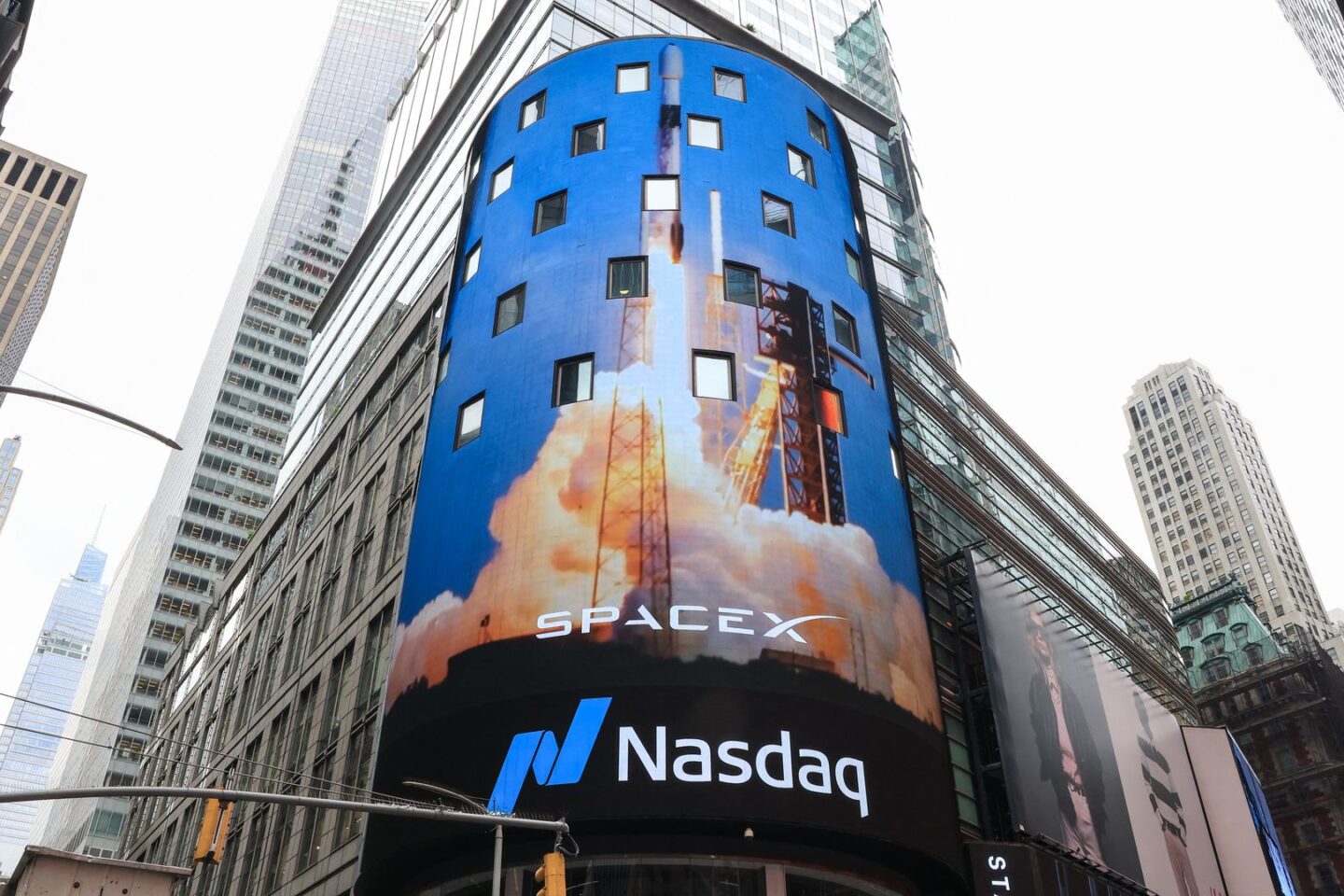
Elon Musk and SpaceX President and COO Gwynne Shotwell rang the opening bell on Friday, with Musk joining virtually from Texas and Shotwell at the Nasdaq in New York City. The milestone comes as Musk’s combined stakes in SpaceX and Tesla propelled his net worth past the $1 trillion mark. At the IPO price, his SpaceX holdings alone were valued at around $690 billion, while his Tesla stake contributed approximately $279 billion.
Unprecedented Deal Terms That Shocked Wall Street Bankers
What makes the SpaceX IPO even more remarkable is the deal structure. Investment bankers from Goldman Sachs, Morgan Stanley, and other top firms agreed to a total fee of $500 million — roughly 0.67% of the $75 billion raised. While this is still one of the largest fee-paying events in Wall Street history, it represents an incredibly lean payout compared to typical IPO economics.
Lead banks Goldman Sachs and Morgan Stanley are expected to split the biggest portion, taking home around $100 million each. Yet the real headline is the greenshoe provision: underwriters can exercise the option within 30 days to sell additional shares but will earn zero extra fees for doing so. This unusual concession highlights the immense demand for SpaceX shares and the leverage Musk’s team wielded during negotiations.
Representatives for Morgan Stanley and Goldman Sachs declined to comment, but the arrangement underscores how coveted participation in this historic SpaceX IPO truly was.
Inside SpaceX: From Reusable Rockets to Global AI and Satellite Ambitions
Founded in 2002, SpaceX has transformed from a bold reusable rocket venture into a multifaceted giant. According to its prospectus, the company has recorded a cumulative loss of $41.3 billion over more than two decades. Yet profitability has been achieved in key areas, particularly the Starlink satellite internet division, which has been cash-flow positive since around 2015, as Musk noted in a pre-IPO JPMorgan Chase livestream.
Musk emphasized that the SpaceX IPO timing aligns with a major growth phase. Plans include deploying over 100,000 satellites for enhanced global communications and building artificial intelligence data centers in space. These initiatives position SpaceX at the intersection of aerospace, telecommunications, and cutting-edge AI.
In February 2026, SpaceX acquired Musk’s startup xAI, integrating advanced data centers, Grok AI models, the embattled AI chatbot and image generator, and the social network X (formerly Twitter). This consolidation strengthens SpaceX’s position in the rapidly evolving AI landscape, especially as competitors like OpenAI and Anthropic now eye their own mega IPOs inspired by this success.
The only consistently profitable segment today remains Starlink, powering high-speed internet in remote areas and supporting critical operations worldwide. With reusable rocket technology continuing to lower launch costs, SpaceX maintains a formidable competitive edge.
Market Reaction and Broader Implications of the SpaceX IPO
Investors worldwide celebrated the SpaceX IPO. The 19% first-day pop reflects massive enthusiasm for Musk’s vision and the tangible progress of his companies. Skeptics, however, warn that the sky-high $2.1 trillion valuation may be overly optimistic given the capital-intensive nature of space exploration and satellite networks.
On the same day, Tesla shares rose 1.8% to close at $406.43, lifting its market cap to around $1.5 trillion. This synergy between Musk’s ventures continues to fuel his extraordinary wealth accumulation.
Broader markets showed modest gains, while crude oil prices dipped amid ongoing Middle East developments. Yet all eyes remained fixed on the Nasdaq debut of SPCX.
Why the SpaceX IPO Matters for the Future of Innovation
The success of this SpaceX IPO extends far beyond financial metrics. It validates the potential of private space enterprises to attract public capital at unprecedented scale. By raising $75 billion, SpaceX secures substantial resources for ambitious projects that could reshape global connectivity, accelerate AI development, and advance human spaceflight goals.
Elon Musk’s leadership has repeatedly defied conventional wisdom. From landing reusable rockets to creating a thriving satellite constellation, his track record inspires confidence. The integration of xAI further amplifies SpaceX’s technological capabilities, potentially leading to breakthroughs in orbital computing and next-generation AI systems.
For everyday investors, the SpaceX IPO opens new opportunities to participate in the space economy. With strong trading volume and sustained post-IPO momentum, the stock’s performance signals robust long-term interest.
Challenges and Opportunities Ahead
Despite the euphoria, SpaceX faces significant hurdles. The accumulated losses highlight the high costs of innovation in rocketry and satellite infrastructure. Regulatory scrutiny, technical risks, and competition in the satellite internet space remain factors to watch.
Nevertheless, the SpaceX IPO provides a powerful financial cushion. Musk’s stated goal of using proceeds for aggressive expansion — including massive satellite deployments and space-based AI infrastructure — suggests a clear roadmap for growth.
As OpenAI and Anthropic prepare their own public debuts, the bar has been set extraordinarily high. SpaceX’s ability to negotiate favorable terms while delivering outsized returns to early investors sets a new benchmark for tech IPOs.
Elon Musk’s Enduring Legacy in Business and Beyond
Few entrepreneurs have shaped multiple industries like Elon Musk. Through Tesla’s electric vehicle revolution, SpaceX’s space achievements, and now the integration of AI and social media assets, Musk continues to push boundaries.
Becoming the world’s first trillionaire via the SpaceX IPO is not merely a wealth milestone — it represents the triumph of visionary risk-taking over traditional business caution. As shares continue to perform strongly in after-hours trading, the narrative around Musk’s empire grows even more compelling.
Investors, technologists, and space enthusiasts alike will be closely monitoring SpaceX’s next moves. With a market cap of $2.1 trillion and ambitious plans on the horizon, the company is poised to remain a dominant force for years to come.
The SpaceX IPO marks the beginning of a new chapter, not just for Elon Musk and his companies, but for the entire ecosystem of innovation. As global markets digest this historic event, one thing is clear: the future of space, AI, and sustainable technology looks brighter than ever.