Mirabai Chanu Wins Historic Asian Games Silver Medal – Completes Career Collection
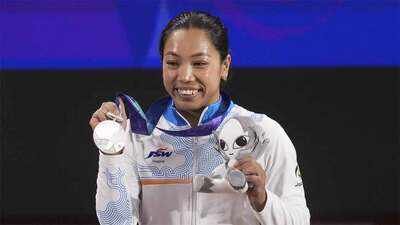
Mirabai Chanu has finally filled the one blank that had haunted her career for years. On Wednesday in Nagoya, the Indian weightlifter stepped onto the platform in the women’s 49 kg category and lifted a total of 198 kg to secure silver at the Asian Games. With that medal around her neck and a wide smile on her face, she said the words that summed up more than a decade of struggle: “In a way, my life is complete now.”
For years the absence of an Asian Games medal sat like an unfinished sentence in an otherwise glittering résumé. Mirabai Chanu already owned an Olympic silver from Tokyo, a world championship title and multiple Commonwealth Games golds. She had risen from failure in Rio, where she could not register a valid lift, to podium glory five years later. She had battled injuries, long rehabilitation periods and the crushing weight of national expectation. Yet the Asian Games medal remained missing. In Hangzhou three years ago she finished fourth. In Paris last year she again missed bronze by a single kilogram. On Wednesday, at the age of 32 and as the oldest lifter in a seven-athlete field, she closed the gap.
Mirabai Chanu opened with 87 kg in the snatch and followed it with 111 kg in the clean and jerk for a 198 kg total. It was enough for silver behind North Korea’s Ri Song-gum, who completed a golden hat-trick with a world-record 215 kg total that included a 121 kg clean and jerk. Gold was never realistic against a fully fit Ri, but the silver still carried historic weight. Mirabai Chanu became India’s first Asian Games weightlifting medallist since Karnam Malleswari’s silver in Bangkok in 1998. Twenty-six years of waiting ended in one evening in Japan.
The result was never guaranteed. Every time Mirabai Chanu steps onto the platform, a medal is expected. She knows it. The country knows it. That expectation becomes its own kind of load. “There is pressure. Really. There is pressure,” she admitted afterwards. “The whole world has kept hope for me. That Mirabai will get a medal.” Yet she has learned to draw strength from the same belief that sometimes threatens to crush her. “On the one hand, I feel strong. There is strength. People think so positively of me. They have prayed so much for me. That thing gives me more confidence.” The darker side remains: “What if something is left by mistake? What will I do? Everyone is thinking that I will get a medal. If I don’t get it, what will I do? There is pressure.”
That pressure has been constant for more than a decade. After the disappointment of Rio, Mirabai Chanu rebuilt herself. Tokyo brought redemption and Olympic silver. Hangzhou brought another fourth-place finish and the familiar sting of a podium just out of reach. Paris repeated the heartbreak, this time by the narrowest of margins. Many athletes would have stepped away. Mirabai Chanu did not. Alongside her long-time coach Vijay Sharma she continued training in the basement of a gym in Ghaziabad, chasing the one medal that still eluded her. At 32 she understood that opportunities were finite. The pursuit was no longer about proving she belonged among the world’s best. She had already done that. It was simply about completing the set.
In a sport that has struggled for consistency and clean headlines, Mirabai Chanu has been the rare constant. Indian weightlifting has endured repeated doping scandals and suspensions that damaged its reputation and stalled the talent pipeline. Through it all, Mirabai Chanu kept competing, winning and returning. When the sport needed a medal, a positive story or simply a reason to believe, she was usually the one providing it. Her longevity, consistency and ability to deliver on the biggest stages despite physical setbacks have made her the most successful Indian weightlifter of her generation and, in many ways, the face that held the sport together at the highest level.
The question of what comes next is already being asked. Promising younger lifters are emerging, yet none currently combine Mirabai Chanu’s durability, medal record and international presence. Her career has spanned generations and continued to produce results long after many expected it to fade. There is no obvious replacement. Perhaps she understands this better than anyone. At Sharma’s academy in Ghaziabad she is already investing time in the next generation, passing on the lessons learned through years of competing, recovering and returning. “If I can do it, others can too,” she said.
The silver in Nagoya will not erase the earlier disappointments, but it reframes them. Rio’s failure, Hangzhou’s fourth place and Paris’s near-miss now form the backdrop against which the final major medal shines brighter. Mirabai Chanu’s career was never perfect. It was persistent. That quality has defined her more than any single result. She has shown that setbacks, injuries and the heavy burden of expectation do not have to be career-ending. They can be the material from which a complete story is eventually written.
For Indian sport, the moment carries extra resonance. Weightlifting has long needed a sustained success story that rises above controversy. Mirabai Chanu has provided it. Her medals are important; the example she sets for younger athletes may prove more lasting. She has demonstrated that a career can stretch across Olympic cycles, survive physical tolls and still deliver at the highest level when the final missing piece is within reach.
As she stood on the podium in Nagoya with the silver medal around her neck, the unfinished sentence of her career finally received its full stop. Mirabai Chanu now owns Olympic silver, world championship gold, Commonwealth golds and, at last, an Asian Games silver. The collection is complete. The persistence that defined her has been rewarded. And for a sport still searching for its next constant, she has left both a standard and a pathway for those who will follow.