India Netherlands Strategic Partnership: PM Modi Elevates Bilateral Ties with Netherlands During Historic Hague Visit
India Netherlands Strategic Partnership Reaches New Heights: PM Modi’s Landmark Visit to The Hague
New Delhi/Hague, May 17, 2026 – In a significant development amid evolving global geopolitics, India and the Netherlands have decided to elevate their bilateral relationship to the level of a Strategic Partnership. Prime Minister Narendra Modi announced this milestone following extensive talks with Dutch Prime Minister Rob Jetten in The Hague, marking a new chapter in India Netherlands relations that spans trade, investment, innovation, defence, sustainability, and cultural heritage.
This elevation comes at a crucial time as both nations seek deeper collaboration in key sectors. The Netherlands remains one of India’s largest trading partners in Europe, with bilateral trade reaching USD 27.8 billion in 2024-25. It is also India’s fourth-largest investor, with cumulative Foreign Direct Investment (FDI) touching an impressive USD 55.6 billion. These figures underscore the robust economic foundation upon which the new India Netherlands Strategic Partnership is being built.
PM Modi, who began his two-day visit to The Hague on Friday as part of a four-nation European tour, emphasized the progress achieved in the last decade. “There has been significant progress in India-Netherlands ties in the last decade,” Modi stated in his opening remarks during the bilateral talks.
Deep Historical and People-to-People Ties
The Prime Minister highlighted the deep historical and people-to-people connections between the two countries. “India considers the Netherlands among its most important partners as the historical and people-to-people relations between the two sides are deep,” he said. Both nations share common values including democracy, market economy, and responsible global behaviour.
Cooperation in water management, healthcare, and education has already delivered tangible benefits to citizens of both countries. Modi stressed the need for greater convergence between Dutch expertise and India’s scale, speed, and skilled workforce. “We need to take our cooperation in areas of innovation, investment, sustainability and defence to new heights,” he added. Under this shared vision, the two countries are formally taking India-Netherlands relations to the strategic partnership level.
Dutch PM Rob Jetten echoed these sentiments, highlighting growing ties across multiple domains and formally announcing the elevation to strategic partnership status.
Boosting Economic Cooperation and Ease of Doing Business
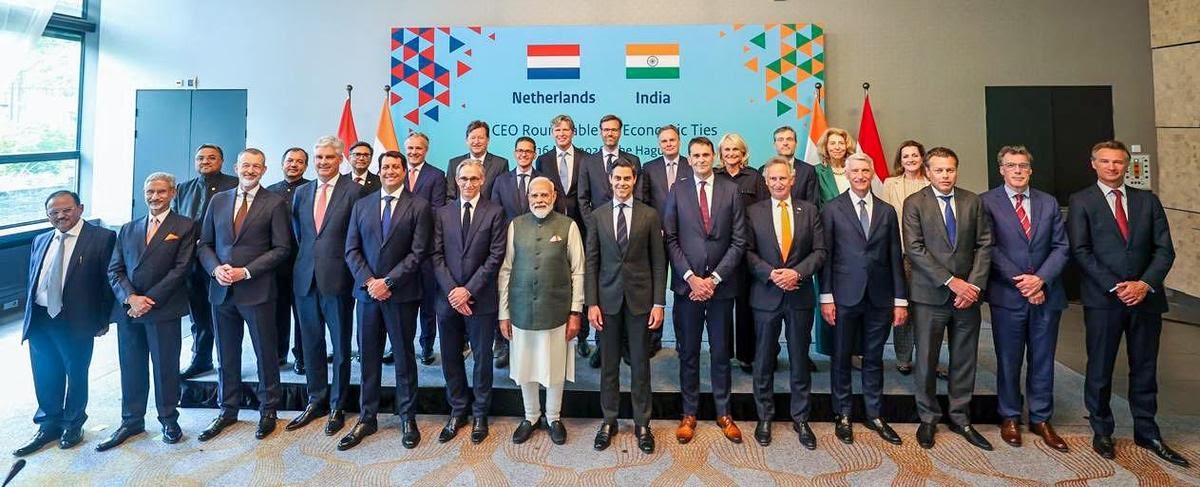
Ahead of the formal talks, PM Modi interacted with prominent CEOs of leading Dutch companies from sectors including energy, ports, health, agriculture, trade, and technology. He invited Dutch firms to explore massive opportunities in India, particularly in maritime, renewable energy, digital technologies, semiconductors, artificial intelligence, and healthcare.
“We are continuously reducing compliance and increasing the ease of doing business. We have recently carried out next-generation reforms in taxation, labour codes, and governance,” Modi told the business leaders. He pointed out that manufacturing in India is becoming highly cost-effective while the services sector drives efficiency and innovation.
“Today’s India is a symbol of scale and stability. In terms of scale, we are the fastest-growing major economy in the world and home to the world’s largest talent pool. Infrastructure, clean energy or connectivity – no one in the world can match India’s speed,” the Prime Minister asserted.
On stability, Modi noted his completion of 12 years as Prime Minister of the world’s largest democracy. “With continuous reforms, we have transformed our economic DNA. Our direction has been clear – to give policy predictability to the private sector and increase opportunities for them.” His government has opened up critical sectors such as space, mining, and nuclear energy to private participation.
These reforms are expected to attract more Dutch investment under the new India Netherlands Strategic Partnership, creating win-win opportunities for businesses on both sides.
Repatriation of 11th-Century Chola Copper Plates: A Cultural Milestone
One of the most emotionally significant moments of the visit was the repatriation of the historic Anaimangalam Copper Plates, famously known in the Netherlands as the Leiden Plates. The Netherlands handed back these priceless 11th-century artefacts to India in a special ceremony attended by PM Modi and Dutch PM Jetten.
The 21 copper plates (along with 3 smaller ones), weighing approximately 30 kilograms, are bound by a bronze ring with the royal seal of the Chola dynasty. Dating back to the reign of Emperor Rajaraja Chola I (985–1014 CE), these inscriptions are among the most important surviving records of the Chola empire and Tamil heritage outside India.
India had been seeking their return since 2012. The plates document land grants and tax revenues to the Chudamani Vihara, a Buddhist monastery in Nagapattinam built by Sri Mara Vijayotunga Varman of the Srivijaya kingdom (present-day Indonesia). Historians value them for insights into Chola maritime prowess, religious pluralism, and cultural exchanges between South India and Southeast Asia. They also highlight how Hindu rulers patronized Buddhist institutions, reflecting India’s ancient tradition of interfaith harmony.
PM Modi described the moment as “a joyous moment for every Indian.” In a post on X, he wrote: “Chola Copper Plates dating back to the 11th Century will be repatriated to India from the Netherlands. The Chola Copper Plates are a set of 21 large plates and 3 small plates and largely contain texts in Tamil, one of the most beautiful languages of the world.”
He further added that the plates relate to Rajendra Chola I formalizing commitments made by his father Rajaraja Chola I and showcase the greatness of the Cholas. Modi thanked the Government of the Netherlands and Leiden University, where the plates were preserved since the mid-19th century.
This cultural repatriation adds a powerful emotional and historical dimension to the strengthening India Netherlands ties.
Strategic Importance Amid Global Geopolitics
The elevation to strategic partnership is not merely symbolic. It reflects shared interests in a rapidly changing world. Both countries are committed to a rules-based international order, sustainable development, and technological advancement.
Key areas identified for deeper cooperation under the new framework include:
- Defence and Security: Joint exercises, technology transfer, and maritime security cooperation.
- Renewable Energy and Sustainability: Collaboration on green hydrogen, solar power, and climate resilience, leveraging Dutch water management expertise.
- Semiconductors and Digital Technologies: Supply chain resilience and AI innovation.
- Healthcare and Pharmaceuticals: Joint research and manufacturing.
- Agriculture and Ports: Modern farming techniques and port infrastructure development.
- Education and Innovation: Student exchanges and startup collaborations.
The two leaders also underlined the importance of early implementation of the India-EU Free Trade Agreement (FTA), which would further boost India Netherlands economic engagement given the Netherlands’ strategic position as a gateway to Europe.
Historical Context of India Netherlands Relations
India Netherlands relations date back several centuries through trade links during the Dutch East India Company era. Modern diplomatic relations were established after India’s independence, but the last decade has witnessed exponential growth under the leadership of PM Modi.
The Prime Minister’s 2026 visit is his second to the Netherlands after 2017. Officials describe the timing as an “important juncture” for deepening cooperation in critical and emerging technologies, supply chain diversification, and Indo-Pacific stability.
Economic Data and Future Potential
Bilateral trade at USD 27.8 billion (2024-25) shows healthy growth, but experts believe the strategic partnership can push it significantly higher in the coming years. Dutch investments of USD 55.6 billion have created jobs and brought advanced technology to India in sectors like logistics, water treatment, and financial services.
India offers Dutch companies a massive market of 1.4 billion people, a young demographic dividend, and policy stability. Conversely, the Netherlands provides India access to cutting-edge European technology, expertise in high-value agriculture, and efficient port management.
PM Modi’s emphasis on “Design and Innovate in India” perfectly aligns with Dutch strengths in R&D and engineering. Sectors like semiconductors are particularly promising as India pushes its semiconductor mission while the Netherlands is home to global leaders like ASML.
Broader European Tour Context
The Hague visit is part of PM Modi’s four-nation European tour aimed at strengthening bilateral ties across defence, trade, technology, and diaspora engagement. The outcomes from the Netherlands are expected to set a positive tone for engagements with other European partners.
Conclusion: A Future-Ready Partnership
The elevation of India Netherlands relations to strategic partnership level signals mutual confidence and long-term commitment. As PM Modi noted, the coming together of Dutch expertise with India’s scale, speed, and skill creates unmatched potential.
From the return of ancient Chola artefacts symbolizing shared heritage to forward-looking cooperation in AI, semiconductors, and green energy, the partnership balances history with the future. For businesses, investors, and citizens, this development opens new doors of opportunity.
As both nations implement the strategic partnership roadmap, the world can expect deeper collaboration that contributes not only to their national growth but also to global stability, sustainability, and technological progress.