Nitish Kumar Resigns as Bihar Chief Minister After 21 Years: Samrat Choudhary Elected BJP Legislature Party Leader, Set to Become First BJP CM of Bihar
Nitish Kumar Resigns as Bihar Chief Minister: A Historic Power Shift in Bihar Politics as Samrat Choudhary Takes Over
In a significant development that marks the end of an era in Bihar politics, Nitish Kumar tendered his resignation as Chief Minister of Bihar on Tuesday, April 14, 2026. The resignation, accepted by Governor Lt. Gen. (Retd.) Syed Ata Hasnain, comes after Nitish Kumar presided over his final State Cabinet meeting earlier in the day. This move paves the way for Deputy Chief Minister Samrat Choudhary to become the next Chief Minister, making him the first leader from the Bharatiya Janata Party (BJP) to hold the top post in the state.
Nitish Kumar, who has steered Bihar for over 21 years across multiple terms, informed his Cabinet colleagues about dissolving the Council of Ministers—a constitutional necessity before stepping down. His decision follows his election to the Rajya Sabha last week and his subsequent oath as a Member of Parliament on April 11, 2026. Nitish Kumar had earlier resigned as a Member of the Legislative Council (MLC) on March 30, 2026, adhering to parliamentary rules that require an elected Rajya Sabha member to vacate any state legislative seat within 14 days.
The transition represents a major milestone for the National Democratic Alliance (NDA) in Bihar. For the first time, the BJP is set to lead the government in the state, reflecting the party’s strengthened position after the 2025 Bihar Assembly elections where it emerged as the single largest party with 89 seats.
Background: The 2025 Bihar Assembly Elections and NDA’s Landslide Victory
The seeds of this leadership change were sown in the Bihar Legislative Assembly elections held in November 2025. The NDA, comprising the BJP, Janata Dal (United) [JD(U)], Lok Janshakti Party (Ram Vilas), and other allies, secured a resounding victory, winning over 200 seats in the 243-member Assembly. The BJP alone bagged approximately 89-92 seats (reports vary slightly across sources), becoming the single largest party and surpassing its previous highs.
Nitish Kumar led the NDA campaign, with strong support from Prime Minister Narendra Modi, who addressed multiple rallies. The alliance’s focus on development, law and order, welfare schemes, and infrastructure resonated with voters, overcoming anti-incumbency factors. In contrast, the opposition Mahagathbandhan (led by Rashtriya Janata Dal) managed only around 35 seats.
Post-election, Nitish Kumar took oath for a record tenth term as Chief Minister. However, his decision to move to national politics via the Rajya Sabha opened the door for a smooth transition within the NDA. JD(U) leaders have emphasized that the new government will continue Nitish Kumar‘s policies, with the veteran leader remaining a guiding force for Bihar’s development even from Delhi.
The Day’s Events: From Cabinet Meeting to NDA Deliberations
On April 14, 2026, political activities in Patna reached a fever pitch:
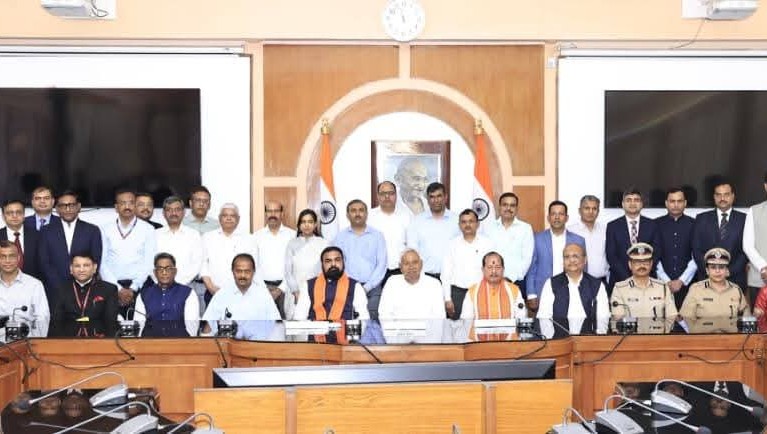
- Nitish Kumar chaired the last Cabinet meeting in the morning, where he formally dissolved the Council of Ministers.
- A BJP Legislature Party meeting was held at 3 PM at the party office, with Union Minister and former Madhya Pradesh Chief Minister Shivraj Singh Chouhan attending as the central observer.
- Samrat Choudhary was unanimously elected as the BJP’s Legislature Party leader.
- An NDA meeting followed at 4 PM in the Central Hall of the Bihar Legislative Assembly, formalizing the decision.
Bihar BJP State President Sanjay Saraogi confirmed the developments. The oath-taking ceremony for the new government is scheduled for April 15, 2026, at Lok Bhawan, with Prime Minister Narendra Modi likely to grace the occasion.
Samrat Choudhary, currently serving as one of the Deputy Chief Ministers alongside Vijay Sinha, expressed his gratitude on X (formerly Twitter): “This is not merely a position for me, but a sacred opportunity to serve the people of Bihar, to fulfil their trust and dreams. I pledge to live up to the expectations of one and all with complete dedication, commitment, and integrity.”
Who is Samrat Choudhary? Profile of Bihar’s Incoming Chief Minister
Samrat Choudhary (also known as Rakesh Kumar in some contexts), born on November 16, 1968, has emerged as a key figure in Bihar’s BJP unit. He hails from a politically active background and has built a reputation for organizational skills and grassroots connect, particularly in the state’s central and northern regions.
Prior to becoming Deputy CM, Choudhary held various responsibilities within the BJP and has been instrumental in strengthening the party’s base in Bihar. His elevation comes after months of speculation, with sources indicating that Nitish Kumar himself backed him as a suitable successor to ensure continuity of governance and alliance harmony.
The 243-member Bihar Assembly permits a cabinet of up to 36 ministers. Reports suggest that most current ministers may be retained, with only minor reshuffles expected to accommodate new priorities.
Nitish Kumar’s Long Journey: From ‘Sushasan Babu’ to National Leader
Nitish Kumar‘s political career spans decades. Known affectionately as ‘Sushasan Babu’ (Good Governance Man), he focused on improving law and order, women’s empowerment (including liquor prohibition), infrastructure development, and social justice in Bihar. His multiple alliances and realignments—switching between NDA and Mahagathbandhan—often drew criticism but also showcased his pragmatic approach to Bihar’s complex caste and political dynamics.
Despite the shifts, Nitish Kumar maintained a strong emphasis on development. JD(U) Working President and Rajya Sabha MP Sanjay Kumar Jha stated that Nitish Kumar will remain committed to Bihar’s progress: “As far as Bihar is concerned, we contested the 2025-30 election mandate under Nitish Kumar’s leadership with the support of the NDA. The Prime Minister campaigned regularly, and the new government will continue Nitish Ji’s policies and work under his guidance. Even if he is not Chief Minister, his focus remains on Bihar, travelling to Delhi only for Parliament sessions.”
Nitish Kumar’s move to Rajya Sabha allows him to contribute at the national level while mentoring the state government from behind the scenes.
Implications for Bihar Politics and Governance
This transition signals a new chapter for Bihar:
- First BJP Chief Minister: Samrat Choudhary‘s elevation underscores the BJP’s growing dominance in the state, moving beyond its traditional role as a junior partner in the NDA.
- Continuity with Change: The new government is expected to build on Nitish Kumar‘s initiatives in education, health, roads, electricity, and women’s safety while introducing fresh momentum in areas like investment, skill development, and industrialization.
- Alliance Stability: JD(U) leaders have assured full support to the new dispensation, ensuring NDA unity remains intact for the 2025-2030 term.
- Opposition Response: The RJD-led opposition is likely to intensify its criticism, positioning itself as a watchdog against any perceived central interference or policy shifts.
- Development Agenda: With a stable majority, the focus will likely remain on fulfilling the 2025 election promises, including employment generation and infrastructure projects.
Political analysts view this as a strategic move that allows Nitish Kumar to exit active state executive role gracefully while the BJP gains direct executive experience in a key Hindi heartland state.
The Janata Parivar in Electoral Politics: A Brief Timeline
The developments also reflect the evolving dynamics of the ‘Janata Parivar’—the socialist-rooted parties that once dominated Bihar. From the days of Karpoori Thakur and Ram Manohar Lohia to the fragmentation into JD(U), RJD, and others, Bihar’s politics has seen numerous realignments. Nitish Kumar‘s leadership of JD(U) within the NDA represents one of the more stable phases in recent years.
The 2025 verdict further consolidated the NDA while diminishing the RJD’s influence, setting the stage for the current leadership change.
What Lies Ahead: Oath Ceremony and Policy Continuity
The oath-taking on April 15, 2026, will be a high-profile event, symbolizing both continuity and transition. Prime Minister Modi’s presence is expected to send a strong message of central support for Bihar’s growth.
Samrat Choudhary will face the immediate task of forming his Council of Ministers and addressing ongoing governance issues. Observers anticipate a people-centric approach, leveraging his experience as Deputy CM in home and other departments.
JD(U) leaders have reiterated that Nitish Kumar‘s vision for a developed Bihar (‘Viksit Bihar’) will guide the new administration.
Conclusion: End of an Era, Beginning of a New Chapter
The resignation of Nitish Kumar after more than two decades as Bihar’s Chief Minister marks the closing of a significant chapter in the state’s political history. His contributions to restoring governance, infrastructure, and social equity are widely acknowledged, even by critics.
As Samrat Choudhary prepares to take charge, Bihar stands at a crossroads. The first BJP-led government in the state carries the weight of expectations—from continuing welfare schemes to accelerating economic growth and maintaining social harmony in one of India’s most populous and politically vibrant states.
This power shift, rooted in the mandate of the 2025 elections and executed smoothly within the NDA framework, reflects the maturing of coalition politics in Bihar. Whether under Samrat Choudhary‘s leadership the state achieves new heights in development remains to be seen, but the commitment to Nitish Kumar‘s policies provides a strong foundation.
For live updates, reactions from leaders, and analysis on Bihar’s political future, stay tuned to our coverage. The story of Bihar’s governance continues—with a new face at the helm but the same focus on progress.