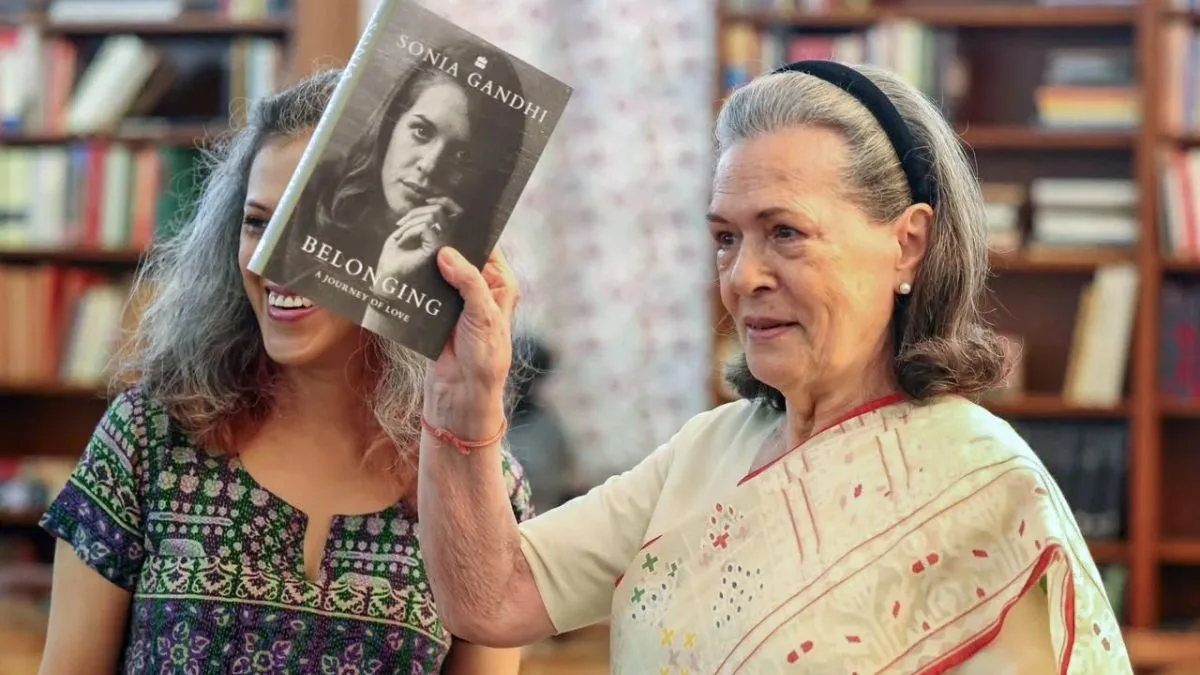
Sonia Gandhi Belonging Book Reveals Shocking Truths of Love, Loss & Power in 544 pages
New Delhi, November 10, 2026 — In a moment long anticipated across India and beyond, Congress Parliamentary Party chairperson Sonia Gandhi’s memoir Belonging: A Journey of Love hit bookstores today. The 544-page volume, published in India by HarperCollins India and internationally by Alfred A. Knopf, offers the first extended personal account from one of the most private figures in modern Indian politics. For decades others wrote her story. Today she tells it herself.

The book opens not in the corridors of power but in post-war Italy. Sonia Maino grew up in the Piemontese village of Sangano and the nearby town of Orbassano near Turin. From that modest beginning the narrative moves to Cambridge in 1965, where a 19-year-old student fell in love at first sight with Rajiv Gandhi, the quiet, dark-eyed grandson of India’s first prime minister, Jawaharlal Nehru. Three years later they married in New Delhi. She wore a sari woven from yarn spun by Nehru himself during his years in prison. The young Italian bride entered the formidable Nehru-Gandhi household and began the long process of making India her home — learning Hindi, mastering the sari, and developing a taste for Indian food while forming a complex relationship with her mother-in-law, Indira Gandhi.
Belonging is at its core a story of love and belonging, yet it is also a chronicle of almost unbearable loss. Readers encounter the death of Sonia and Rajiv’s first child shortly after birth, the plane-crash death of Sanjay Gandhi in 1980, the assassination of Indira Gandhi in 1984, and the suicide bombing that killed Rajiv Gandhi in 1991 while he was campaigning. These successive tragedies, Gandhi has said, ultimately pulled her from a fiercely guarded private life into the public arena she had long resisted. “It was heartbreak and loss that threw me into the public world of politics,” she has stated. “Up till then I had guarded my privacy fiercely.”
The memoir does not shy away from family tensions that have long been the subject of speculation. One of the more closely watched sections addresses Sonia Gandhi’s relationship with Maneka Gandhi. She describes the younger woman as a “pretty and vivacious girl” and later “high-spirited and talkative” when she first entered the family as Sanjay’s wife. After Sanjay’s death the relationship deteriorated amid political ambitions and differing loyalties. Gandhi recounts episodes that, in her telling, felt deliberately wounding, including a birthday celebration for young Feroze Varun Gandhi held at the home of a political opponent rather than with the wider family. The portrait is personal rather than purely political, yet it inevitably carries political resonance.
Perhaps the most consequential political revelation concerns May 2004. After the Congress-led United Progressive Alliance unexpectedly won the general election, Sonia Gandhi was widely expected to become prime minister. In the memoir she revisits the night she ultimately declined the post. She describes arriving at Rashtrapati Bhavan with Manmohan Singh, the technical requirements around signatures on the list of supporting MPs, and her own internal calculation. She writes that she knew the opposition would weaponise her foreign origin and that the resulting controversy would consume the new government’s capacity to govern. “Knowing that this could harm the country I love, how could I agree to take on the post of Prime Minister of India? No, never!” The decision, she makes clear, was deliberate and final.
Gandhi has repeatedly emphasised that Belonging is not a political tract. “This is not a political book. It is a personal one,” she wrote ahead of publication. “Much has been written about my family, but rarely with real insight into who they were, their motivations, their struggles, their very human flaws. I wanted to portray them honestly, as people I knew and loved.” The book spans six decades of India’s social and economic transformation as observed first from the margins of the family and later from its centre. It is, in her words, “a testament of my heart’s journey through the tender joys and dark despair” that shaped her life.
The road to publication itself became part of the story. An earlier arrangement with Penguin Random House India ended in an “impasse.” HarperCollins India stepped in and scheduled the Indian release for 10 November 2026, matching the international date set by Knopf. The first print run was announced at 100,000 copies, signalling strong publisher confidence in public interest. In the weeks leading up to release Gandhi made her first forays onto Instagram and X, sharing glimpses of the book and stating that “others have spent decades telling my ‘story’, now it’s my turn.” She predicted there would be “some tamasha” — and the prediction has already proved accurate.
Political reactions arrived swiftly. Supporters of the Congress have welcomed the memoir as a long-overdue corrective to years of rumour and caricature. Critics from the ruling Bharatiya Janata Party have accused the book of “whitewashing” the historical record of the Nehru-Gandhi family. Gandhi has declined to engage in the publishing controversy or the partisan spin, preferring to let the text speak for itself. The volume includes rare photographs, some taken by Rajiv Gandhi himself, including the cover image of a younger Sonia. Other pictures document childhood, courtship, wedding, and family life that had never before been made public.
For many readers the deepest value of Belonging will lie less in political score-settling than in the intimate portrait of a woman who crossed continents, languages, and cultures, who endured successive public tragedies, and who ultimately chose a form of service that kept her at the centre of Indian politics for decades without ever occupying the prime minister’s chair. The narrative moves between the personal and the historical with deliberate care: the Cambridge romance, the adjustment to life in the Gandhi household, the gradual assumption of responsibility after 1991, the rebuilding of the Congress party, and the quiet but decisive exercise of influence after 2004.
At 544 pages the book is substantial. It is also, by all early accounts, carefully written. Gandhi began drafting material more than a decade ago and worked on the manuscript in earnest for roughly five years after stepping back from day-to-day political management. The result is neither pure autobiography nor conventional political memoir. It is an attempt to reclaim narrative control over a life that has been endlessly interpreted by others.
Whether Belonging: A Journey of Love changes how Indians — or the wider world — view Sonia Gandhi remains to be seen. What is already clear is that the long-silent matriarch of the Congress party has chosen this moment to speak in her own voice. In doing so she has offered readers a rare inside account of love, identity, duty, and the complicated meaning of home in one of the world’s most enduring political families. Bookstores across India reported strong early demand on the day of release. For those who have followed the Nehru-Gandhi story for decades, and for a new generation discovering it for the first time, Belonging supplies the missing first-person chapter.
The memoir closes a circle that began in a small Italian town and led, through love and successive losses, to the heart of Indian public life. Sonia Gandhi has written that she found the strength to remake her life and to serve the country where she ultimately belonged. With the publication of Belonging: A Journey of Love, that journey is now available to every reader willing to open its pages.