Kishau Dam Project Fast-Tracked After 86 Years: MoU Signed by Six States for Irrigation, Power & Water Security
Kishau Dam Project Finally on Fast Track After 86-Year Wait as Six States Sign Landmark MoU
The long-awaited Kishau Dam project is set to move into high gear after six beneficiary states signed a crucial memorandum of understanding, ending decades of deadlock over cost-sharing and financial liabilities. Conceived as far back as 1940 during the British era, the project is now expected to deliver irrigation, drinking water and hydropower benefits across northern India while generating substantial revenue for the hill states that will host the dam.
Himachal Pradesh, Uttarakhand, Haryana, Delhi, Uttar Pradesh and Rajasthan are the six states that have come together for this multi-purpose venture on the Tons River, a major tributary of the Yamuna. The signing clears the path for Union Cabinet approval, after which construction is projected to take 96 months—or eight years—to complete. Declared a project of national importance in 2008, the Kishau Dam project will see the Centre bearing 90 percent of the water-component cost, a decision first formalised in 2013.
A Project with Deep Historical Roots
The idea of the Kishau Dam project first emerged in 1940 when Sir Henry Duffield Craik was Governor of undivided Punjab and Sir Sikandar Hayat Khan served as Premier. Prominent farmers’ leader Chaudhary Chhotu Ram, then Revenue Minister, played an influential role in its early conception. The first survey took place in 1944-45. After Independence, the Uttar Pradesh government revived the proposal in 1962. A preliminary survey report appeared in 1964, and the first detailed project report (DPR) for a 235-metre-high dam was submitted to the Central Water Commission in 1965.
The CWC rejected the gravity-dam design over earthquake risk and geological concerns, recommending a rock-fill structure instead. Work resumed in the 1970s; a rock-fill draft was prepared in 1978 and later approved. Kishau village itself proved unsuitable, leading planners to examine Atal, Sambarkheda and Morar. Ultimately a concrete gravity dam site was fixed at Sambarkheda, yet the project retained the name Kishau Dam project.
A fresh DPR was prepared in 1988 and revised in 1998. The Yamuna Water Sharing Agreement of 1994 reshaped inter-state equations. After Uttarakhand’s formation in 2000, Himachal Pradesh and Uttarakhand emerged as the principal stakeholder states. Technical and financial clearance was withheld by the Central Electricity Authority in 2010 over unresolved cost allocation. The two hill states signed an MoU in 2015 and formed Kishau Corporation Limited in 2017. The CWC pegged the project cost at ₹11,500 crore in 2018; the latest estimate stands at ₹15,624 crore.
Scale, Benefits and Water Allocation
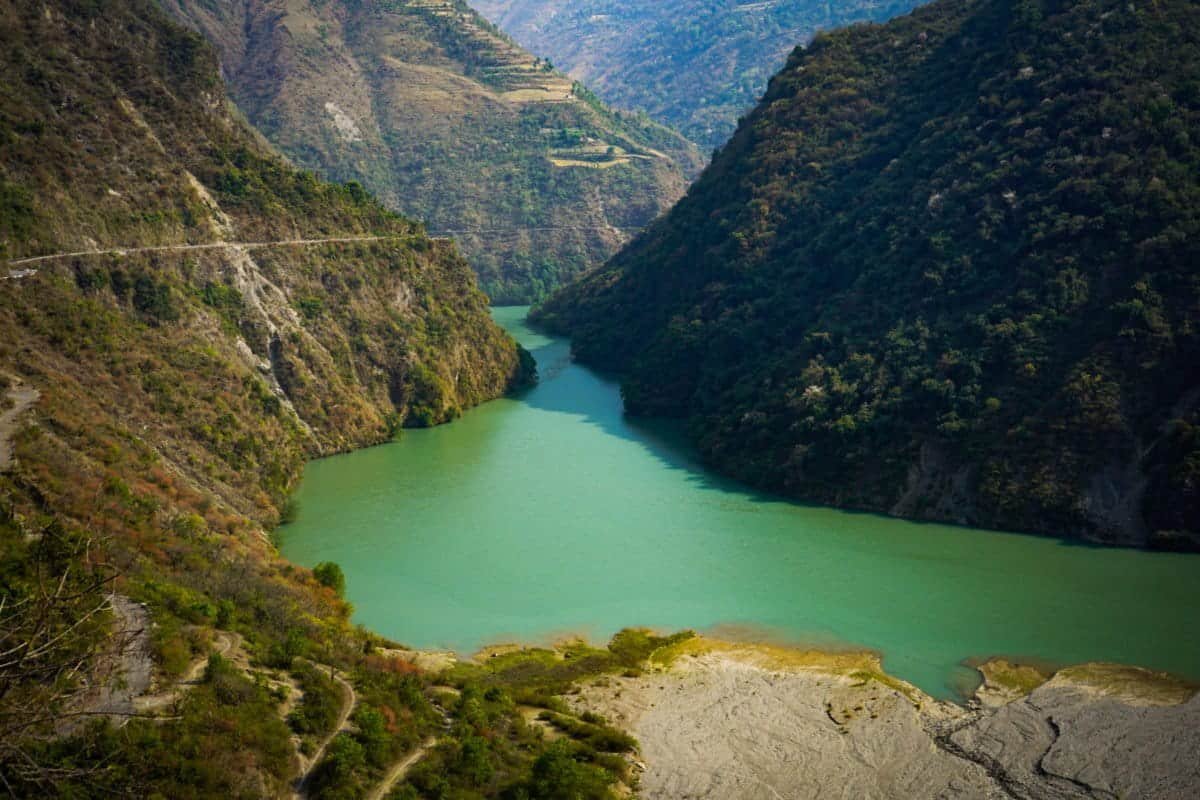
The dam will rise 236 metres high and stretch 680 metres long, creating a reservoir approximately 32 km long. At a full-reservoir level of 860 metres it will submerge 1,498 hectares in Himachal Pradesh and about 1,452 hectares in Uttarakhand.
Water allocation under the project is as follows:
- Haryana – 5.71 billion cubic litres
- Uttar Pradesh – 3.71 billion cubic litres
- Rajasthan – 1.119 billion cubic litres
- Delhi – 0.724 billion cubic litres
- Uttarakhand – 0.311 billion cubic litres
Himachal Pradesh will not receive water but is projected to earn around ₹600 crore annually, according to Chief Minister Sukhvinder Singh Sukhu. The project is also expected to generate 1,379 million units of electricity each year and irrigate roughly 97,000 hectares of farmland across the beneficiary states.
Himachal Pradesh Power Corporation Limited (HPPCL) will execute the state’s share of the work. Kishau Corporation Limited, jointly owned by Himachal and Uttarakhand, will oversee overall implementation with technical support from the Central Water Commission.
Human and Environmental Costs
Progress on the Kishau Dam project comes with significant social and ecological trade-offs. In Himachal Pradesh, 2,092 people from eight villages—primarily in the Shillai area of Sirmaur district spanning five panchayats (Balikoti, Kando, Dharwa, Chamra Mohrad and Siyasu)—face displacement. In Uttarakhand, 3,406 people from nine villages will be affected. Overall, the project touches approximately 40 revenue villages and, according to 2011 census data, 632 joint families and 508 nuclear families.
Around 82,000 trees will be felled and 2,438 hectares of forest land submerged. The fertile lands along the Tons River currently support ginger, garlic, peas, peaches and apples. Kishau Corporation Limited is required to undertake compensatory afforestation exceeding the number of trees lost.
Former Shimla Deputy Mayor Tikender Panwar has stressed that Himachal’s interests must be protected, displaced families properly rehabilitated and ecological damage minimised. Environment activist Kulbhushan Upmanyu has urged the government to provide fertile replacement land rather than treat displacement as a secondary concern. Opposition continues in Uttarakhand’s Vikasnagar and Kwanu areas, where public hearings are expected to address outstanding issues.
Political Claims and the Road Ahead
The recent MoU has triggered a credit contest between the Congress and the BJP. Chief Minister Sukhu maintains that his government safeguarded the state’s financial interests and secured the ₹600-crore annual revenue stream. BJP leaders counter that the Centre’s sustained push for projects of national importance made the breakthrough possible.
With cost-sharing obstacles now cleared, the MoU is scheduled for formal approval by the Union Cabinet. Once cleared, the eight-year construction clock will start ticking. The Kishau Dam project promises to strengthen water security, expand irrigation and add clean power to the northern grid. At the same time, its success will be measured not only by the volume of water released and units of electricity generated, but by how fairly the thousands of people whose homes and farms will disappear beneath the reservoir are resettled and by how effectively the lost forest cover is restored.
After 86 years of surveys, revised reports, inter-state disputes and technical reviews, the Kishau Dam project stands closer than ever to realisation—an engineering and political test that will shape the lives of farmers, hill communities and city dwellers across six states for generations to come.