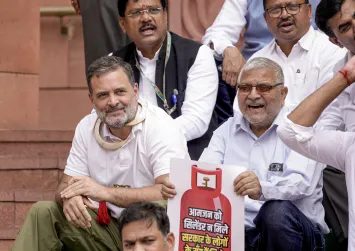
Rahul Gandhi Warning on LPG Shortage: Energy Security at Risk Amid Middle East Conflict – Urgent Call for Government Preparations
In a sharp and timely intervention on March 12, 2026, Congress leader and Leader of Opposition in Lok Sabha Rahul Gandhi sounded a serious alarm over the looming LPG shortage and broader fuel supply challenges facing India. Speaking to reporters outside Parliament amid reports of disruptions triggered by the escalating conflict in the Middle East—particularly the ongoing US-Israel-Iran tensions—Rahul Gandhi warned that the country’s energy security stands compromised due to what he described as a “flawed foreign policy.”
Rahul Gandhi’s statement comes at a critical juncture when global fuel markets are reeling from disruptions in key shipping routes like the Strait of Hormuz, through which a significant portion of India’s oil, liquefied petroleum gas (LPG), and liquefied natural gas (LNG) imports pass. The Congress leader emphasized that the government must act immediately to prepare for potential shortages in oil, cooking gas (LPG), petrol, and diesel, warning that failure to do so could lead to severe hardships for crores of ordinary Indians.
Rahul Gandhi’s Key Statements and Context
Rahul Gandhi highlighted procedural hurdles he faced in raising the issue in Parliament. “Normally the procedure is that you can ask to talk. So I asked to be allowed to make a statement about the LPG gas and oil situation in the country… But a new procedure has started where the Minister will first decide, then I will speak, then the Minister will reply,” he said. This remark followed an attempt by Congress MP KC Venugopal to urge Lok Sabha Speaker Om Birla to permit the LoP to address the LPG crisis directly in the House.
Elaborating on the gravity of the situation, Rahul Gandhi stated: “Basically, the main thing is that all fuel is going to be a problem because essentially our energy security has been compromised. Flawed foreign policy has created this problem… Now we have to prepare. We still have a bit of time left. The government and the Prime Minister should instantly start the preparations, otherwise crores of people will suffer great losses.”
He further stressed that this was “not a political statement” but a genuine concern, adding, “I can see a big problem is coming.” Rahul Gandhi urged a shift in mindset to prioritize India’s interests, protecting citizens from the ripple effects of global instability.
Background: The LPG Crisis and Middle East Conflict
The warnings from Rahul Gandhi are rooted in the rapidly deteriorating situation in West Asia. The conflict involving Iran, Israel, and the US has disrupted petroleum shipments through the Strait of Hormuz—a narrow chokepoint handling around 20% of global oil flows and a major artery for India’s energy imports. Reports indicate that shipments have halted or slowed significantly, leading to immediate supply pressures.
India, the world’s second-largest importer of LPG after China, relies heavily on Middle Eastern sources—accounting for 85-90% of its LPG imports. With domestic production meeting only a fraction of demand (around 12-13 million tonnes annually against consumption exceeding 33 million tonnes), any disruption hits hard. Analysts note that stocks at refiners and distributors may cover just 2-3 weeks of demand under normal circumstances, making the current scenario particularly vulnerable.
The government has responded by directing refineries to prioritize domestic household LPG supplies over commercial users. This has eased pressure on residential consumers but triggered acute shortages for businesses, especially restaurants, hotels, and small eateries. Commercial 19-kg LPG cylinders have seen sharp price hikes (up to Rs 114-115 in some cities), forcing many establishments to explore alternatives like induction cooktops, microwaves, firewood, or solar options. Panic buying, long queues at agencies, and reports of potential closures have surfaced in major cities including Mumbai, Bengaluru, Delhi, and Prayagraj.
Domestic LPG prices have also risen by around Rs 60 per 14.2-kg cylinder in recent days, reflecting global price surges. European natural gas prices jumped nearly 40% in response to similar disruptions, underscoring the interconnected nature of energy markets.
Impact on India’s Energy Security and Economy
Rahul Gandhi’s critique centers on India’s over-reliance on imported energy and the perceived failures in foreign policy that have left the nation exposed. Over 40-50% of India’s crude oil imports, 50-60% of LNG, and 80-85% of LPG transit through vulnerable routes like the Strait of Hormuz. A prolonged closure or continued instability could lead to:
- Higher Fuel Prices: Petrol, diesel, and cooking gas costs could spike, fueling inflation and squeezing household budgets.
- Business Disruptions: Restaurants and hospitality sectors face operational halts, threatening jobs and livelihoods in a sector already recovering from past challenges.
- Wider Economic Ripple Effects: Increased transport costs, supply chain delays, and reduced industrial activity could slow GDP growth.
- Social Hardships: Millions dependent on subsidized LPG under schemes like Ujjwala could face access issues if supplies tighten further.
The opposition, including Congress, has staged protests in Parliament, demanding urgent debates and measures. Rahul Gandhi has accused the government of complacency, contrasting the Prime Minister’s calls for calm with distractions over unrelated issues.
Government Response and Assurances
The Centre has maintained that there is no shortage for domestic LPG, with refineries ramping up production to prioritize households. Officials blame external geopolitical factors rather than policy lapses, urging citizens against panic bookings. Increased domestic output and diversified sourcing (e.g., from other regions) are cited as buffers.
However, critics like Rahul Gandhi argue that reactive measures fall short. He has called for proactive diplomacy to secure alternative supplies, strategic reserves buildup, and a rethink of energy dependencies to safeguard national interests.
Why Rahul Gandhi’s Warning Matters
Rahul Gandhi’s intervention highlights a bipartisan concern over energy security but frames it through opposition lenses—blaming “flawed foreign policy” for vulnerabilities. His call for preparation while “we still have a bit of time left” resonates amid real-time disruptions. As the Middle East conflict evolves, India’s response will test its resilience.
For millions of households relying on LPG for daily cooking and businesses using it as a lifeline, the stakes are high. Whether the government heeds the warning and accelerates preparations could determine if the crisis remains manageable or escalates into widespread hardship.
This developing story underscores the intersection of geopolitics, energy policy, and everyday life in India. As global tensions persist, Rahul Gandhi’s warning on LPG shortage serves as a reminder that energy security is foundational to national stability—and demands urgent, unified action.