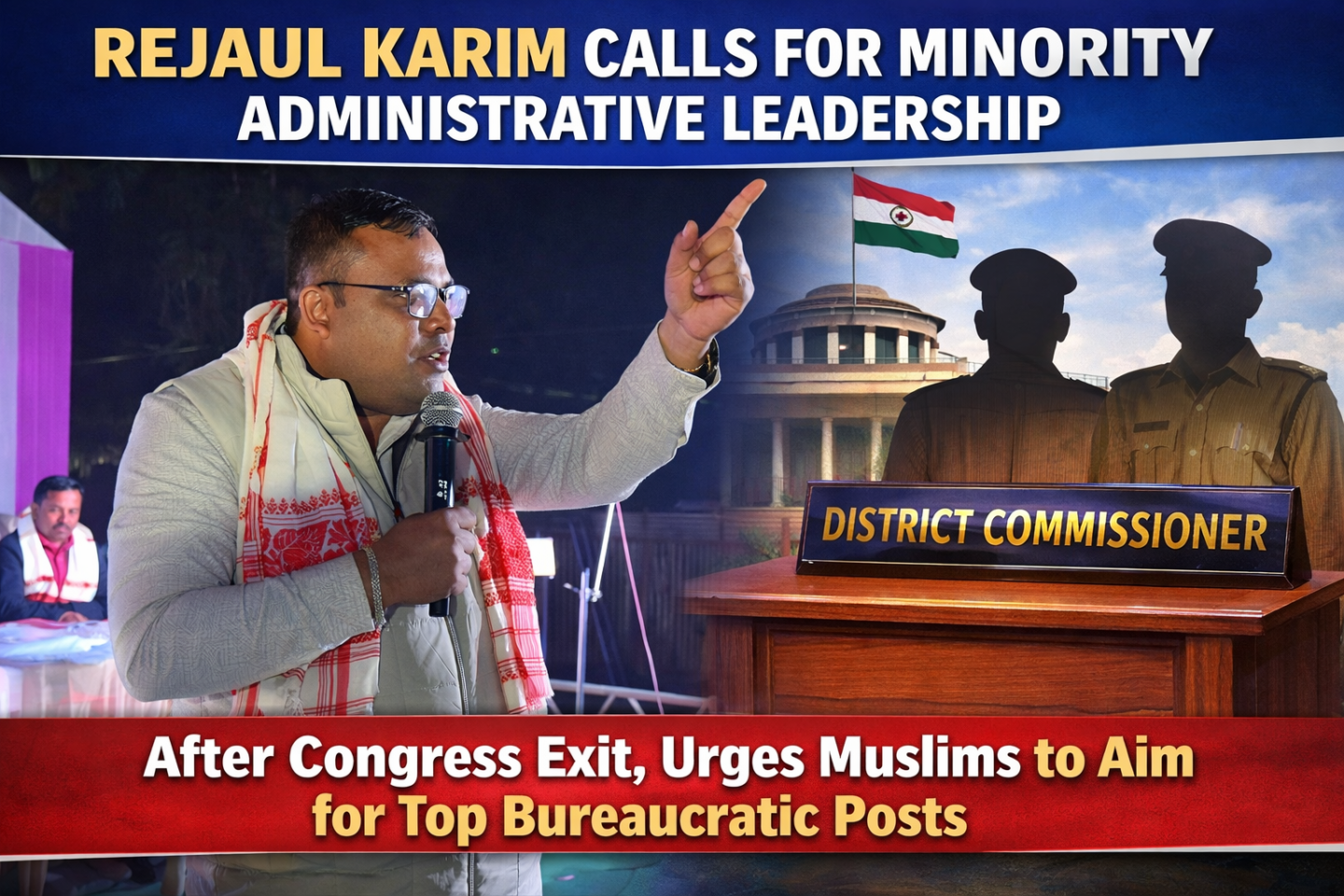
Rejaul Karim Calls for Minority Representation in Administration After Congress Exit
Having briefly entered direct party politics only to face intense controversy and public criticism, Rejaul karim The former president of the All Assam Minority Students’ Union (AAMSU), Rejaul Karim Sarkar, who joined the Indian National Congress on January 11 and resigned just three days later on January 14, has once again stirred debate with a powerful and provocative speech targeting minority empowerment and administrative representation.
The rapid rise and fall of Rejaul Karim within Congress was triggered by a controversial speech in which he attempted to compare Dhubri and Sivasagar districts. His remarks sparked widespread backlash across political and social circles, drawing criticism even from senior Congress leaders. The controversy intensified so quickly that Rejaul Karim chose to resign from the party, marking one of the shortest political tenures in recent Assam politics.
There is an old Assamese saying: “Words bring praise, and words bring ruin.” That proverb seems to have come true in the case of Rejaul Karim. Yet, instead of retreating, the young leader has re-emerged with a renewed and more aggressive call—this time directed squarely at minority Muslims across Assam.
Speech at Bongaigaon Cultural Program Draws Attention
Rejaul Karim recently addressed a large gathering at a cultural program organized by the Tapatari Regional Youth Club at the playground of Tapatari High School in Bongaigaon district. The event took place in the minority-dominated Tapatari area and witnessed enthusiastic participation from local residents, youths, and community elders.
Although the program featured cultural performances, it quickly transformed into a platform for strong political and social messaging. Rejaul Karim used the occasion to emphasize education, representation, and the long-standing rights of minority communities in Assam.
“Education Is the Ultimate Weapon”: Rejaul Karim
In his speech, Rejaul Karim strongly asserted that education is the most powerful tool for empowering minority communities. Addressing parents directly, he urged them not to allow poverty or economic hardship to stand in the way of their children’s future.
“If necessary, sell a kidney, but whether it is a boy or a girl, ensure your children get an education, so that tomorrow they can secure government positions,” Rejaul Karim said, drawing loud applause and emotional reactions from the audience.
While the statement was provocative, supporters viewed it as an expression of urgency, highlighting the desperation many minority families face when it comes to accessing quality education.
Call for Administrative Representation in Minority-Dominated Districts
One of the most significant points raised by Rejaul Karim was his demand for greater minority representation in the administrative machinery of Assam. He argued that districts with substantial minority populations—such as Dhubri and Bongaigaon—should have administrative leadership that reflects local demographics.
According to Rejaul Karim, the appointment of minority officers to key posts like District Commissioner (DC) or Deputy Commissioner would help address long-standing grievances, improve trust in governance, and ensure fairer implementation of government schemes.
He stressed that representation is not about division but about inclusion and dignity, stating that communities feel more secure when they see themselves reflected in positions of authority.
Warning Against Intimidation and Discrimination
Touching on issues of self-respect and rights, Rejaul Karim warned against any attempts to intimidate or marginalize minority communities. He stated firmly that blaming or threatening a society based on identity would not be tolerated and would be met with resistance.
The former AAMSU president’s speech clearly indicated a shift from party politics to a broader socio-political movement centered on identity, education, and administrative empowerment.
Political Significance and Public Reaction
Political observers note that even after leaving Congress, Rejaul Karim remains a significant voice among minority youths in Assam. His ability to draw crowds and ignite discussions suggests that his influence extends beyond formal party affiliations.
While critics accuse him of making polarizing statements, supporters argue that Rejaul Karim is articulating long-suppressed frustrations of minority communities seeking equal opportunities.
As Assam’s political climate continues to evolve, Rejaul Karim’s latest remarks have once again placed him at the center of public debate—raising crucial questions about representation, governance, and the role of education in shaping the future of marginalized communities.
Whether one agrees or disagrees with his approach, it is clear that Rejaul Karim is not stepping away from the spotlight anytime soon.