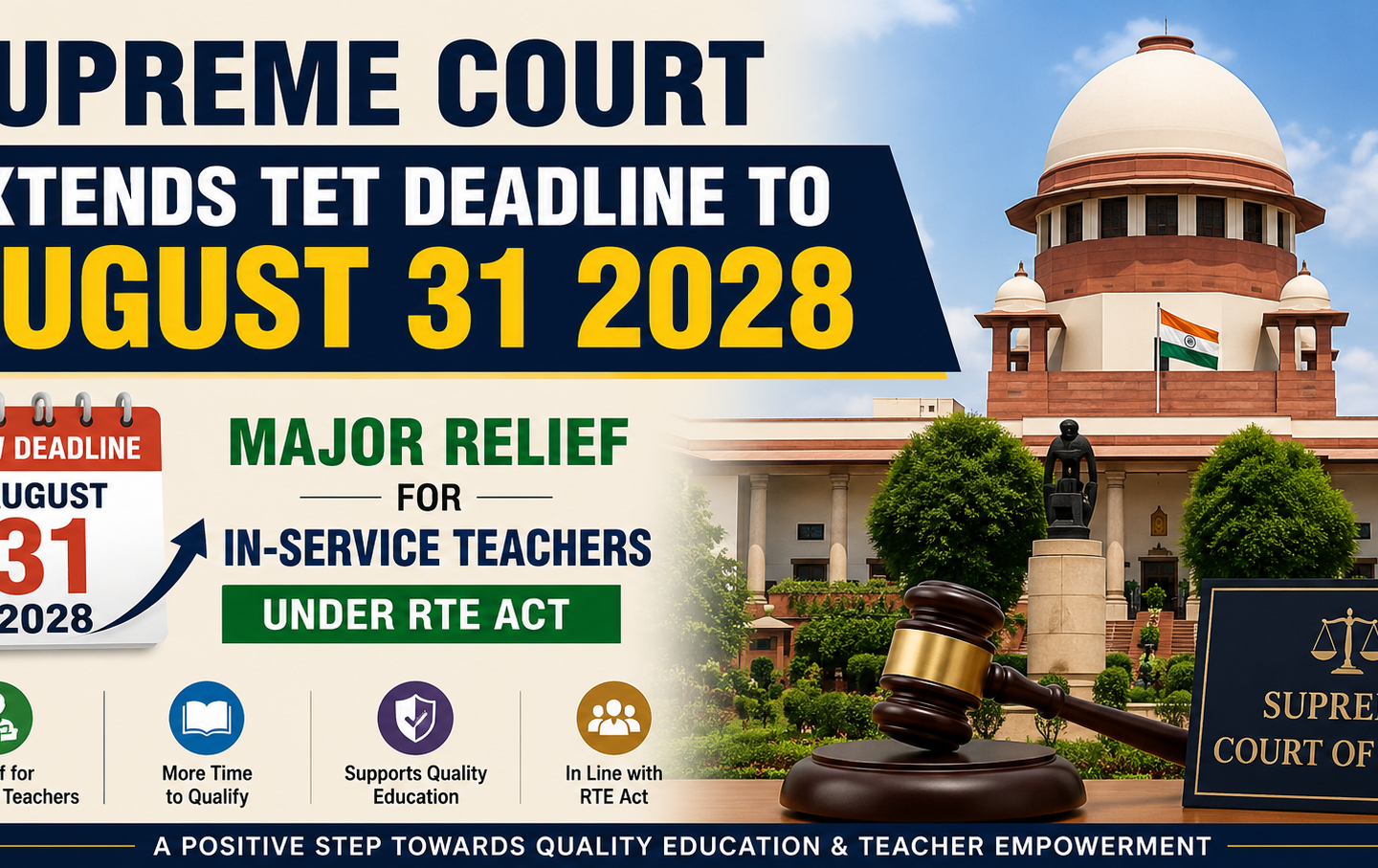
Supreme Court Extends TET Deadline to August 31 2028: Major Relief for In-Service Teachers Under RTE Act
Supreme Court Extends TET Deadline to August 31, 2028: Major Relief and Final Warning for In-Service Teachers
In a significant development for India’s education sector, the Supreme Court on Friday extended the TET qualification deadline for in-service teachers to August 31, 2028. This landmark order brings relief to thousands of teachers while reinforcing the commitment to quality education under the Right of Children to Free and Compulsory Education (RTE) Act, 2009.
The bench comprising Justices Dipankar Datta and Manmohan dismissed over 65 review petitions filed by state governments, teachers’ associations, and individual teachers. The court made it crystal clear: clearing the Teacher Eligibility Test (TET) remains mandatory, and this is the final extension.
Background: Why TET Matters for In-Service Teachers
The TET was introduced to ensure minimum standards in teaching quality. Conducted by the National Council for Teacher Education (NCTE), the exam tests pedagogical skills, child psychology, and subject knowledge essential for elementary education.
Prior to the RTE Act, many states appointed teachers without a uniform eligibility test. The 2009 Act changed this by mandating that all teachers, including those already in service, must acquire prescribed qualifications. The Supreme Court’s 2025 judgment in the Anjuman Ishaat-e-Taleem Trust case had originally set a two-year deadline from September 1, 2025 (i.e., till August 31, 2027).
After reviewing petitions highlighting practical difficulties, the court extended this by one year. Teachers appointed before the RTE Act with more than five years left before retirement must now clear TET by August 31, 2028.
Key Highlights of the Supreme Court Order on TET
- Extended Timeline: Qualification must be obtained by August 31, 2028 instead of 2027.
- No Further Extension: The court explicitly stated that this is the last opportunity.
- Mandatory Nature: TET is non-negotiable for in-service teachers to continue in service.
- Periodic Exams: States must conduct TET at least twice a year with a six-month gap.
- Rejection of Retrospective Application Argument: The bench ruled that the RTE Act clearly intended in-service teachers to upgrade qualifications within a reasonable timeframe.
The judgment emphasized that exemptions in subordinate legislation or NCTE notifications cannot override the parent statute (RTE Act).
Court’s Strong Stance: Child-Centric Approach Over Teacher Convenience
The Supreme Court delivered a powerful message: “The RTE Act is a child-centric legislation and must be read so. Service of teachers cannot come at the cost of educational future of the children.”
Justice Datta and Justice Manmohan observed that allowing unqualified teachers to continue would harm generations of students. The bench rejected pleas that enforcing TET midway through careers was unfair, stating that maintaining educational standards flows from the constitutional mandate of quality education.
The order noted that the legislature had specifically addressed in-service teachers and granted them time to meet the threshold. Continuing teachers without TET qualification was deemed unacceptable despite potential large-scale job losses.
Implications for Teachers and State Governments
This ruling affects lakhs of teachers across states who were appointed before 2009. Many had argued that sudden changes in service conditions were harsh, especially for senior educators. However, the court prioritized children’s right to quality education.
Positive Aspects for Teachers:
- One extra year to prepare and clear TET.
- States directed to conduct frequent exams, providing multiple attempts.
- Recognition of practical difficulties while balancing educational needs.
Challenges Ahead:
- Teachers must invest time and resources in preparation.
- Risk of losing jobs after August 2028 if they fail to qualify.
- States need to organize large-scale TET examinations efficiently.
Many states had warned of disruptions in public education if thousands of teachers were removed. The court acknowledged these concerns but stressed that continuity in education cannot compromise quality.
History and Evolution of TET Requirement
The Teacher Eligibility Test journey began with the RTE Act 2009, which made education a fundamental right. The 2011 NCTE amendment further strengthened qualification norms.
Initially, many states granted relaxations. However, repeated Supreme Court interventions highlighted the need for uniform standards. The Anjuman Ishaat-e-Taleem Trust case became the turning point, setting a clear two-year window that has now been adjusted to three years.
This extension reflects a pragmatic yet firm judicial approach — giving breathing space while upholding the law.
Why This TET Ruling is Crucial for Indian Education System
India’s elementary education faces multiple challenges: teacher shortages, uneven quality, and learning gaps. TET ensures teachers possess necessary skills to handle diverse classrooms, implement activity-based learning, and support inclusive education.
Experts believe qualified teachers directly correlate with better student outcomes in reading, mathematics, and critical thinking. By enforcing TET, the Supreme Court has sent a strong signal that teaching is a profession requiring continuous upskilling, not just a job secured decades ago.
This decision also aligns with National Education Policy (NEP) 2020 goals of improving teacher quality and professional development.
What Should Teachers Do Now?
- Start Preparation Immediately: Focus on pedagogy, child development, language, mathematics, and environmental studies — core TET areas.
- Utilize Resources: Join coaching institutes, online platforms, and state-sponsored training programs.
- Monitor Notifications: Regularly check state education department websites for TET exam dates.
- Multiple Attempts: With exams planned twice yearly, use every opportunity.
- Document Everything: Keep records of appointments and service periods.
Role of State Governments and Authorities
The Supreme Court has directed all states and competent authorities to:
- Conduct TET expeditiously.
- Allocate sufficient resources.
- Organize exams preferably twice a year.
- Ensure transparency in the process.
States like Uttar Pradesh, Bihar, Rajasthan, Madhya Pradesh, and others with large numbers of in-service teachers will need robust planning to avoid administrative chaos after 2028.
Potential Impact on Public Education
While some fear short-term disruptions, long-term benefits include:
- Higher teaching standards.
- Better learning outcomes for children.
- Increased accountability in the education system.
- Motivation for teachers to upgrade skills continuously.
The court rightly noted that protecting unqualified teachers at the expense of children’s futures is not sustainable.
Broader Context: Education Reforms in India
This TET ruling comes amid ongoing efforts to strengthen foundational literacy and numeracy. With ASER reports often highlighting learning deficits, professional teacher standards become even more critical.
The judgment also clarifies the hierarchy of laws — parent statutes like RTE Act prevail over notifications and exemptions.
Expert Views on the Extension
Educationists have welcomed the balanced approach. While appreciating the extra year, many stress that teachers must treat this as a final opportunity. Teacher unions may continue advocacy, but the Supreme Court’s firm stance leaves little room for further legal challenges.
Future Outlook After August 2028
Post-2028, only TET-qualified teachers are expected to continue in elementary classrooms. This could lead to fresh recruitment drives and increased focus on B.Ed and D.El.Ed programs aligned with TET patterns.
Schools may witness a transition phase where qualified teachers mentor others, creating a culture of continuous professional development.
Frequently Asked Questions (FAQs) on TET Deadline
Q1: Is TET mandatory for all in-service teachers?
Yes, as per the Supreme Court ruling, teachers with sufficient service period left must clear it by August 31, 2028.
Q2: Will there be any further extension?
The court has categorically ruled out any further extensions.
Q3: How many attempts can teachers get?
With exams twice a year, teachers will have multiple opportunities before the deadline.
Q4: Does this apply only to government school teachers?
The ruling primarily covers teachers under RTE norms, including aided and government schools.
Q5: What happens if a teacher fails to clear TET by 2028?
They may face removal from service as per the original judgment.
This comprehensive Supreme Court decision on TET underscores India’s commitment to quality elementary education. While it provides relief through the extended deadline, it also serves as a wake-up call for teachers and authorities alike.
The coming three years will be decisive. Teachers who proactively prepare will secure their careers while contributing to a stronger education system. States that efficiently conduct examinations will ensure smooth implementation.
As the nation moves towards better learning outcomes, this TET ruling stands as a milestone — balancing compassion with accountability, and teacher welfare with children’s fundamental right to quality education.