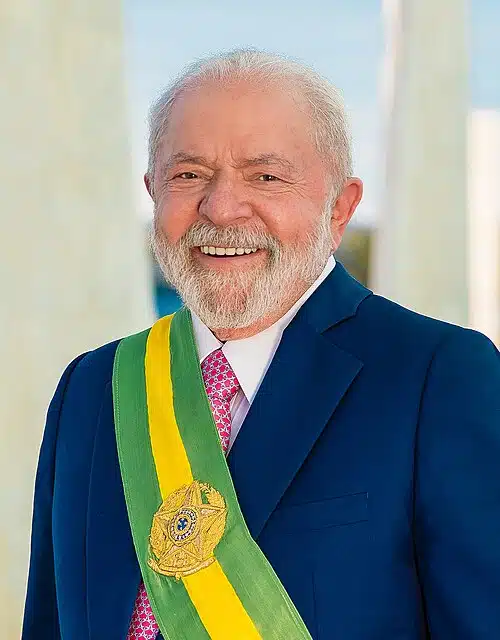
Brazilian President Lula Wins Historic Fourth Term After Dramatic Election Fightback Against Flávio Bolsonaro
Brazilian president Luiz Inácio Lula da Silva has staged one of the most remarkable political comebacks in modern Brazilian history, defeating far-right rival Flávio Bolsonaro to claim a historic fourth term in office. With 100% of the votes counted, the 80-year-old leftist secured 51.79% of the valid ballots against Bolsonaro’s 48.21%, finishing with a decisive margin of 4.4 million votes. The result marks the first time since the return of democracy in the 1980s that a candidate who finished second in the first round has gone on to win the runoff.
The victory of Brazilian president Lula arrives after three weeks of intense campaigning and widespread anxiety among progressive voters. In early October, Lula narrowly lost the first round to Flávio Bolsonaro, plunging many of his supporters into despair. Record abstention of 21.08% in that opening vote had disproportionately hurt Lula’s base, as his voters often live farther from polling stations. In the second round, turnout improved and the abstention rate fell to 19.21%, allowing the Brazilian president to close the gap and surge ahead.
Speaking to a packed crowd of ecstatic supporters in a São Paulo conference hall shortly after the result was confirmed, Brazilian president Lula declared: “We are going to change the way that this country is governed … This election was a defeat for denialism … I want to thank God and to thank you, Brazilian men and women of this country … it was democracy that made this happen.” Joyous scenes erupted on the streets of São Paulo, where Lula had been following the count, and at the hotel where his team monitored the results.
Alexandre Padilha, Lula’s health minister, described the outcome as “a huge victory for the Brazilian people who in the second round had the chance to think about what President Lula means for the environment, for the defense of our national health service and our education system and the Brazilian constitution. And the risks that the extreme right candidate entailed.” Padilha added that the win carries significance far beyond Brazil’s borders: “It’s a massive victory – not just for Brazil. It’s also an important signal to the rest of Latin America and to the world.”
Yet the celebration was quickly tempered by controversy. Soon after Brazil’s electoral authority officially confirmed Brazilian president Lula’s victory, Flávio Bolsonaro refused to concede. Speaking during Lula’s victory address, the 45-year-old far-right candidate stated it was “impossible to concede the election result” and announced that his legal team would seek to have the election annulled. The refusal injects uncertainty into the transition period and raises questions about institutional stability in the coming weeks.
The scale of Lula’s turnaround is striking. Never before in the post-dictatorship era had a first-round runner-up overcome such a deficit to claim the presidency. Analysts point to several factors that enabled the Brazilian president to reverse the narrative. Improved turnout among his traditional base proved decisive. Campaign messaging that emphasized environmental protection, the public health system (SUS), education, and constitutional norms resonated with voters who had sat out the first round. Lula’s allies had identified turnout as the key opportunity, and the drop in abstention from 21.08% to 19.21% delivered precisely the margin needed.
Throughout the runoff campaign, Brazilian president Lula framed the contest as a defense of democracy against denialism and extremism. The final vote share of 51.79% to 48.21% reflects a polarized electorate, yet the clear numerical victory—4.4 million votes—gives the incoming administration a stronger mandate than many expected after the first-round setback. At 80 years of age, Lula becomes one of the oldest leaders to assume or resume the Brazilian presidency, adding a layer of historical weight to an already unprecedented fourth term.
The streets of São Paulo and other major cities filled with supporters waving red flags and chanting in celebration once the electoral authority released the final tally. For many progressive Brazilians, the result ends three weeks of anxiety and restores confidence that the country’s democratic institutions remain resilient. At the same time, Bolsonaro’s immediate challenge to the results ensures that the coming days will test those same institutions. Legal proceedings seeking annulment are expected to unfold under close national and international scrutiny.
Brazilian president Lula’s victory speech struck a tone of both gratitude and determination. He thanked voters and God while promising a different style of governance. The emphasis on defeating denialism and reaffirming democratic norms signals that the new term will prioritize continuity in social programs, environmental policy, and institutional respect. Health minister Padilha’s comments underscore the policy stakes: protection of the national health service, investment in education, and safeguarding of the constitution were presented as central reasons voters returned to the polls.
Looking ahead, the Brazilian president faces the practical challenges of forming a governing coalition in a still-divided Congress and managing the transition amid legal challenges from the defeated candidate. The 4.4-million-vote margin provides a buffer, yet the closeness of the percentage share—51.79% versus 48.21%—illustrates the depth of polarization that remains. International observers will watch closely how Brazil navigates the post-election period, given the regional and global signal that Padilha highlighted.
In the end, the story of this election is one of resilience. Brazilian president Lula, written off by some after the first-round loss, mobilized his supporters, reduced abstention, and delivered a historic fourth term. The result reaffirms that in Brazilian democracy, the second round can still rewrite the narrative. Whether the legal challenges mounted by Flávio Bolsonaro gain traction or fade, the official count stands: Lula has won, and Brazil has chosen its path for the next four years.
The coming weeks will reveal how the defeated camp responds and how the incoming administration begins to implement the agenda that voters endorsed. For now, the images of celebration in São Paulo and the words of an 80-year-old leader thanking the Brazilian people remain the defining notes of a dramatic election night. Brazilian president Lula has once again rewritten the political script, proving that in a democracy, the final word belongs to the voters who turn out.