Kargil Vijay Diwas 2026: Remembering 527 Brave Heroes of Operation Vijay on 27th Anniversary
On July 26 every year, India stands united in solemn pride to observe Kargil Vijay Diwas. In 2026, the nation marks the 27th anniversary of one of its most hard-fought and inspiring military victories. This day commemorates the successful culmination of Operation Vijay, the Indian Armed Forces’ campaign that reclaimed every inch of territory occupied by Pakistani intruders in the high-altitude Kargil sector of Ladakh in 1999.
The story of Kargil is not merely a chapter in military history. It is a living testament to unmatched courage, supreme sacrifice, and the unbreakable spirit of the Indian soldier. More than five hundred young men gave their lives so that the tricolour could once again fly high over the icy peaks. Their legacy continues to inspire generations and shapes India’s defence preparedness even today.
The Background of the Kargil Conflict
In the early months of 1999, Pakistani troops and irregulars, operating under the code name Operation Badr, crossed the Line of Control and occupied strategic heights in the Kargil district. These positions overlooked the vital Srinagar-Leh National Highway, a critical supply route for Indian forces in Ladakh and Siachen. The intrusion was detected in early May when local shepherds reported unusual activity. What initially appeared to be small-scale infiltration soon revealed itself as a well-planned military operation by Pakistan’s Northern Light Infantry, disguised as militants.
India responded with resolve. The Indian Army launched Operation Vijay while the Indian Air Force conducted Operation Safed Sagar, the first large-scale use of air power in the Kashmir region since 1971. The conflict unfolded in extreme conditions — altitudes of 15,000 to 18,000 feet, temperatures plunging to minus 30 degrees Celsius, thin air that made every movement exhausting, and terrain that favoured the defenders.
Despite the odds, Indian soldiers fought with extraordinary determination. Key battles at Tololing, Tiger Hill, Point 4875, Point 5140, and in the Batalik and Mushkoh sectors turned the tide. By mid-July, the momentum had shifted decisively. On July 14, 1999, then Prime Minister Atal Bihari Vajpayee declared Operation Vijay a success. On July 26, India formally announced complete victory after all occupied positions had been recaptured without crossing the Line of Control.
The Human Cost and the Heroes Who Defined the War
The victory came at a heavy price. Official figures record that 527 Indian soldiers laid down their lives and more than 1,300 were wounded. Many of those who fell were young officers and jawans in their early twenties. Their names are etched forever on the walls of the Kargil War Memorial at Dras and in the hearts of a grateful nation.
Among the most celebrated Kargil War heroes are the recipients of the Param Vir Chakra, India’s highest gallantry award:
- Captain Vikram Batra of 13 Jammu and Kashmir Rifles became the face of the war. His battle cry “Yeh Dil Maange More” after the capture of Point 5140 captured the nation’s imagination. He later made the supreme sacrifice while leading the assault on Point 4875, saving a fellow soldier under heavy fire. He was awarded the Param Vir Chakra posthumously.
- Lieutenant Manoj Kumar Pandey of 1/11 Gorkha Rifles displayed exceptional leadership in the Batalik sector. Despite being grievously wounded, he continued to lead his men until he fell during the capture of Jubar Top. He too received the Param Vir Chakra posthumously.
- Grenadier Yogendra Singh Yadav of 18 Grenadiers, only 19 years old, scaled a near-vertical cliff face under intense enemy fire during the assault on Tiger Hill. Hit by multiple bullets, he still neutralised enemy bunkers in hand-to-hand combat, enabling his platoon to succeed. He remains one of the youngest living Param Vir Chakra recipients.
- Rifleman Sanjay Kumar of 13 Jammu and Kashmir Rifles charged enemy positions on Flat Top despite severe injuries, earning the Param Vir Chakra for his extraordinary courage.
Other bravehearts such as Major Vivek Gupta, Captain Anuj Nayyar, Major Rajesh Adhikari, and countless unnamed soldiers displayed equal valour in different sectors. Their collective sacrifice ensured that the highway remained open and India’s territorial integrity was restored.
Kargil Vijay Diwas 2026: Nationwide Commemorations
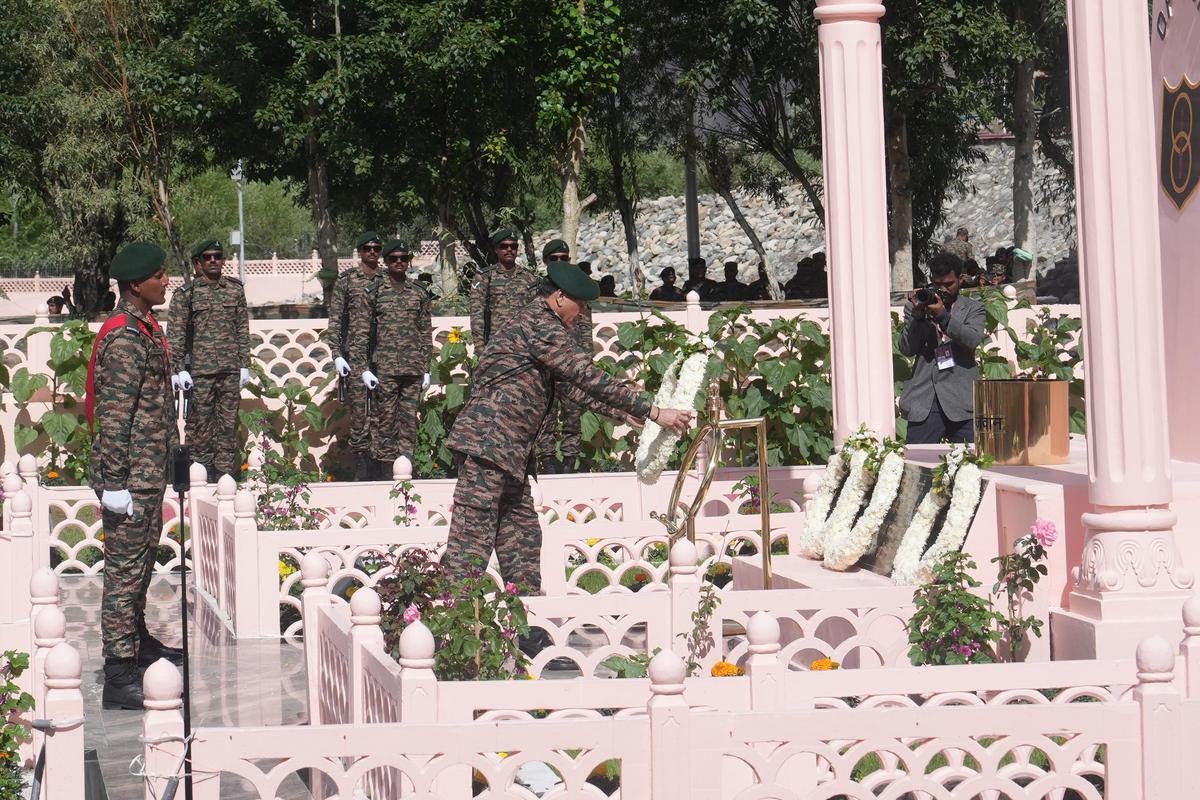
In 2026, the 27th anniversary is being observed with special solemnity. The main events are centred at the iconic Kargil War Memorial in Dras, Ladakh. Defence Minister Rajnath Singh is attending the two-day commemorations. On July 25, a “Shaurya Sandhya” was held at the memorial, featuring tributes, cultural performances by the Ladakh Scouts Regimental Centre Band, and a motorcycle display by the “Shwet Ashwa” team. A “Yudh Sansmaran” video presentation recounted the war and honoured the families of 40 bravehearts present at the venue.
On July 26, the traditional “Shradhanjali Samaroh” — a wreath-laying ceremony — takes place at the memorial. The Defence Minister, Army Chief, senior officers, war veterans, Veer Naris, Veer Matas, and next of kin of the martyrs pay homage. The programme includes “Gaurav Gatha,” recounting the extraordinary courage of the Indian Armed Forces, and the inauguration of a virtual walkthrough portal of the battlefield.
Across the country, similar tributes are being paid. From military stations to schools and public squares, citizens remember the heroes of 1999. Motorcycle expeditions such as the “Shaurya Vijay Yatra” from the National War Memorial in New Delhi to Dras symbolise the nation’s enduring gratitude. Cultural programmes, discussions, and exhibitions of military equipment further keep the memory alive.
The Enduring Significance of Kargil Vijay Diwas
Kargil Vijay Diwas is far more than a remembrance of a past victory. It serves as a powerful reminder of several enduring truths.
First, it highlights the critical importance of vigilance along the borders. The Kargil Review Committee report led to significant reforms in intelligence, surveillance, and high-altitude warfare capabilities. India’s military preparedness today — better equipment, improved logistics, and enhanced jointness between the Army, Air Force, and other services — draws direct lessons from 1999.
Second, the day reinforces the bond between the armed forces and the people of India. The televised images of the war in 1999 brought the realities of high-altitude combat into every home. The nation responded with an outpouring of support for the soldiers and their families. That emotional connection remains strong.
Third, Kargil Vijay Diwas inspires the youth. Stories of Captain Vikram Batra’s infectious enthusiasm, Grenadier Yadav’s refusal to give up despite 15 bullet wounds, and the quiet determination of thousands of ordinary soldiers continue to motivate young Indians to serve the nation, whether in uniform or in civilian life.
Finally, the day underlines India’s commitment to peace through strength. India fought a limited war under the nuclear shadow, carefully avoiding escalation while ensuring complete restoration of the status quo. The message remains clear: India will never accept aggression on its territory, yet it seeks peaceful relations with all neighbours.
A Nation’s Eternal Debt
As the sun rises over the Dras valley on July 26, 2026, the sandstone walls of the Kargil War Memorial once again bear silent witness to the names of 527 heroes. Families of the martyrs gather, many of them now parents and grandparents themselves, carrying photographs and memories of young men who never returned. Veterans who fought on those ridges stand tall, remembering comrades who fell beside them.
The rest of the nation pauses too. In cities and villages, people light candles, share stories, and teach children about the price of freedom. Social media fills with tributes using hashtags that trend every year, yet the emotion remains genuine and deep.
Kargil Vijay Diwas is not a celebration of war. It is a celebration of the human spirit that refuses to surrender in the face of impossible odds. It is a promise that the sacrifices made on those frozen peaks will never be forgotten. And it is a renewal of the resolve that the India those heroes died for will always remain strong, secure, and united.
On this 27th anniversary of Kargil Vijay Diwas, the nation bows its head in gratitude and lifts its heart in pride. Jai Hind. The legacy of the Kargil War heroes lives on — in every soldier who stands guard today, in every citizen who values freedom, and in the eternal hills of Kargil that once again fly the Indian flag high.