India Rejects False Claims: No E20 Petrol Export Offer Made to Bhutan – Centre Clarifies
India Centre Firmly Dismisses Misleading Reports on Bhutan E20 Petrol Proposal – Full Details on E20 Petrol Success
New Delhi, July 5, 2026: In a decisive move to counter misinformation, the Indian Central Government has categorically rejected media reports suggesting that Bhutan turned down an offer to import E20 Petrol from India. The Ministry of Petroleum and Natural Gas clarified that no such proposal was ever made by Indian Oil Marketing Companies (OMCs), and there is absolutely no plan to export the advanced ethanol-blended fuel to the neighbouring Himalayan nation at this stage.
This clarification comes as a powerful rebuttal to sensational headlines that spread rapidly across digital platforms, potentially creating unnecessary diplomatic ripples between the two friendly countries. India’s robust E20 Petrol initiative continues to gain momentum as a flagship programme for sustainable energy, reduced oil imports, and cleaner air for millions of citizens.
What Exactly is E20 Petrol and Why Does It Matter?
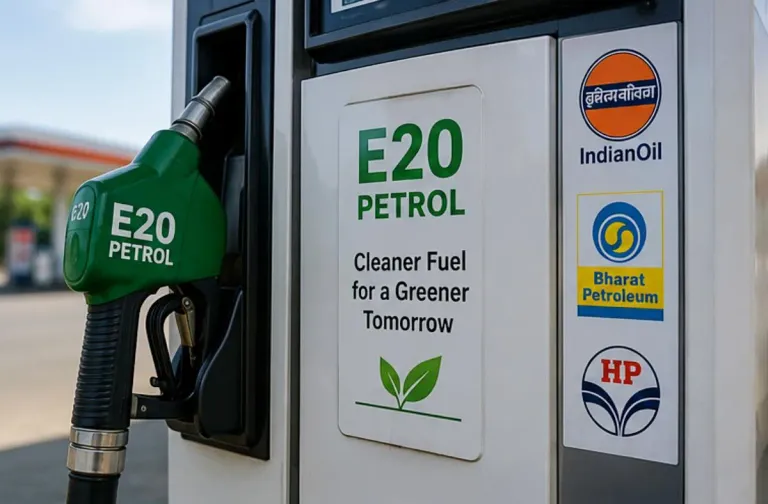
E20 Petrol represents a groundbreaking 20% ethanol blend with 80% conventional petrol. This cleaner fuel alternative is at the heart of India’s ambitious Ethanol Blending Programme (EBP), which has achieved remarkable success by meeting the E20 target five years ahead of the original 2025 schedule.
The programme’s benefits are substantial and multi-fold:
- Massive Foreign Exchange Savings: Successful implementation is projected to save billions of dollars annually by reducing crude oil imports. Earlier phases already delivered over Rs. 1.44 lakh crore in forex savings and substituted millions of tonnes of crude.
- Significant Emission Reductions: Ethanol blending leads to lower carbon monoxide, hydrocarbons, and particulate matter. Studies show E20 can cut CO emissions by up to 50% in two-wheelers and 30% in four-wheelers, contributing to better air quality.
- Farmer Empowerment: The push for ethanol boosts rural economies by creating demand for sugarcane, maize, and other feedstocks, generating substantial income for farmers – potentially Rs. 40,000 crore in one year alone at full scale.
- Energy Security: By promoting domestic biofuel production, India strengthens its energy independence amid global uncertainties.
Extensive testing by authorities like the Automotive Research Association of India (ARAI), Society of Indian Automobile Manufacturers (SIAM), and major automakers has confirmed that E20 Petrol meets stringent quality standards and is compatible with modern vehicles when used appropriately.
Unpacking the Misleading Reports on Bhutan and E20 Petrol
Recent media stories, citing unnamed Bhutanese officials, claimed that the country declined an Indian proposal for E20 Petrol due to infrastructure challenges. Concerns reportedly included the hygroscopic (moisture-absorbing) nature of ethanol, risks to ageing underground storage tanks in mountainous terrain, potential phase separation, and compatibility issues with older vehicles.
However, the Centre has firmly dismissed these narratives as “incorrect” and “without basis.” No formal offer for exporting E20 Petrol was extended by Indian OMCs such as Indian Oil Corporation, Bharat Petroleum, or Hindustan Petroleum. Bhutan, which relies heavily on India for fuel supplies, continues to receive conventional petrol as per existing arrangements.
This episode highlights the importance of verifying information from official sources, especially on sensitive bilateral matters. India and Bhutan share deep historical, economic, and strategic ties. Fuel supply cooperation is a cornerstone of this friendship, and both nations continue to collaborate on multiple fronts for mutual prosperity.
India’s E20 Petrol Journey: A Model of Sustainable Progress
The journey toward E20 Petrol began years ago but accelerated significantly under focused policy measures. From a mere 1.5% blending in 2013-14, India has scaled up dramatically. The nationwide rollout ensures E20 Petrol availability across the country, empowering consumers with a greener choice at pumps.
Key advantages highlighted by experts include:
- Higher octane rating for better engine performance and acceleration, particularly beneficial in city driving.
- Reduced greenhouse gas emissions – up to 65% lower for sugarcane-based ethanol compared to pure petrol.
- Support for circular economy through utilization of agricultural residues and damaged food grains.
While some concerns exist regarding mileage in older vehicles or storage requirements, comprehensive studies and real-world data affirm the programme’s viability. The government and industry have emphasized public awareness campaigns to help consumers select appropriate fuels for their vehicles.
Broader Implications for Regional Energy Cooperation
The clarification on the non-existent E20 Petrol export proposal to Bhutan underscores India’s responsible approach to international partnerships. Rather than pushing unready solutions, India focuses on strengthening domestic capabilities first while maintaining reliable conventional fuel supplies to neighbours.
As West Asia faces ongoing conflicts and global energy markets remain volatile, initiatives like E20 Petrol become even more critical for India’s strategic autonomy. The Strait of Hormuz, a vital chokepoint for oil shipments, highlights the risks of over-dependence on imported crude – making biofuels a smart, forward-looking alternative.
Experts predict that sustained E20 adoption could deliver annual savings of around Rs. 30,000 crore while planting the equivalent of millions of trees in carbon offset terms.
Future of E20 Petrol in India and Beyond
With E20 Petrol now a reality nationwide, the focus shifts to higher blends like E25 or E30 in the coming years, alongside advancements in flex-fuel vehicles and second-generation ethanol from non-food sources.
For neighbouring countries like Bhutan, any future discussions on advanced fuels would involve careful assessment of local infrastructure, vehicle fleets, and environmental conditions. India’s transparent clarification reinforces trust in bilateral relations.
Consumers across India are encouraged to embrace E20 Petrol for its environmental and economic benefits. Vehicle manufacturers continue to certify compatibility, and fuel stations are equipped to handle the blend efficiently.
Conclusion: Facts Over Fiction in India’s Green Fuel Revolution
The Centre’s swift dismissal of unfounded reports regarding Bhutan and E20 Petrol reaffirms the government’s commitment to factual communication and successful implementation of its energy transition roadmap. E20 Petrol stands as a shining example of innovation that simultaneously addresses pollution, farmer distress, and energy security challenges.
As India leads by example in the global shift toward renewables, the E20 Petrol programme promises a cleaner, more self-reliant future. Stay tuned for more updates on this transformative initiative that is reshaping India’s energy landscape for generations to come..