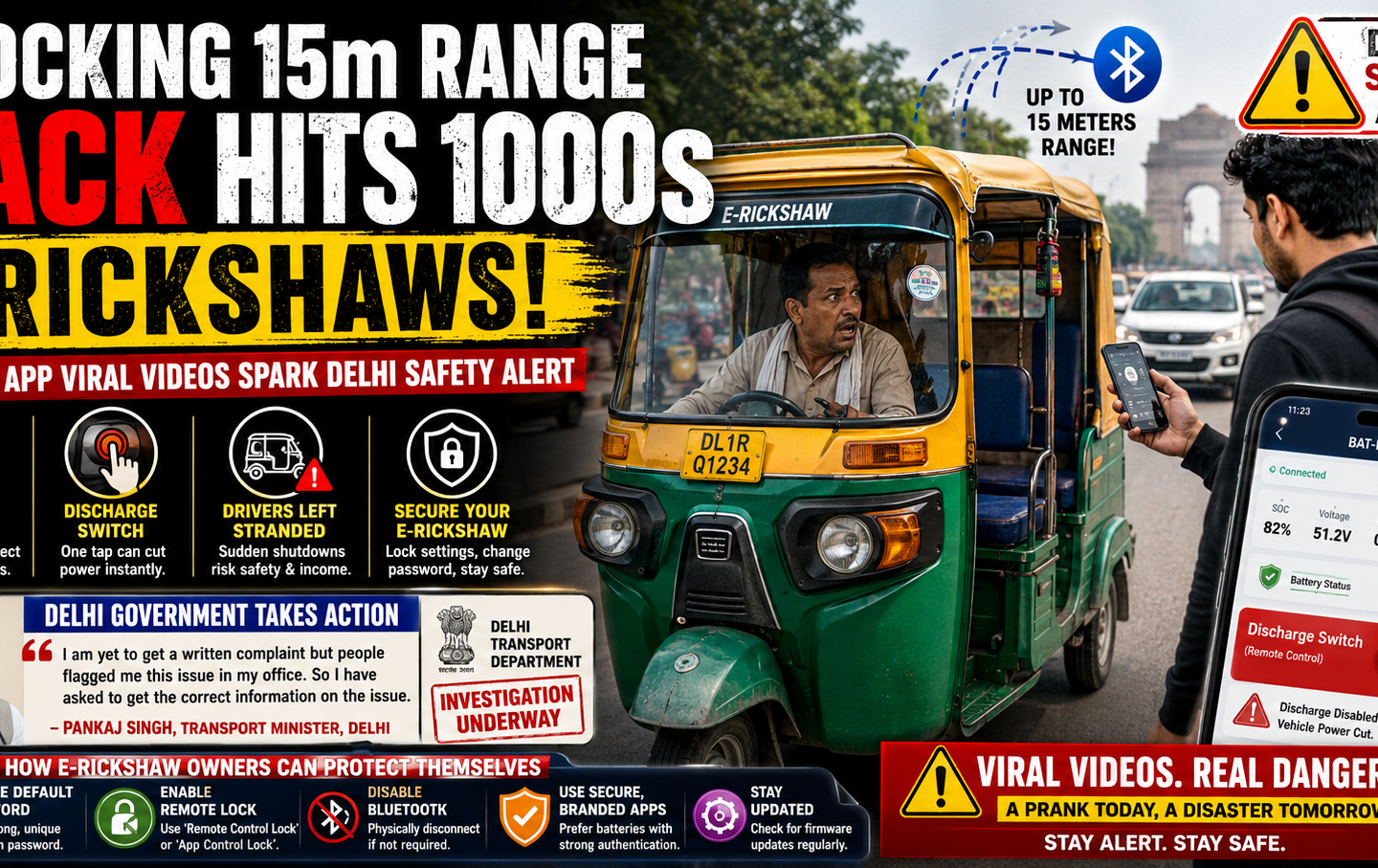
E-Rickshaws Remote Shutdown Crisis: BAT-BMS App Viral Videos Spark Delhi Safety Alert
E-Rickshaws Under Threat: How BAT-BMS App Enables Remote Shutdowns and Leaves Drivers Stranded
In a disturbing new trend sweeping social media, the humble e-rickshaws that form the backbone of last-mile connectivity in Indian cities are facing an unexpected digital vulnerability. Commonly known as “tirris” in local parlance, these electric three-wheelers are now at the center of a major safety controversy involving the BAT-BMS smartphone application. Videos of pranksters using the app to remotely shut down e-rickshaws via Bluetooth have gone massively viral, raising serious concerns about public safety, driver livelihoods, and the security of electric vehicles (EVs) across India.
The issue first gained traction when influencers and content creators began recording themselves approaching moving e-rickshaws and electric scooters, connecting to their battery management systems through the BAT-BMS app, and activating a discharge switch. Within seconds, the vehicles come to a grinding halt, leaving bewildered drivers stranded in the middle of busy roads. Millions of users have viewed these clips on Instagram, YouTube, and X (formerly Twitter), turning a serious technical flaw into a dangerous social media prank trend.
What is the BAT-BMS App and How Does It Work?
BAT-BMS is a mobile application developed by Chinese manufacturer Shenzhen Grenergy Technology. Available on the Google Play Store, the app is designed to wirelessly monitor Bluetooth-enabled lithium-ion battery packs used in various electric vehicles, including e-rickshaws. According to its official description, the BAT-BMS app offers several legitimate features for battery management:
- Real-time monitoring of battery charge (SOC), voltage, current, temperature, cycle life, and cell health.
- Tracking of charge and discharge cycles.
- Compatibility with smartphones supporting Bluetooth 5.0 (BLE).
- Wireless connection range of up to 15 meters.
- Ability to monitor multiple batteries, though only one phone can control a specific battery at a time.
While these features are useful for legitimate owners and technicians, the lack of robust security in many low-cost lithium-ion batteries has turned the app into a tool for mischief. Many e-rickshaws use battery systems with Bluetooth enabled by default and no password protection or authentication required. This allows anyone within range to download the app, pair with the vehicle, and tap the “Discharge Switch” to instantly cut power.
In a demonstration conducted by Hindustan Times with a driver’s consent, an e-rickshaw was successfully switched off remotely. Restarting the vehicle required using the same app to re-enable the discharge function — the ignition key alone was ineffective. This highlights a critical design flaw in how some modern electric three-wheelers are manufactured.
Delhi Government Takes Notice of E-Rickshaws Remote Shutdown Incidents
The controversy has now reached the corridors of power in Delhi. Transport Minister Pankaj Singh confirmed that while no formal written complaint has been filed yet, concerned citizens have raised the issue directly with him. In response, the Delhi Transport Department has been directed to verify the authenticity of the BAT-BMS application and thoroughly examine the claims.
“I am yet to get a written complaint but people flagged me this issue in my office. So I have asked to get the correct information on the issue,” Singh told NDTV.
A senior government official noted that preliminary assessments confirm the app can wirelessly connect to compatible Bluetooth-enabled lithium batteries within a limited range. The department is now evaluating the broader implications for road safety and public transport in the capital, where thousands of e-rickshaws operate daily.
This development comes at a time when the Indian government is actively promoting electric mobility to reduce pollution and dependence on fossil fuels. However, incidents like these underscore the urgent need for better cybersecurity standards in EV components, especially affordable e-rickshaws that serve millions of daily commuters and drivers.
The Human Cost: Drivers Left Bewildered and Vulnerable
For e-rickshaw drivers, many of whom rely on these vehicles as their sole source of income, the remote shutdown prank is more than an inconvenience — it’s a direct threat to their livelihood and safety. Imagine navigating busy Delhi streets during peak hours only to have your vehicle suddenly lose power. The resulting confusion can lead to traffic snarls, potential accidents, and harassment from frustrated commuters.
Videos show drivers looking utterly perplexed as their e-rickshaws stop moving without any mechanical fault. Some pranksters laugh while filming, seemingly unaware or unconcerned about the real-world dangers they are creating. On crowded roads, a stalled vehicle can quickly become a hazard, endangering not just the driver but other road users as well.
The trend has sparked widespread anger among the e-rickshaw community, dealers, and EV users. Many fear organized misuse beyond mere pranks, such as theft or targeted harassment.
Technical Flaw Behind the E-Rickshaws Shutdown Menace
The root of the problem lies not primarily with the BAT-BMS app itself but with how certain low-cost lithium-ion battery packs are designed and deployed in e-rickshaws. Unlike older lead-acid batteries, which lack Bluetooth connectivity and remain safe from such remote interference, modern lithium systems often ship with Bluetooth modules active and minimal security.
Similar apps like Lossigy have also been mentioned in connection with these incidents. The absence of password protection or authentication mechanisms means that pairing is straightforward for anyone nearby. Once connected, the app grants control over critical functions like the discharge switch.
Some manufacturers have started addressing the issue by implementing password requirements before allowing access to sensitive controls. However, many existing e-rickshaws on the roads still use vulnerable systems, creating a large attack surface in cities like Delhi.
How E-Rickshaws Owners and Drivers Can Protect Themselves
Fortunately, there are practical steps e-rickshaw drivers and owners can take to safeguard their vehicles against unauthorized BAT-BMS access:
- Change the Default Bluetooth Password: Connect to the battery using the BAT-BMS app and navigate to Settings or Parameter Settings. Set a strong, unique password if the option is available.
- Enable Remote Control Locks: Look for features such as “Remote Control Lock” or “App Control Lock” within the battery management system and activate them.
- Disable Bluetooth Module: If Bluetooth monitoring is not essential for daily operations, consult a qualified technician to physically disconnect the Bluetooth module. The e-rickshaw will continue functioning normally without the remote vulnerability.
- Use Manufacturer-Specific Apps: Opt for batteries that come with proprietary software featuring stronger authentication instead of generic third-party apps.
- Stay Updated: Regularly check for firmware updates from battery manufacturers that might patch security loopholes.
Drivers are also advised to remain vigilant in crowded areas and report suspicious activity to local authorities.
Broader Implications for EV Adoption in India
The e-rickshaws remote shutdown issue arrives as India pushes aggressively toward electric mobility. With schemes like FAME-II and state-level incentives, the number of electric three-wheelers is growing rapidly. However, this incident highlights gaps in the ecosystem — particularly in component-level security and quality control for affordable segments.
Experts warn that without standardized cybersecurity protocols for Battery Management Systems (BMS), similar vulnerabilities could affect electric scooters, cars, and other connected EVs in the future. The Delhi government’s intervention is a welcome first step, but industry-wide action involving manufacturers, regulators, and app developers is essential.
Shenzhen Grenergy Technology, the developer of BAT-BMS, has not issued an official statement on the misuse reports as of now. Responsible app updates that enforce mandatory authentication could significantly mitigate risks.
Viral Trend or Serious Security Threat?
What began as seemingly harmless prank videos has evolved into a conversation about digital safety in physical mobility. The laughter in the clips masks a deeper concern: when technology meant to empower becomes a tool for disruption, it erodes public trust in emerging innovations like e-rickshaws.
As millions continue to watch and share these videos, the real victims are the hardworking drivers who depend on reliable, uninterrupted service. The Delhi Transport Department’s ongoing verification and potential regulatory response will be crucial in restoring confidence.
For now, e-rickshaw operators are urged to implement protective measures immediately. Awareness campaigns targeting drivers, dealers, and users could help prevent further misuse while authorities work toward long-term solutions.
This episode serves as a timely reminder that as India embraces electric vehicles, innovation in hardware must be matched by equally robust software security and user education. The future of sustainable urban transport depends on addressing such vulnerabilities head-on before they escalate into larger crises.