National Science Day 2026: Celebrating the Raman Effect and Empowering Women in Science for Viksit Bharat
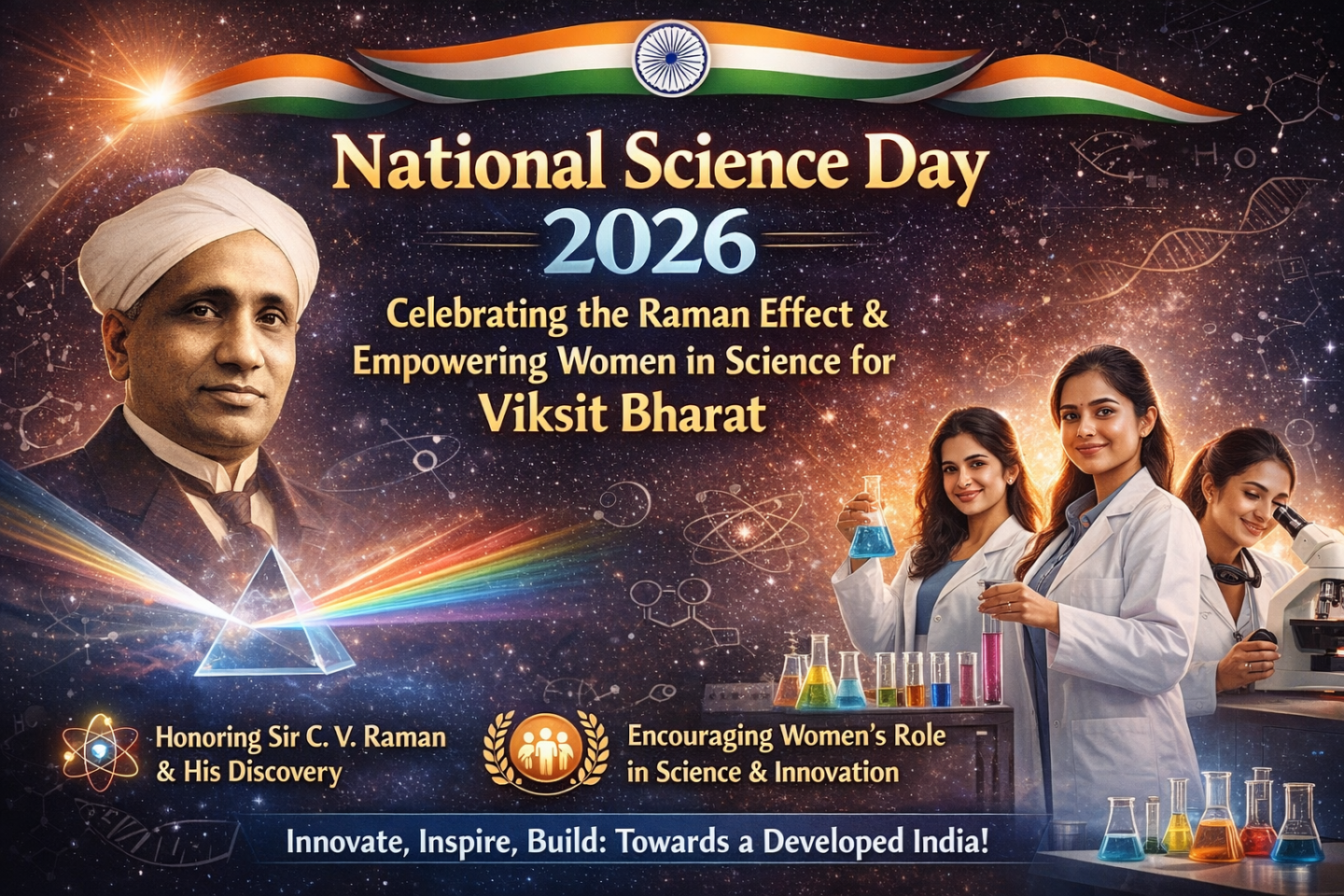
National Science Day 2026 marks a significant milestone in India’s scientific calendar, observed annually on February 28 to commemorate one of the most groundbreaking discoveries in modern physics—the Raman Effect by Sir Chandrasekhara Venkata Raman in 1928. This day not only pays homage to a historic achievement that earned India its first Nobel Prize in the sciences but also serves as a powerful platform to foster scientific temper, encourage research, and drive innovation across the nation.
In 2026, National Science Day gains added relevance as India accelerates toward its ambitious vision of Viksit Bharat (Developed India) by 2047. The official theme for National Science Day 2026—”Women in Science: Catalysing Viksit Bharat“—highlights the pivotal role of women scientists, researchers, and innovators in propelling the country toward technological self-reliance, sustainable development, and global leadership in STEM fields.
The Historical Significance: Honoring the Raman Effect
The foundation of National Science Day lies in Sir C.V. Raman’s announcement of the Raman Effect on February 28, 1928. This phenomenon describes the inelastic scattering of light by molecules, resulting in a change in the wavelength of scattered light. It provided crucial insights into molecular structure and became a cornerstone for spectroscopy techniques used today in chemistry, physics, biology, and materials science.
Raman’s discovery was made using relatively simple equipment in Calcutta (now Kolkata), demonstrating that extraordinary scientific breakthroughs can emerge from modest setups with sharp intellect and persistence. For this work, he was awarded the Nobel Prize in Physics in 1930, becoming the first Asian and first non-White scientist to receive the honor in any scientific category. This achievement shattered barriers and placed Indian science firmly on the global map during colonial times.
The National Council for Science and Technology Communication (NCSTC) under the Department of Science and Technology (DST) proposed designating February 28 as National Science Day in 1986, and the Government of India officially adopted it. Since 1987, the day has been celebrated nationwide with events aimed at popularizing science, promoting rational thinking, and inspiring the youth.
National Science Day 2026 Theme: Women in Science Catalysing Viksit Bharat
The 2026 theme—”Women in Science: Catalysing Viksit Bharat“—aligns perfectly with India’s broader national goals. Viksit Bharat envisions a developed, self-reliant India by its 100th year of independence, with science and technology as key drivers. Women scientists are positioned as catalysts in this journey, contributing to innovations in space, defense, healthcare, renewable energy, AI, and critical materials.
Despite progress, gender disparities persist in STEM. However, Indian women have made remarkable strides—leading missions like Chandrayaan, heading research labs, filing patents, and driving startups. The theme emphasizes reducing these gaps, increasing women’s participation in research (women now lead over 30% of DST projects in some sectors), and recognizing their contributions to national development.
The Government of India, via the Ministry of Science and Technology’s Department of Science and Technology (DST), organizes the national-level event at Vigyan Bhawan in New Delhi. This central celebration underscores the theme’s importance.
National-Level Celebrations at Vigyan Bhawan
The flagship program at Vigyan Bhawan features an array of high-profile activities designed to bridge science, policy, and society:
- Inaugural Lectures: Chaired by Principal Scientific Adviser Professor Ajay K Sood, the sessions include expert talks on cutting-edge topics.
- Dr. Shubha V Iyengar discusses indigenous aerospace and defense technologies, highlighting self-reliance in strategic sectors.
- Dr. K Balasubramanian addresses critical metals and advanced materials essential for emerging technologies like EVs, semiconductors, and green energy.
- Shri Shashi S. Vempati explores direct-to-mobile broadcasting, showcasing innovations in communication tech.
- Panel Discussion on Science-Policy Interface: Experts from NITI Aayog, Indian National Science Academy (INSA), CSIR institutions, CSTEP, and Indo-German Science & Technology Centre (IGSTC) deliberate on aligning research priorities with national goals like sustainable development, economic growth, and inclusive innovation.
- Science Communication in Indian Languages: Sessions focus on disseminating scientific knowledge in regional languages to reach diverse populations and build widespread scientific literacy.
- Interactive Engagements: “Face to Face with Scientists” allows students and the public to interact directly with leading researchers, inspiring the next generation.
These events emphasize that science is not isolated but integral to policy-making and societal progress, particularly through women’s leadership.
Outreach Programs: Taking Science to the Public
National Science Day extends far beyond formal ceremonies. Research institutions nationwide open their doors for public engagement, fostering curiosity and hands-on learning.
A highlight is the Raman Research Institute (RRI) in Bengaluru, hosting its annual Open Day on February 28, 2026, to mark the 98th anniversary of the Raman Effect discovery. As the institute founded by Sir C.V. Raman himself, this event carries special symbolic weight.
The RRI Open Day features:
- Live science demonstrations and research exhibitions showcasing ongoing work in astronomy, quantum physics, soft matter, and more.
- Hands-on experiments for participants.
- Science quizzes, photography contests, and interactive sessions with scientists.
- Expectation of over 1,000 students from government and private schools, promoting inclusivity and sparking interest among underprivileged learners.
Similar outreach occurs at institutions like IISER Pune (three-day program with lectures by women scientists and demonstrations by Padma Shri Arvind Gupta), UR Rao Satellite Centre (ISRO-related student competitions), and many CSIR labs, IITs, and state science centers. These initiatives include exhibitions, workshops, debates, and project displays, engaging millions annually.
Why National Science Day Matters in 2026
In the context of Viksit Bharat, National Science Day 2026 is more than commemoration—it’s a call to action. By spotlighting women in science, it addresses gender equity in STEM, boosts R&D investment (targeting higher GDP allocation), and encourages indigenous innovation.
The day promotes scientific temper as enshrined in the Indian Constitution (Article 51A), urging citizens to think critically and embrace evidence-based approaches. In an era of misinformation, this is vital.
For students, it’s an opportunity to explore careers in science. For policymakers, a reminder to integrate research into development agendas. For society, a celebration of how fundamental discoveries like the Raman Effect lead to practical applications—from medical diagnostics to telecommunications.
As India marches toward becoming a global science powerhouse, National Science Day 2026 inspires collective effort. The legacy of Sir C.V. Raman lives on, now amplified by the contributions of women scientists catalyzing a developed, inclusive Bharat.
This comprehensive article is optimized for searches like “National Science Day 2026”, “Women in Science Catalysing Viksit Bharat”, “Raman Effect National Science Day”, and related terms, with detailed, structured content for better Google ranking.