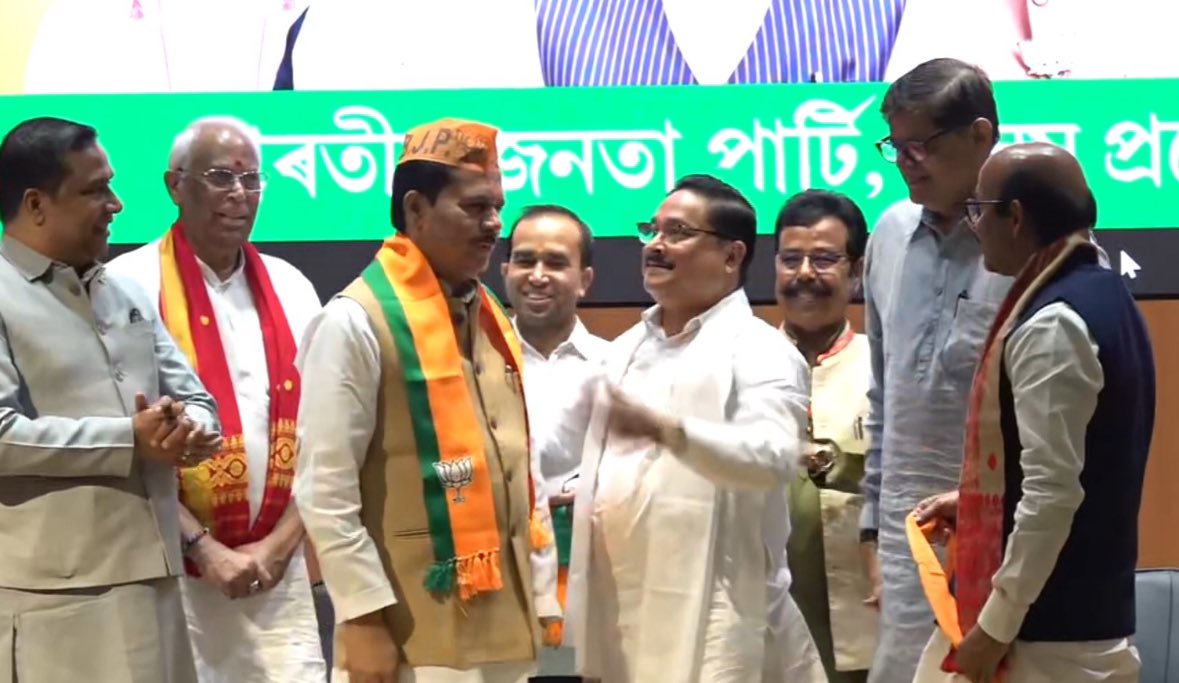
In a seismic shift that has dramatically altered the political landscape of the state, former Assam Congress President Bhupen Borah officially joined the Bharatiya Janata Party (BJP) on Sunday, February 22. This high-profile defection comes just months ahead of the highly anticipated Assam state assembly elections, dealing a severe blow to the opposition’s efforts to mount a united front.
For anyone tracking Assam politics, the phrase “Bhupen Borah joins BJP” has dominated headlines and political discussions over the past week. Ending a 32-year-long association with the grand old party, Borah’s departure highlights deep-rooted internal frictions within the Assam Pradesh Congress Committee (APCC). He was accompanied by former Congress worker Sanju Bora, who also formally switched sides and entered the saffron party on the same day.
The transition from the Congress to the ruling BJP was marked by a highly publicized meeting with top BJP brass, setting the stage for a fiercely contested electoral battle as Chief Minister Himanta Biswa Sarma aims to retain power in the state.
The Formal Switch: Meeting Amit Shah and a Tell-Tale Post
The formal induction of Bhupen Borah into the BJP was the culmination of days of intense political speculation. The final seal of approval came following a crucial meeting between Borah and Union Home Minister Amit Shah in New Delhi.
Immediately after the meeting, Bhupen Borah took to social media to share a sharp, cryptic post that summarized his reasons for the sudden political pivot. He wrote:
“32 years vs 32 hours — the difference is visible.”
This statement struck a chord across political circles. It was a direct comparison between the three decades he dedicated to the Indian National Congress—where he recently felt marginalized and ignored—and the immediate respect, swift decision-making, and high-level engagement he received from the BJP leadership within just 32 hours of initiating contact.
For the BJP, welcoming a leader of Borah’s stature is a calculated masterstroke. As a prominent grassroots organizer with deep ties to the Assamese community, his induction is expected to heavily bolster the BJP’s localized campaign strategies ahead of the 2026 assembly polls.
A Week of High Drama: Resignation and the Congress’s Failed Persuasion
The journey to Bhupen Borah’s eventual exit was fraught with political theater. The timeline of events showcases a massive scramble by the Congress high command to retain one of its most recognizable faces in the Northeast.
Here is a breakdown of how the dramatic week unfolded:
- The Initial Resignation (February 16): Citing a lack of self-respect and increasing alienation within the state unit, Bhupen Borah sent an email to Congress President Mallikarjun Kharge at 8:00 AM, stepping down from his primary membership.
- The Scramble to Placate: Refusing to accept his resignation, the Congress central leadership immediately swung into action. AICC General Secretary in-charge of Assam, Jitendra Singh, along with current Assam PCC chief Gaurav Gogoi and other senior leaders, rushed to Borah’s Guwahati residence.
- The Rahul Gandhi Intervention: In a last-ditch effort, senior Congress leader Rahul Gandhi held a 15-minute telephonic conversation with Borah, urging him to remain in the party and promising to address his grievances.
- Buying Time: Following the high-level interventions, Borah temporarily softened his stance, telling the media that he had sought “some time” to consult with his family, well-wishers, and constituents from Lakhimpur before making a final decision.
- The CM’s Masterstroke: The very next day, Assam Chief Minister Himanta Biswa Sarma visited Borah’s residence. Welcomed with a traditional aarti, Sarma held a closed-door meeting with the veteran leader. Shortly after, the Chief Minister publicly announced that Bhupen Borah would formally join the BJP on Sunday, February 22.
Why Did Bhupen Borah Leave the Congress?
Bhupen Borah’s exit was not an overnight decision but the result of simmering discontent over the span of several months. Having served as the President of the Assam Pradesh Congress Committee from 2021 to 2025, Borah was largely credited with keeping the grassroots workers united after the party’s consecutive defeats.
However, his relationship with the state leadership deteriorated due to several key factors:
1. The Rise of the “APCC-R” Faction
Borah publicly expressed immense frustration with the growing concentration of power in the hands of Dhubri MP Rakibul Hussain. Borah alleged that the state unit had effectively devolved into “APCC-R” (indicating a faction controlled by Rakibul). He claimed that leaders who wanted to survive in the party were forced to align with this parallel power center, creating an environment of “mental distress” for veteran workers.
2. The Samaguri By-Poll Sidelining
The breaking point reportedly occurred during the November by-elections for the Samaguri assembly constituency. The seat was vacated by Rakibul Hussain after he was elected to the Lok Sabha. Borah, seeking to lead from the front, expressed his desire to contest from Samaguri. Instead, the party ticket was handed to Hussain’s son, Tanzil Hussain, who ultimately lost the Muslim-majority constituency to the BJP. Borah felt deeply slighted by this dynastic preference over a seasoned former APCC chief.
3. Leadership Transition
In May 2025, the Congress high command replaced Bhupen Borah with Gaurav Gogoi as the new Assam Congress Chief. While the party viewed Gogoi as a leader with a larger national profile capable of taking on Himanta Biswa Sarma, Borah felt stripped of his authority and relegated to the sidelines, especially regarding crucial alliance negotiations with regional parties like the Raijor Dal and Assam Jatiya Parishad.
Congress Reacts: The “Ocean” Metaphor
Despite the optics of losing a two-time former MLA and former state president, the Assam Congress attempted to downplay the impact of Bhupen Borah’s exit.
Assam PCC President Gaurav Gogoi projected confidence, asserting that the party’s electoral machinery remains intact. Reacting to the development, Gogoi stated:
“Congress is like an ocean; we are all just water drops in it. Congress was there long before our fathers and forefathers existed. Bhupen Borah’s leaving will not impact our party’s prospects in the assembly polls.”
While the Congress leadership insists that the departure of one individual will not derail their momentum, political analysts suggest otherwise. Borah was a vital bridge between the Congress and regional anti-BJP outfits. His absence leaves a significant organizational vacuum in Upper Assam and North Bank regions.
Himanta Biswa Sarma and the “Last Hindu Leader” Narrative
Chief Minister Himanta Biswa Sarma, who himself famously left the Congress in 2015 to join the BJP, played a pivotal role in facilitating this transition. Sarma was quick to weave a potent political narrative around the event, framing it not just as a political defection, but as an ideological homecoming.
Sarma repeatedly referred to Bhupen Borah as the “last recognized Hindu grassroots leader in the Assam Congress.” By doing so, the BJP aims to cement the perception that the opposition party in Assam is heavily reliant on minority vote banks and has lost its connection with the mainstream indigenous Assamese identity.
“When a leader leaves a party after serving it for 32 years, the party should address the reasons. The problem with the Congress is that it does not address such issues,” Sarma remarked, drawing parallels to his own exit. He further assured that Borah would be treated with the utmost dignity in the BJP and promised him a “safe seat” to contest in the upcoming assembly elections.
Bhupen Borah: Background and Political History
To understand the magnitude of this shift, it is essential to look at Bhupen Borah’s extensive political resume. He has been a familiar face in Assam politics since his student days in the early 1990s.
Quick Profile: Bhupen Borah
| Detail | Information |
| Full Name | Bhupen Kumar Borah |
| Born | October 30, 1970 (Lakhimpur, Assam) |
| Education | M.A. in Political Science (Dibrugarh University) |
| Political Entry | Joined Indian National Congress in 1994 |
| Electoral Record | Two-term MLA from Bihpuria constituency (2006–2016) |
| Key Roles Held | President of Assam Pradesh Youth Congress, APCC President (2021–2025), AICC Secretary |
| New Affiliation | Bharatiya Janata Party (Joined Feb 22, 2026) |
Starting as a student leader at North Lakhimpur College and Dibrugarh University, Borah climbed the ranks through the Youth Congress. During the tenure of former Chief Minister Tarun Gogoi, he served as a spokesperson and a parliamentary secretary, solidifying his reputation as an accessible, non-dynastic leader. His transition to the BJP marks the end of an era for the Congress in the Lakhimpur district.
Impact on the Assam Assembly Elections 2026
The timing of Bhupen Borah joining the BJP could not be more critical. Assam is set to hold assembly elections later this year. The political chessboard is currently arranged with the BJP, led by the formidable Himanta Biswa Sarma, looking to secure another consecutive term, while the Congress seeks to mount a renewed challenge through a united opposition alliance.
Here is how Borah’s move alters the electoral calculus:
- Strengthening the BJP in Upper Assam: Borah’s influence in the Bihpuria and broader Lakhimpur regions provides the BJP with a ready-made, battle-tested grassroots network. It virtually guarantees a strong performance in a region where the Congress was hoping to make inroads.
- Demoralization of Congress Cadre: Losing a former state president sends a demoralizing signal to mid-level party workers. If a leader with 32 years of loyalty can jump ship, it breeds insecurity among the rank and file regarding the party’s future under current leadership.
- Disruption of Opposition Unity: Borah was the chief architect of the Congress’s back-channel talks with regional entities like Akhil Gogoi’s Raijor Dal. His departure deeply fractures the trust and communication lines required to sustain a united front against the NDA machinery.
- Narrative Warfare: The BJP now has ultimate ammunition to label the state Congress as an organization plagued by infighting and minority appeasement, leveraging the “32 years vs 32 hours” quote to attract more disillusioned Congress workers before the polls.
Ultimately, as Bhupen Borah dons the saffron scarf alongside Sanju Bora and potentially other loyalists, the road ahead for the Assam Congress looks increasingly steep. The BJP, conversely, has managed to turn a potential rival into a powerful asset, setting a dominant tone for the impending democratic contest.