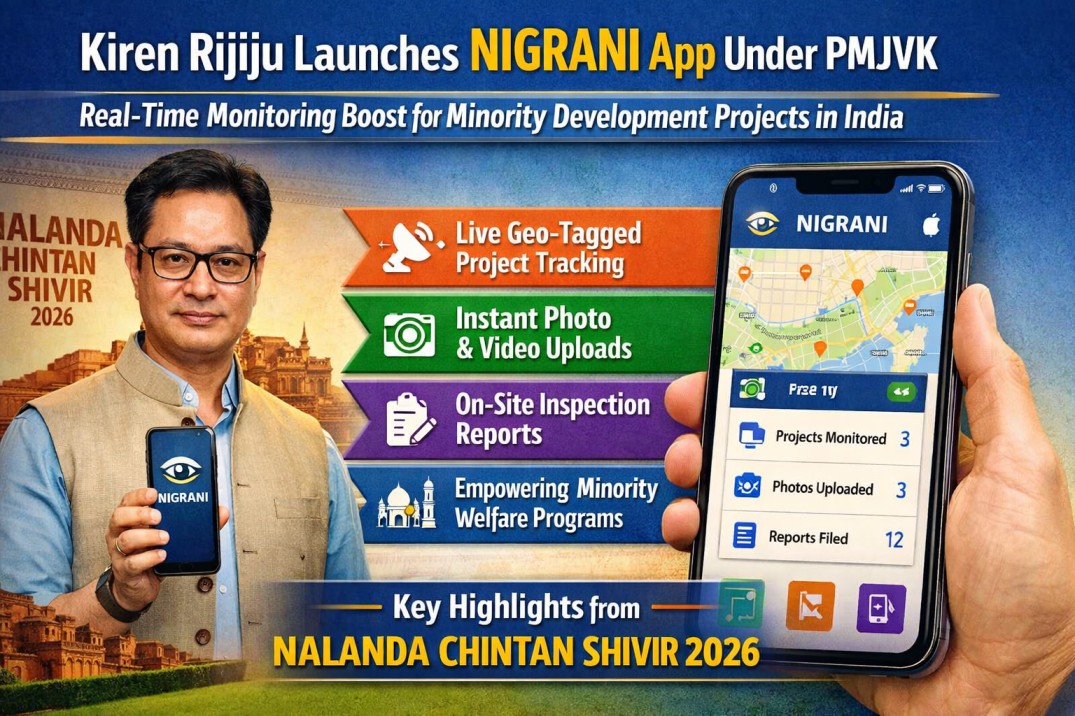
The event occurred on February 19, 2026, during the formal inauguration or second day activities of the two-day National Chintan Shivir organized by India’s Ministry of Minority Affairs at the historic Nalanda University in Rajgir, Bihar. Union Minister of Minority Affairs and Parliamentary Affairs Kiren Rijiju led the launch of the NIGRANI App under the Pradhan Mantri Jan Vikas Karyakram (PMJVK) scheme. This digital tool focuses on real-time monitoring of infrastructure and development projects in minority-concentrated areas, promoting transparency, faster execution, and bridging developmental gaps.
The Chintan Shivir brought together Union and State Ministers, senior officials, domain experts, and representatives to deliberate on policy-driven strategies for minority welfare and socio-economic empowerment. It aligns with the government’s vision of Viksit Bharat@2047 (Developed India by 2047), emphasizing inclusive growth where no community is left behind.
Kiren Rijiju Launches NIGRANI App Under PMJVK: Real-Time Monitoring Boost for Minority Development Projects in India – Key Highlights from Nalanda Chintan Shivir 2026
In a landmark move toward digital governance and inclusive development, Union Minister of Minority Affairs Kiren Rijiju officially launched the NIGRANI App on February 19, 2026, during the high-profile National Chintan Shivir held at Nalanda University in Rajgir, Bihar. The app, rolled out under the flagship Pradhan Mantri Jan Vikas Karyakram (PMJVK) scheme, is set to revolutionize how development initiatives in minority-concentrated regions are tracked, implemented, and evaluated.
The NIGRANI App—named after the Hindi word for “vigilance” or “monitoring”—serves as a powerful mobile and digital platform that enables real-time tracking of infrastructure projects. These include schools, hospitals, skill development centers, hostels, and other community assets aimed at uplifting minority communities across India. By leveraging satellite imagery, geo-tagging, digital reporting, and data analytics, the app provides instant updates on physical and financial progress. This ensures greater transparency, reduces delays, identifies bottlenecks early, and facilitates quicker resolution of issues on the groundThe launch formed part of a broader technology push by the Ministry of Minority Affairs. Alongside the NIGRANI App, Minister Rijiju unveiled the Haj Wrist Band (a smart wearable for pilgrims with features like SOS alerts, emergency response, and location tracking) and AI-powered Chatbots to improve service delivery, information dissemination, and citizen engagement. These initiatives collectively aim to bridge the gap between policy formulation and last-mile execution, making government schemes more accessible and effective for minorities.
The two-day Chintan Shivir (Thought Workshop) was a strategic brainstorming platform themed around minority welfare and socio-economic empowerment. Organized by the Ministry of Minority Affairs, it commenced on February 18, 2026, and culminated with the formal inauguration and launches on the second day. The venue—Nalanda University—added symbolic weight, as Rijiju described it as a beacon of India’s ancient civilizational heritage and a global center of excellence. Discussions focused on innovative proposals from states, better alignment with national goals, and enhanced Centre-State coordination to achieve grassroots impact.
Key dignitaries present included Union Minister of State for Minority Affairs George Kurien, Bihar’s Minority Welfare Minister Jama Khan, and representatives from various states. In his address, Rijiju stressed that holistic minority development is indispensable for realizing a developed India by 2047. He reiterated the Modi government’s core mantra: “Sabka Saath, Sabka Vikas, Sabka Vishwas” (Together with all, Development for all, Trust for all). Without integrating minorities into the mainstream of progress, he noted, the vision of an advanced nation cannot be fully achieved.
The PMJVK scheme, formerly known as the Multi-sectoral Development Programme (MsDP), targets 90 minority-concentrated districts and blocks across India. It addresses critical gaps in education, health, skill training, and basic infrastructure. The introduction of the NIGRANI App marks a significant upgrade, shifting from periodic manual reporting to continuous, tech-driven oversight. Officials highlight that satellite-based tools and digital dashboards will allow stakeholders—from central officials to local implementers—to view live status, upload geo-tagged photos, track fund utilization, and generate analytical reports. This not only minimizes corruption risks but also accelerates project completion, ensuring benefits reach the intended beneficiaries faster.
During the deliberations, state representatives shared region-specific challenges and suggestions for optimizing PMJVK implementation. Rijiju praised these inputs, calling the scheme one of the ministry’s flagship programs and underscoring the importance of collaborative federalism. He outlined ongoing policy efforts to drive economic, social, and educational advancement for minorities, including Muslims, Christians, Sikhs, Buddhists, Jains, and Parsis.
The government’s commitment to transparency and efficiency is evident in this digital transformation. The NIGRANI App empowers citizens and officials alike by making project data publicly accessible in many cases, fostering accountability. For instance, community leaders in minority areas can now monitor nearby school or health center constructions in real time, report discrepancies via the app, and contribute to better outcomes. This citizen-centric approach aligns with Digital India and aligns perfectly with the broader push for tech-enabled governance.
Experts view the launch as a game-changer for minority welfare schemes. In the past, delays in infrastructure projects often stemmed from poor monitoring, leading to cost overruns and subpar quality. With NIGRANI, real-time alerts and data visualization can preempt such issues. The app’s integration with existing government portals could further streamline processes, such as linking with PFMS (Public Financial Management System) for fund tracking.
The event also spotlighted other launches: The Haj Wrist Band enhances pilgrim safety during the annual Haj journey by providing health monitoring, navigation, and emergency features. The AI Chatbots offer 24/7 assistance on schemes, eligibility, application status, and more, reducing dependency on physical offices and improving outreach in remote areas.
Rijiju’s remarks encapsulated the larger vision: “The true essence of Sabka Saath, Sabka Vikas lies in bringing every section, especially minorities, into the development mainstream. Through policies and tools like NIGRANI, we are ensuring holistic progress.” He expressed confidence that such steps will play a pivotal role in building a Viksit Bharat by 2047—a self-reliant, inclusive, and prosperous India.
This development comes amid growing emphasis on minority empowerment under the current administration. Schemes like scholarships, skill training under Seekho aur Kamao, equity loans, and coaching for competitive exams have already benefited millions. The addition of tech layers like NIGRANI ensures these efforts are measurable and impactful.
For states like Bihar, with significant minority populations, the app holds particular promise. Bihar’s participation, including the presence of its Minority Welfare Minister, signals strong buy-in for collaborative implementation. Similar enthusiasm from other states during the Chintan Shivir points to nationwide rollout potential.
As India marches toward its 2047 centenary goal, initiatives like the NIGRANI App exemplify how technology can democratize development. By ensuring no project in minority areas remains unmonitored or delayed, the government is reinforcing trust and delivering on promises of equitable growth.
In summary, the launch of the NIGRANI App at Nalanda University’s Chintan Shivir is more than a tech rollout—it’s a statement of intent for transparent, inclusive, and accelerated minority development. With real-time monitoring at its core, it paves the way for a more connected and empowered future for India’s diverse communities.