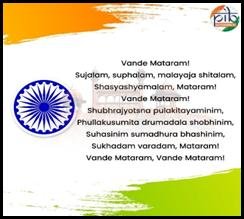
Vande Mataram Gets Legal Protection: Parliament Passes Landmark Bill Making Insult a Crime in 2026
In a significant move that has reignited one of India’s longest-running cultural and political debates, the Parliament on Thursday passed the Prevention of Insults to National Honour (Amendment) Bill, 2026, extending full legal protection to Vande Mataram, the country’s national song. The legislation now places Vande Mataram on the same legal footing as the national anthem Jana Gana Mana, making any intentional insult, disturbance or prevention of its singing a criminal offence punishable by up to three years in prison, a fine, or both.
The Bill was cleared by voice vote in the Lok Sabha amid noisy scenes and sharp political exchanges. With this amendment, intentionally preventing the singing of Vande Mataram or causing a disturbance during its rendition becomes a punishable crime. For a second and every subsequent conviction, the law mandates a minimum prison term of one year, signalling the government’s intent to treat disrespect towards the national song with the same seriousness as offences against the national anthem.
Minister of State for Home Nityananda Rai, while replying to a brief debate in which only two members participated, delivered a pointed political message. He accused the Congress of failing to give Vande Mataram its due respect during its 76 years in power and of resorting to “appeasement politics.” “For Ek Bharat, Shreshtha Bharat, we need the complete (all six stanzas) Vande Mataram song,” Rai said, concluding his reply by chanting “Vande Mataram.” The Opposition’s amendments were rejected by the House.
The passage of the Bill has once again brought to the surface the complex history of Vande Mataram and the contested interpretations of its place in India’s national identity. Originally composed by Bankim Chandra Chatterjee in the 1870s and later included in his novel Anandamath, the song became a powerful rallying cry during the freedom struggle. Its first two stanzas were adopted as the national song, while the remaining four, which contain more explicit religious imagery, were left out of official usage for decades.
Critics, particularly from the DMK, have framed the new law as an attempt to impose a particular cultural narrative. DMK MP A. Raja tore up some documents and threw them towards the Well of the House in protest. His colleague K. Kanimozhi opposed the Bill, calling it a “Hindutva agenda” brought in the guise of nationalism. “It is against federalism. You cannot impose nationalism by bringing a law; the song goes against the secularism of the country. The founding fathers had the wisdom to stop only with two stanzas, but today you are trying to polarise the country by making it compulsory and making it a criminal offence if we do not sing all the six stanzas,” she said.
BJP MP Sambit Patra countered that the Congress, despite ruling for most of independent India’s history, never accorded Vande Mataram the stature it deserved as the national song. The debate reflects deeper fault lines over what constitutes authentic Indian nationalism and whether legal compulsion is the right instrument to foster respect for national symbols.
Supporters of the amendment argue that Vande Mataram is not merely a song but a living symbol of India’s civilisational continuity and the spirit of the freedom movement. They contend that protecting it from deliberate insult is a natural extension of the existing law that already shields the national anthem, the national flag and the Constitution. In their view, the three-year maximum sentence and the mandatory one-year minimum for repeat offenders send a clear message that wilful disrespect will no longer be treated lightly.
Opponents, however, worry that the law could be misused to stifle dissent or target communities that have historically expressed discomfort with certain stanzas of the song on religious grounds. They point out that the original decision by the Constituent Assembly and subsequent national leaders to limit official usage to the first two stanzas was a carefully considered compromise aimed at preserving national unity in a diverse society. Making the full six-stanza version the subject of criminal law, they argue, risks reopening old wounds rather than healing them.
The timing of the legislation is also noteworthy. Coming in 2026, the Bill arrives at a moment when questions of national identity, cultural assertion and historical memory dominate public discourse. The government’s emphasis on “complete” Vande Mataram aligns with a broader push for cultural confidence and the rejection of what it describes as decades of selective secularism.
Legal experts note that the amendment does not make the singing of Vande Mataram compulsory in every public setting. Rather, it criminalises intentional acts of prevention or disruption. The distinction is important: the law targets deliberate insult and obstruction, not passive non-participation. Nevertheless, the mere existence of a criminal penalty is expected to change the atmosphere around public performances of the song.
For many Indians, Vande Mataram remains an emotional and spiritual touchstone. Generations grew up singing its opening lines in schools, at independence-day functions and during moments of national crisis. The song’s capacity to evoke both pride and controversy is precisely why successive governments approached it with caution. By removing that caution and placing the song under the protective umbrella of the Prevention of Insults to National Honour Act, the current Parliament has chosen a more assertive path.
Whether this legal shield will strengthen genuine respect for the national song or deepen existing polarisation remains to be seen. What is clear is that Vande Mataram has once again moved from the realm of cultural memory into the arena of hard law and heated politics. The three-year prison term and the mandatory minimum for repeat offenders mark a decisive shift: disrespect towards India’s national song is no longer merely a matter of personal opinion or political disagreement; it is now a criminal offence.
As the country digests the implications of the new law, the familiar chant of “Vande Mataram” will continue to echo—sometimes as an expression of unity, sometimes as a point of contention, and now, under the protection of the statute book.