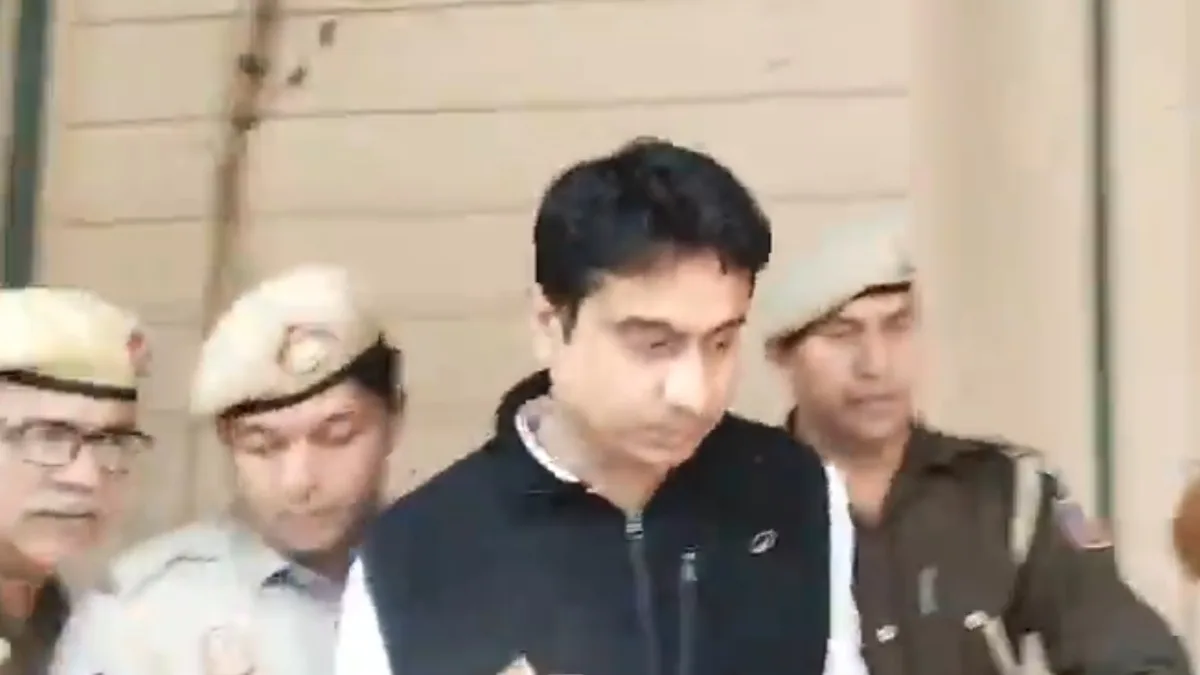
Shirtless Protest at India AI Impact Summit 2026: Youth Congress Chief Uday Bhanu Chib Arrested Amid Political Firestorm
The recent shirtless protest by Indian Youth Congress workers at the India AI Impact Summit in Delhi has ignited a major political controversy, leading to the arrest of IYC national president Uday Bhanu Chib and drawing sharp reactions from across the political spectrum. This incident, which unfolded during a high-profile international event attended by global leaders and tech icons, has raised questions about protest tactics, national image, democratic rights, and alleged conspiracies.
In a dramatic turn of events that has dominated headlines across India, the India AI Impact Summit 2026, held at Bharat Mandapam in New Delhi from February 16 to 20, 2026, was disrupted by a highly unconventional protest. Members of the Indian Youth Congress (IYC), the youth wing of the Congress party, staged a shirtless protest inside the venue, removing their T-shirts to reveal slogans criticizing Prime Minister Narendra Modi and the central government. The protest, which involved shouting anti-Modi slogans such as “PM is compromised,” targeted alleged issues like the India-US trade deal and other policy matters. This act, occurring in the presence of international dignitaries including French President Emmanuel Macron, OpenAI founder Sam Altman, Google CEO Sundar Pichai, and representatives from over 80 countries, quickly escalated into a nationwide political storm.
The summit itself was a landmark event showcasing India’s advancements in artificial intelligence. It aimed to position the country as a global leader in AI governance, ethics, and innovation. World leaders and tech pioneers praised India’s initiatives, with Macron reportedly expressing admiration for the nation’s progress. The Burj Khalifa in Dubai even lit up in tribute to the event, highlighting its international significance. However, the shirtless protest overshadowed these achievements, causing confusion, verbal altercations with attendees, and security interventions. Police detained several protesters on the spot, marking the beginning of a series of arrests.
Delhi Police swiftly launched an investigation, describing the incident as a breach of decorum at a high-security diplomatic gathering. Initial reports indicated that around 10 Youth Congress workers entered the exhibition hall, shed their outer T-shirts to display inner ones with objectionable messages—including images related to PM Modi—and raised slogans. Security personnel intervened, leading to detentions. In the days following the protest on February 20, arrests mounted. Four IYC workers were remanded to police custody initially, with the court citing the need for further interrogation.
The case took a major turn when Uday Bhanu Chib, the national president of the Indian Youth Congress, was summoned for questioning at Tilak Marg Police Station. After nearly 15-20 hours of intense interrogation—sources vary slightly on the exact duration—police arrested him in the early hours of February 24, 2026. This made him the eighth person detained in connection with the incident. A Delhi court subsequently sent Chib to four days of police custody, allowing investigators to probe his alleged role in planning and orchestrating the protest.
According to Delhi Police statements in court, Chib did not cooperate during questioning and attempted to mislead the probe by concealing information. Charges against him and others include criminal conspiracy, voluntarily causing harm to public servants, obstructing duty, and willful disobedience. Police described Chib as the “mastermind” behind the demonstration, alleging it was not a spontaneous act but a premeditated disruption.
In a striking claim presented before the Patiala House Court, Delhi Police asserted that the protest was part of a larger conspiracy inspired by Nepal’s Gen Z movement. Nepal’s youth-led protests in September 2025 had toppled the government of Prime Minister KP Sharma Oli in under two weeks, resulting in significant unrest and over 70 deaths. Investigators suggested that digital evidence pointed to similar tactics—bold, attention-grabbing actions to challenge authority—being adopted here. Further collection of digital proof, including communications and planning details, was deemed necessary. This angle has added an international dimension to the case, raising concerns about external influences on domestic protests.
Rahul Gandhi, the Leader of Opposition in Lok Sabha, reacted furiously to Chib’s arrest. In posts on X (formerly Twitter) and public statements, he condemned it as reflective of the government’s “dictatorial tendencies” and “cowardice.” He defended the protest as a peaceful, democratic exercise of free speech, emphasizing that raising one’s voice for truth is a fundamental right. Gandhi referred to Chib as a “brave lion” (often translated as “Babbar Sher” in Hindi), praising Youth Congress members for fearlessly standing up for national interests. He reiterated his unwavering support for such courageous comrades, framing the arrest as an attempt to suppress dissent.
Congress president Mallikarjun Kharge echoed similar sentiments, slamming the government’s handling as authoritarian. The party portrayed the protest as an exposure of alleged governmental compromises, particularly on sovereignty issues tied to international deals.
On the opposing side, Prime Minister Narendra Modi delivered a blistering critique. Speaking at a rally in Meerut, Uttar Pradesh, he mocked the Congress, stating that the party was “already naked” ideologically and questioning the need to remove clothes physically. He accused the opposition of engaging in “dirty and naked politics” to tarnish India’s global image during a moment of pride. Modi highlighted how the summit had earned worldwide acclaim—from Macron to Altman and Pichai—yet the protest sought to disrupt this narrative. BJP leaders labeled the act “topless, brainless, shameless,” accusing Congress of jealousy toward India’s progress and anti-national behavior.
The controversy extended beyond the BJP-Congress binary. Some opposition allies expressed discomfort. Samajwadi Party leader Akhilesh Yadav called the semi-nude form “not appropriate.” BSP chief Mayawati deemed it condemnable for damaging national dignity on an international stage. Leaders from YSR Congress and others voiced shame, arguing it embarrassed India before foreign guests. This internal dissent within the opposition INDIA bloc highlighted divisions over protest ethics.
The shirtless protest and subsequent arrests have broader implications. Supporters view it as legitimate dissent against policies perceived as compromising national interests. Critics argue it was indecent, disruptive, and counterproductive—harming India’s soft power at a summit meant to project technological leadership. Security lapses at Bharat Mandapam also came under scrutiny, with questions about how protesters accessed the venue.
As investigations continue, with police custody extensions and potential charges, the episode underscores deepening political polarization in India. The India AI Impact Summit 2026 will be remembered not just for AI diplomacy but for this unprecedented disruption. Whether it galvanizes youth activism or backfires politically remains to be seen, but it has undoubtedly amplified debates on protest rights, decorum, and governance in the world’s largest democracy.
This developing story continues to evolve, with more arrests possible and digital evidence under review. Stay tuned for updates on Uday Bhanu Chib’s case, political reactions, and any new revelations about the alleged Nepal-inspired conspiracy.