NASA Moon Base: Historic Plans for Permanent Human Settlement at Lunar South Pole Revealed After Artemis 2 Success
NASA Moon Base: America’s Bold Leap Toward Permanent Lunar Presence Ignites Global Excitement
In a landmark announcement that builds on the momentum of the triumphant Artemis 2 mission, NASA has unveiled detailed plans for establishing a NASA Moon Base at the lunar south pole. This initiative marks a pivotal shift from short-duration visits to a sustained human outpost on another celestial body, positioning the Moon as a gateway for deeper space exploration, scientific discovery, and potential economic opportunities.
The excitement surrounding humanity’s return to the Moon has reached new heights following the success of Artemis 2. Launched on April 1, 2026, this crewed mission—commanded by Reid Wiseman alongside Victor Glover, Christina Koch, and Canadian astronaut Jeremy Hansen—completed a flawless journey around the Moon, echoing the pioneering spirit of Apollo 8 while setting the stage for future landings. With Artemis 2’s unparalleled success fresh in the public’s mind, NASA’s latest revelations about the Moon Base have captured worldwide attention, sparking what many are calling the era of “Moon Joy.”
The Road to a NASA Moon Base: From Artemis Foundations to Permanent Outpost
NASA’s Artemis program has long been the cornerstone of America’s lunar ambitions. The uncrewed Artemis 1 mission in November 2022 successfully tested the Orion spacecraft, paving the way for crewed flights. Artemis 2 represented the first humans beyond low-Earth orbit since 1972, validating systems for deep-space travel.
Looking ahead, Artemis 3—slated for launch next year—will involve extensive testing in low-Earth orbit of the Orion spacecraft and the lunar lander. The crew for this critical mission is expected to be announced soon. These steps culminate in Artemis 4, targeted for 2028, which aims to deliver four astronauts to the lunar surface near the south pole for an initial short-duration stay.
However, the true game-changer is the vision for a permanent NASA Moon Base. First highlighted during the agency’s Ignition event in March 2026, the base will be situated near Shackleton Crater at the lunar south pole. This location offers strategic advantages: near-continuous sunlight for solar power, access to water ice in permanently shadowed regions for life support and fuel production, and scientifically rich terrain for exploration.
NASA Administrator Jared Isaacman emphasized the significance during a recent press conference: “The Moon Base will be America’s and humanity’s first outpost on another celestial world. Every mission, crewed and uncrewed, will be a learning opportunity as we return to the lunar surface, build the infrastructure to stay, and master the skills required to live and operate in one of the most demanding and dangerous environments imaginable.”
Moon Base 1, 2, and 3: Uncrewed Pioneers Laying the Groundwork in 2026
To kickstart construction of the NASA Moon Base, three uncrewed missions are planned for later this year. These missions—aptly named Moon Base 1, Moon Base 2, and Moon Base 3—will deploy essential payloads, instruments, and technologies to reduce risks and gather vital data.
Moon Base 1, scheduled for no earlier than fall 2026, will utilize Blue Origin’s Blue Moon Mark 1 Endurance lander. This robust vehicle, capable of delivering significant cargo, will target the Shackleton Connecting Ridge area. Key payloads include the Stereo Cameras for Lunar Plume-Surface Studies (SCALPSS), which will analyze how lander thrusters interact with lunar dust and regolith—a critical factor for safe future landings. Additionally, a new Laser Retroreflector Array will enhance precision navigation, building on Apollo-era technology.
These instruments are expected to significantly mitigate risks for the crewed Artemis 4 landing in 2028. Blue Origin’s involvement underscores the growing role of commercial partners in NASA’s lunar strategy, promising more frequent and cost-effective access to the Moon.
Following closely, Moon Base 2 will see Astrobotic’s Griffin lander deliver additional cargo and Astrolab’s FLIP rover to the lunar surface near Shackleton Crater. The rover will conduct extensive exploration of the region, providing invaluable data on terrain, mobility challenges, and resource distribution. This information will directly inform the design of future Lunar Terrain Vehicles (LTVs) that Artemis astronauts will use to traverse the harsh lunar landscape.
Moon Base 3, using Intuitive Machines’ Nova-C Trinity lander before the end of 2026, will focus on scientific investigations. While it will carry international and commercial instruments, its primary payload is the Lunar Vertex, designed to study lunar swirls—mysterious features linked to magnetic anomalies. Understanding these phenomena could unlock insights into the Moon’s geological history and magnetic field.
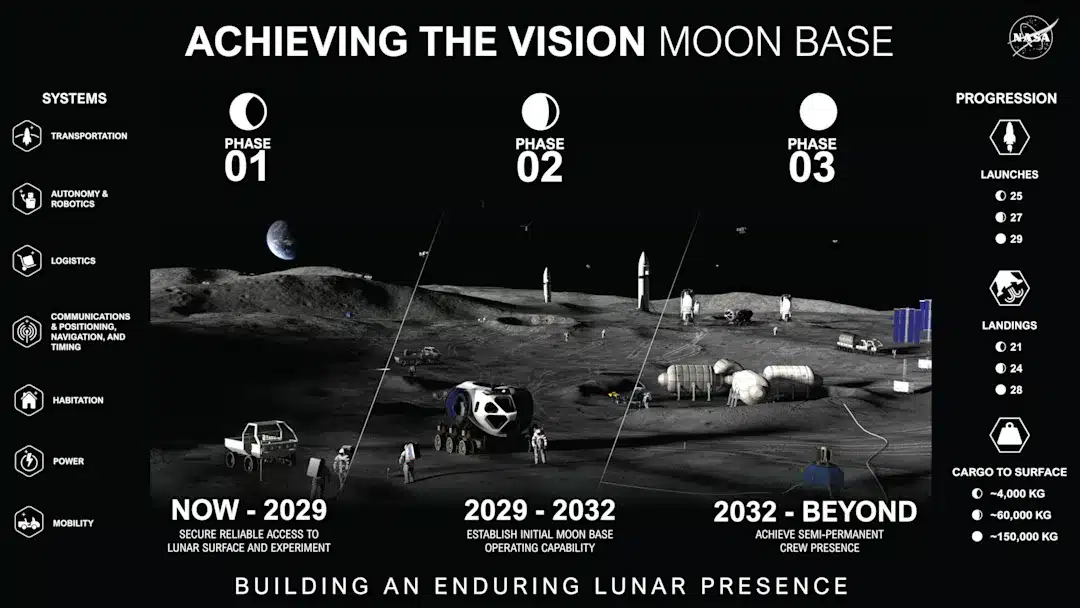
These initial missions represent Phase One of a multi-year roadmap. NASA envisions a three-phase approach: initial robotic groundwork through 2028-2029, followed by crewed landings and infrastructure buildup, ultimately achieving sustained human presence in the early 2030s. The overall effort, with a reported budget approaching $20 billion, involves dozens of launches and international collaborations.
Why the Lunar South Pole? Strategic, Scientific, and Economic Imperatives
The choice of the lunar south pole for the NASA Moon Base is no accident. Shackleton Crater and its surroundings offer several key benefits:
- Water Ice Resources: Permanently shadowed craters are believed to harbor vast deposits of water ice. This can be extracted for drinking water, oxygen production, and—crucially—rocket fuel through electrolysis, enabling in-situ resource utilization (ISRU) that reduces dependency on Earth launches.
- Solar Power Potential: Peaks near the south pole experience near-continuous sunlight, ideal for solar arrays that can provide reliable energy.
- Scientific Riches: The region preserves ancient lunar history in the South Pole-Aitken Basin, offering clues about the Moon’s formation and the early solar system.
- Strategic Location: Proximity to diverse geological features supports a wide range of research while serving as a proving ground for Mars mission technologies.
Experts highlight that a Moon Base will drive innovations in robotics, life support systems, radiation shielding, and closed-loop habitats—technologies with direct applications back on Earth, from medical advancements to sustainable energy solutions.
Challenges and Innovations for Sustained Lunar Living
Establishing a permanent NASA Moon Base is not without hurdles. The lunar environment presents extreme temperatures, high radiation, abrasive regolith dust, and communication delays with Earth. NASA and its partners are developing cutting-edge solutions:
- Modular Habitats: Inflatable or 3D-printed structures using lunar regolith for radiation protection.
- Advanced Rovers and Mobility: FLIP and future LTVs will feature autonomous navigation and robust wheels designed for rough terrain.
- Power and Propulsion: Nuclear systems (like fission surface power) for reliable energy in shadowed areas, alongside high-efficiency solar and fuel cells.
- Plume-Surface Interaction Studies: Data from Moon Base 1 will refine landing techniques to minimize dust interference.
Commercial contributions are accelerating progress. Blue Origin’s Blue Moon series, Astrobotic and Intuitive Machines’ landers, and rovers from Astrolab demonstrate a thriving lunar economy in the making. Partnerships could lead to private sector involvement in mining, tourism, or research outposts.
Broader Implications: Science, Economy, and the Path to Mars
The NASA Moon Base is more than a lunar outpost—it’s a stepping stone. Lessons learned will inform human missions to Mars, including long-duration life support, resource utilization, and crew psychology in isolated environments.
Scientifically, the base will host observatories, geological labs, and astrophysical instruments taking advantage of the Moon’s lack of atmosphere. Economically, it could spur a cislunar economy involving propellant depots, satellite servicing, and rare mineral extraction.
Internationally, Artemis Accords partners—including Canada, Europe, Japan, and others—will contribute, fostering global cooperation in space.
Public Reaction and the Future of Lunar Exploration
The announcement has generated immense enthusiasm. Social media buzzes with “Moon Joy,” as citizens, students, and scientists alike envision humanity’s multi-planetary future. Educational programs, virtual reality tours, and public engagement initiatives are expected to follow, inspiring the next generation of explorers.
As NASA Administrator Isaacman noted, the goal extends beyond exploration: “We will go for the science, for all we stand to gain from an economic and technological perspective, for the innovations that will make life better here on Earth, and to prepare for where we will inevitably go next.”
Conclusion: A New Chapter in Human History
The NASA Moon Base at the lunar south pole represents humanity’s commitment to pushing boundaries. With Moon Base 1, 2, and 3 missions launching this year, followed by crewed Artemis landings, the dream of a permanent lunar settlement is rapidly becoming reality.
This ambitious endeavor, rooted in the success of Artemis 2 and powered by public-private collaboration, promises to redefine our place in the cosmos. As we stand on the cusp of this new era, one thing is clear: the Moon is calling, and humanity is ready to answer—permanently.