Kerala to Keralam: Union Cabinet Approves Historic Name Change Proposal – What It Means for Cultural Identity and 2026 Assembly Elections
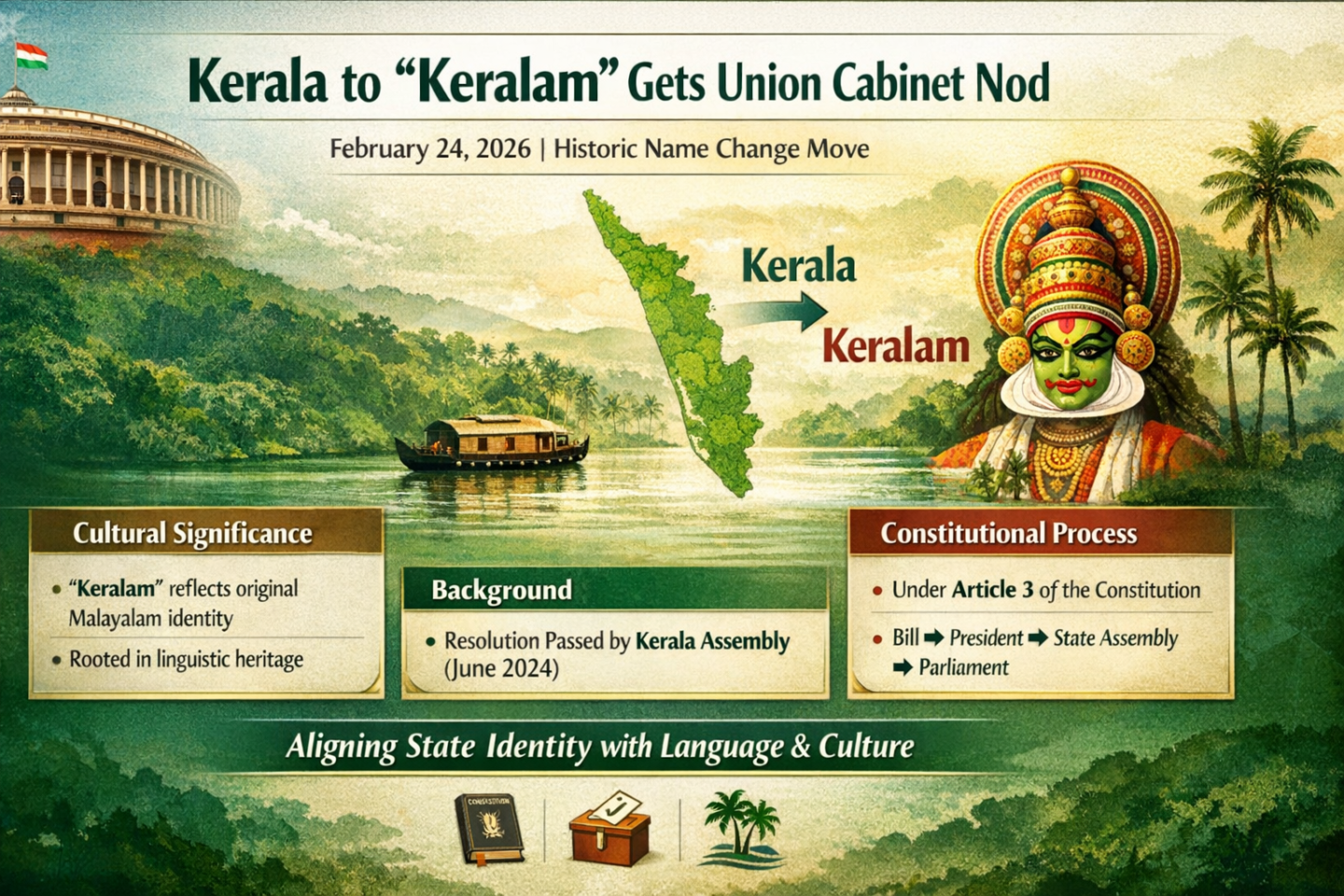
In a landmark development that resonates deeply with Kerala’s linguistic pride and cultural heritage, the Union Cabinet, chaired by Prime Minister Narendra Modi, approved the proposal to officially rename the state from “Kerala” to “Keralam” on February 24, 2026. This decision, announced by Union Minister Ashwini Vaishnaw following the Cabinet meeting, marks a pivotal moment in India’s ongoing efforts to align official nomenclature with regional languages and historical identities.
The move comes at a strategically significant time, just ahead of the highly anticipated Kerala Assembly elections 2026, expected around April-May. With the state’s term ending in May 2026, this Kerala name change to Keralam has already sparked widespread discussions on cultural assertion, political symbolism, and the broader push for de-anglicization in Indian state names.
Background: The Long-Standing Demand for Kerala Rename to Keralam
The journey toward this name change Kerala to Keralam dates back decades but gained fresh momentum in recent years. Kerala, fondly called “God’s Own Country,” was formed on November 1, 1956, as part of the linguistic reorganization of states in independent India. This date is celebrated annually as Kerala Piravi Day, underscoring the state’s foundation on Malayalam linguistic identity.
In Malayalam—the official language of the state—the region has always been referred to as “Keralam.” The term is deeply rooted in etymology, often interpreted as “the land of coconuts” (from “kera” meaning coconut palm), reflecting the state’s abundant coconut groves, coastal geography, and agrarian traditions. Coconut trees dominate Kerala’s landscape, symbolizing prosperity, and feature prominently in its economy, cuisine, and folklore.
However, when the Constitution of India was adopted, the First Schedule listed the state as “Kerala” in its English form. This anglicized version persisted in official documents, maps, and international references, even as “Keralam” remained the native pronunciation and spelling in Malayalam.
The demand to rectify this discrepancy has been a recurring theme in Kerala’s political discourse. Successive governments and cultural organizations argued that retaining “Kerala” undermined the linguistic basis of state formation and showed insufficient respect for Malayalam, one of India’s 22 scheduled languages.
The Kerala Legislative Assembly Resolution: A Unanimous Push
The turning point arrived on June 24, 2024, when the Kerala Legislative Assembly, led by Chief Minister Pinarayi Vijayan of the Left Democratic Front (LDF), unanimously passed a resolution urging the Central Government to amend the First Schedule of the Constitution and rename the state to “Keralam.”
Chief Minister Vijayan, who moved the resolution, emphasized that states reorganized on linguistic lines in 1956 should have names consistent across languages. He highlighted the historical struggle for a united Malayalam-speaking state during the independence movement and post-independence era. The resolution explicitly stated:
“The name of our State is ‘Keralam’ in Malayalam Language. States were formed on the basis of language on the 1st day of November, 1956… But in the First Schedule to the Constitution the name of our State is recorded as ‘Kerala’. This Assembly unanimously appeal to the Central Government to take urgent steps as per Article 3 of the Constitution for modifying the name as ‘Keralam’.”
This was not the first attempt—the Assembly had passed a similar resolution earlier, but technical suggestions from the Ministry of Home Affairs led to a refined version in 2024 for clarity and constitutional compliance. The all-party consensus underscored the issue’s transcendence beyond politics, uniting Left, Congress-led UDF, and BJP factions in support of linguistic pride.
Union Cabinet Approval: A Major Milestone on February 24, 2026
Fast-forward to February 24, 2026: The Union Cabinet’s approval propels the Kerala rename to Keralam into the formal constitutional arena. Union Minister Ashwini Vaishnaw briefed the media post-meeting, confirming that the decision aligns with the state’s aspirations.
The Cabinet’s nod initiates the process under Article 3 of the Indian Constitution, which empowers Parliament to form new states, alter boundaries, or change names—but with safeguards. Specifically, the proviso requires the President to refer any such bill affecting a state’s name to the concerned state legislature for its views.
Thus, President Droupadi Murmu will now refer the Kerala (Alteration of Name) Bill, 2026 to the Kerala Legislative Assembly. The Assembly, having already expressed strong support via its 2024 resolution, is expected to reaffirm its position swiftly.
Once the Assembly’s views are received, the Central Government will seek the President’s recommendation to introduce the bill in Parliament. If both Houses pass it (likely with bipartisan support given the cultural nature), and the President assents, the First Schedule will be amended, officially replacing “Kerala” with “Keralam” in all constitutional references.
This Kerala name change to Keralam will then apply across official documents, passports, currency notes, maps, international treaties, and more. It represents one of the most significant state name alterations since others like Orissa to Odisha (2011) or Bombay to Mumbai (city-level changes).
Cultural and Linguistic Significance of the Kerala Name Change to Keralam
At its core, the Kerala rename to Keralam is about reclaiming identity. Malayalam speakers have long felt the English “Kerala” dilutes the phonetic and semantic richness of “Keralam.” The change honors:
- Linguistic Authenticity: Aligning official name with native usage, similar to how Tamil Nadu is “Tamil Nadu” consistently.
- Historical Legacy: Reinforcing the Akhanda Kerala (United Kerala) movement of the early 20th century.
- Cultural Pride: Boosting symbols like coconut (kera), backwaters, Kathakali, Onam, and literature (from Kumaran Asan to MT Vasudevan Nair).
- Tourism and Global Image: “Keralam” could enhance branding as “God’s Own Country,” appealing to diaspora and international visitors seeking authentic experiences.
Critics, including some like Congress leader Shashi Tharoor, have raised light-hearted questions about derivatives—”Keralite” becoming “Keralamite”?—but supporters argue such adaptations will evolve naturally.
Political Implications Ahead of Kerala Assembly Elections 2026
The timing of the Union Cabinet’s approval is no coincidence. With Kerala Assembly elections 2026 looming (polling likely in April, results in May), the Kerala name change to Keralam carries electoral weight.
For the LDF government under Pinarayi Vijayan, it’s a victory in fulfilling a long-pending promise, reinforcing their pro-regional identity stance. The UDF opposition may credit cross-party support, while BJP could highlight Central cooperation under PM Modi.
The decision may influence voter sentiment in a state known for high literacy, strong political awareness, and emphasis on cultural issues. It adds a layer of pride and symbolism to campaigns, potentially overshadowing routine debates on economy, jobs, or Sabarimala.
What Happens Next? The Road to Official Kerala Rename to Keralam
- Presidential reference of the Bill to Kerala Assembly.
- Assembly debate and opinion submission (likely affirmative).
- Introduction in Lok Sabha/Rajya Sabha.
- Passage and Presidential assent.
- Gazette notification amending the First Schedule.
The process could conclude within months, given consensus.
Broader Context: India’s Renaming Trend
This fits a pattern of decolonizing names—Allahabad to Prayagraj, Mughalsarai to Deen Dayal Upadhyaya Junction, or state-level shifts like Uttaranchal to Uttarakhand. The Kerala name change to Keralam emphasizes federal respect for diversity.
In conclusion, the Union Cabinet’s approval on February 24, 2026, is more than administrative—it’s a celebration of Kerala’s soul. As the state moves toward becoming officially “Keralam,” it reaffirms that true progress honors roots while embracing the future.