The Assam Election 2026 results have delivered a seismic shift in the political landscape of the Northeast, with the ruling National Democratic Alliance (NDA) securing a record-breaking mandate. While the Bharatiya Janata Party (BJP) had predicted a strong performance, the sheer magnitude of the victory—102 seats in the 126-member assembly—has prompted analysts to look beyond the usual factors of governance and incumbency.
The consensus points sharply toward one defining variable: the 2023 delimitation exercise. Acting as a master architect of the 2026 verdict, the redrawing of constituency boundaries has fundamentally altered the electoral arithmetic, effectively diluting traditional vote banks and consolidating indigenous and tribal strongholds .
A Two-Pronged Electoral Map
The results paint a picture of a bipolar state, not just politically, but geographically and ethnically. The NDA, led by the BJP’s 82 seats along with allies Asom Gana Parishad (AGP) and Bodoland People’s Front (BPF) bagging 10 each, has swept the Assamese heartland, the tribal belts, and the urban centres .
Conversely, the Opposition Congress, reduced to 19 seats, has been geographically confined. According to election data, the vast majority of the 24 non-NDA seats (including those won by the AIUDF and Raijor Dal) are located in constituencies largely untouched by the delimitation process or where minority populations remain concentrated . Notably, 22 of these opposition victories were secured by Muslim candidates, highlighting a stark communal consolidation .
“The extent of the delimitation impact is undeniable,” a senior election strategist familiar with the North-East dynamics told this publication. “By breaking up the Muslim-majority clusters and merging them with indigenous areas or reserving them for SC/ST communities, the Election Commission changed the pitch of the game entirely.”
Fragmenting the Minority Stronghold
Historically, the minority vote bank played a decisive role in approximately 35 assembly seats, often acting as the launchpad for the Congress and the AIUDF. However, the 2023 exercise reduced this influence to fewer than 25 seats .
The methodology employed is a classic case of “cracking” in political geography. Constituencies that once had a heavy concentration of Bengali-speaking Muslims were either fragmented or reclassified. For instance:
- Barpeta: Once a Congress stronghold with a significant Muslim population, this seat was reserved for the Scheduled Caste (SC) category. The NDA wrested it decisively from the opposition .
- Goalpara (West): Similar to Barpeta, this seat was reserved for the Scheduled Tribe (ST), neutralizing the Muslim voter base and flipping it to the NDA .
The impact on the AIUDF has been catastrophic. The party, which had won 16 constituencies in 2021, has been virtually wiped out in 2026, managing to secure only two seats . The party’s dependence on fragmented Muslim clusters proved unsustainable when those clusters were merged with Hindu or tribal-majority areas.
The Bodoland Factor and Tribal Reservations
Perhaps the most significant boost for the NDA allies came from the Bodoland Territorial Region (BTR). Delimitation increased the number of seats reserved for STs in this region from 11 to 15 . The BJP strategically aligned with the Bodoland People’s Front (BPF), which was rewarded handsomely.
The BPF won 10 of these tribal-reserved seats, creating a formidable wall for the opposition. The strategy was clear: by increasing the number of constituencies where indigenous communities hold sway, the BJP ensured that its allies could sweep the region without needing to appeal to minority voters . Even the sole Muslim candidate fielded by the BPF in the region lost, indicating that identity politics, sharpened by the new boundaries, trumped traditional party loyalties.
Sarma’s Strategy and the Congress Collapse
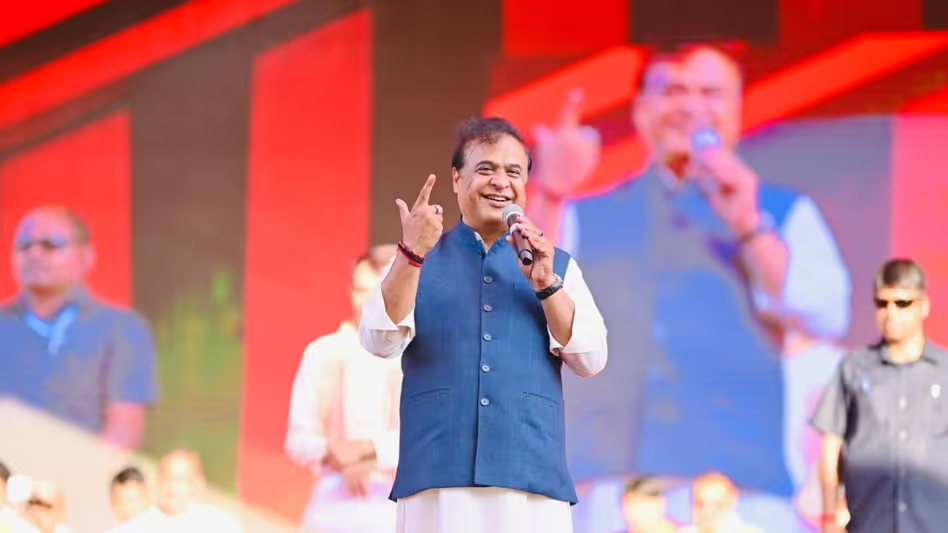
Chief Minister Himanta Biswa Sarma had been laying the groundwork for this moment long before the 2026 campaign began. In the lead-up to the 2023 exercise, Sarma argued against using population as the sole criterion for delimitation, suggesting that communities that adhered to population control policies should not be “punished” .
In the 2026 Assam Election, that philosophy translated into action. The saffron party, maintaining a sharp focus on identity politics, did not field Muslim candidates in most of these redefined seats, preferring to rely on AGP and BPF allies to court the non-Muslim vote .
For the Congress, the results are existential. The party’s campaign, led by state president Gaurav Gogoi, failed to breach the new fortress. While the Congress won 19 seats, its influence is now largely restricted to specific minority belts, a far cry from the statewide presence it once enjoyed. The party’s vote share may have consolidated in specific pockets, but its geographical spread has crumbled.