Delhi Excise Policy Case: Arvind Kejriwal and Manish Sisodia Acquitted – Full Verdict Details, Timeline, and Political Impact 2026
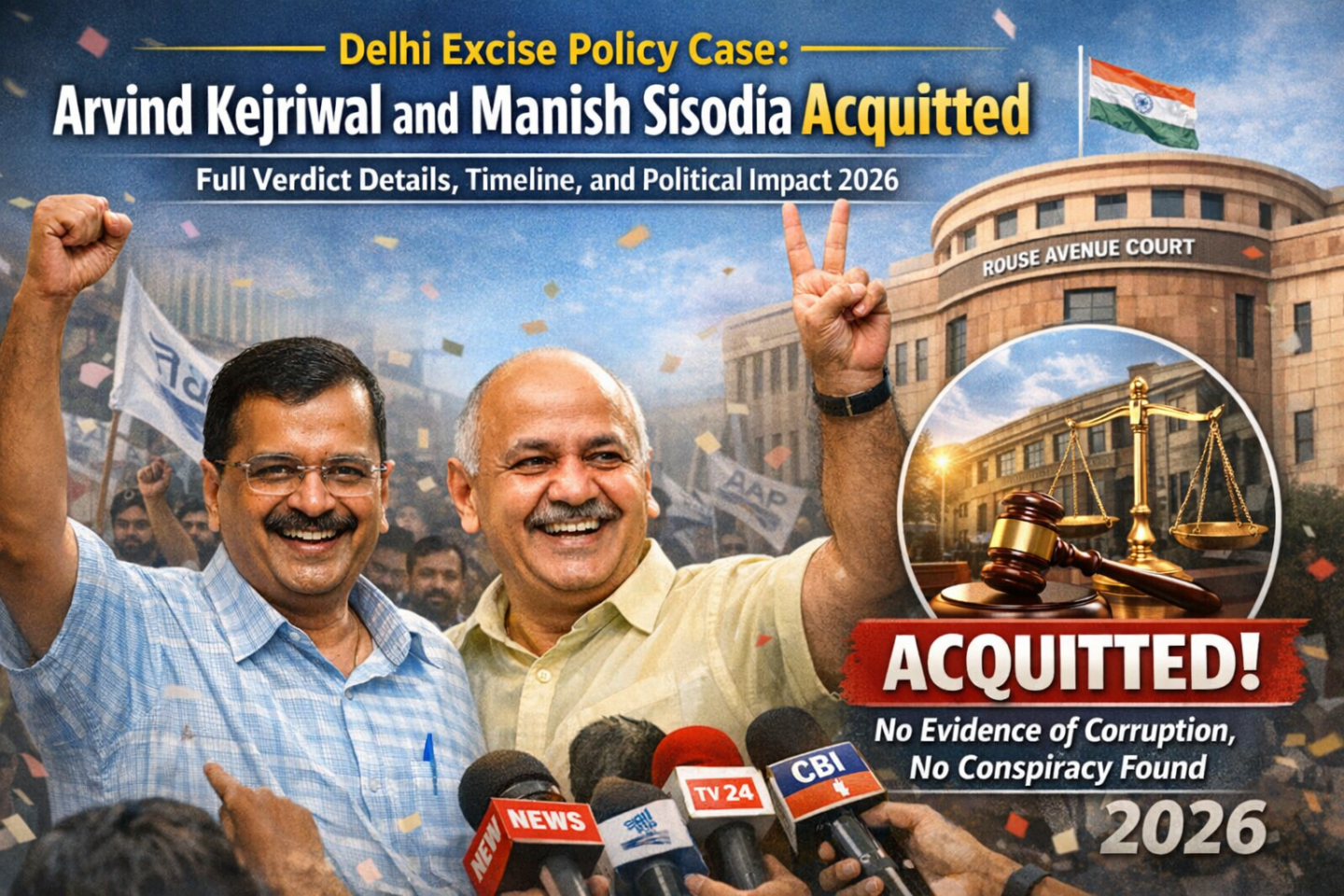
In a landmark judgment that has sent shockwaves through Indian politics, the Rouse Avenue Court in New Delhi on February 27, 2026, acquitted Arvind Kejriwal and Manish Sisodia along with 21 other accused in the high-profile Delhi excise policy case. The court discharged all 23 individuals, ruling that there was no evidence of any overarching criminal conspiracy or corrupt intent in the formulation and implementation of the now-scrapped Delhi Excise Policy 2021-22.
This development marks a complete exoneration for the former Delhi Chief Minister Arvind Kejriwal and former Deputy Chief Minister Manish Sisodia, who had faced prolonged arrests, imprisonment in Tihar Jail, and intense political attacks from opposition parties, particularly the Bharatiya Janata Party (BJP). The verdict comes after years of legal battles, multiple investigations by central agencies like the Central Bureau of Investigation (CBI) and Enforcement Directorate (ED), and significant political fallout, including the Aam Aadmi Party’s (AAP) defeat in the 2025 Delhi Assembly elections.
Court’s Key Observations and Rationale for Acquittal
Special Judge Jitendra Singh of the Rouse Avenue Court delivered the verdict after meticulously reviewing the CBI’s chargesheet and arguments from both sides. The judge emphasized that the prosecution failed to present sufficient material to establish even a prima facie case of corruption or criminal conspiracy.
The court explicitly stated: there was “no overarching conspiracy or criminal intent in the excise policy.” It criticized the investigating agencies for relying on conjecture, inferences, and statements from approvers rather than concrete, substantive evidence. The judge highlighted gaps in the charge sheet, noting that key materials were absent, and serious allegations of corruption cannot stand on narratives alone without backed proof.
In a strong rebuke to the CBI, the court observed that a fair trial requires a fair probe. The decision refused to take cognizance of the CBI chargesheet, effectively closing the chapter on criminal proceedings in this matter for the accused. This ruling underscores the judiciary’s insistence on evidence-based prosecution, especially in high-stakes political cases.
Background of the Delhi Excise Policy Case
The controversy traces back to the Delhi government’s Excise Policy 2021-22, introduced to reform liquor vending in the national capital. The policy aimed to increase revenue, curb illegal liquor trade, and introduce private players through a bidding system for retail zones.
Allegations surfaced that the policy was manipulated to favor certain wholesalers and retailers, leading to windfall profits at the government’s expense. A complaint by the Delhi Lieutenant Governor prompted a CBI probe in 2022, followed by ED involvement under money laundering charges.
Key accusations included:
- Deliberate reduction in license fees to benefit private entities.
- Creation of a cartel among wholesalers who allegedly paid kickbacks.
- Involvement of political leaders in orchestrating the “scam” for personal or party gains.
The case gained massive traction when Manish Sisodia, widely regarded as the architect of the policy, was arrested in February 2023 and sent to Tihar Jail. Arvind Kejriwal faced ED summons in 2023 and eventual arrest in March 2024 in the related money laundering case. Despite securing bail later (with Supreme Court interventions criticizing prolonged detention without trial), Kejriwal was barred from resuming CM duties at times, severely hampering AAP’s governance.
The BJP capitalized on the arrests, labeling Kejriwal as corrupt and running aggressive campaigns portraying him as having fallen into his own anti-corruption trap. Slogans and media narratives questioned how the once self-proclaimed crusader against graft had allegedly become embroiled in a major scam.
Detailed Timeline of the Delhi Excise Policy Case
- 2021-2022: Delhi government implements Excise Policy 2021-22.
- July 2022: LG forwards complaints; CBI registers FIR.
- February 2023: Manish Sisodia arrested by CBI.
- 2023-2024: Multiple raids, arrests of other accused including businessmen and officials.
- March 2024: Arvind Kejriwal arrested by ED.
- 2024: Bail granted to several accused; Supreme Court grants interim bail to Kejriwal in some proceedings.
- 2025: AAP faces electoral setback in Delhi Assembly polls amid ongoing case.
- February 12, 2026: Court reserves judgment after final arguments.
- February 27, 2026: Rouse Avenue Court discharges all 23 accused, including Arvind Kejriwal and Manish Sisodia.
This timeline illustrates how the case dominated Delhi politics for over three years, influencing elections and public perception.
Reactions to the Verdict
Arvind Kejriwal, visibly emotional outside the court, broke down while addressing the media. He declared, “I am not corrupt. The court has said that Kejriwal and Manish Sisodia are kattar imaandaar (staunchly honest).” He described the case as the “biggest political conspiracy” against him and AAP.
Manish Sisodia, who spent over 17 months in jail, expressed relief and gratitude toward supporters.
Sunita Kejriwal, Arvind’s wife, posted on social media: “Truth always prevails,” echoing a sentiment of vindication.
AAP leaders hailed the verdict as proof of judicial independence and a setback to alleged vendetta politics.
The CBI and BJP are yet to issue detailed responses, but opposition voices may question the timing or appeal the decision.
Political Implications for AAP and Delhi Politics
This acquittal provides major relief to AAP, allowing Arvind Kejriwal and Manish Sisodia to rebuild their image as honest leaders. It could boost morale ahead of future elections and counter narratives of corruption that contributed to AAP’s 2025 defeat.
The verdict highlights concerns over the use of central agencies in political cases, with critics calling it “tried on TV, cleared in court.” It may fuel debates on federalism, agency independence, and the weaponization of probes against opposition figures.
For Delhi’s liquor policy controversy, this marks a turning point, potentially reopening discussions on policy reforms without the shadow of criminality.
Why This Verdict Matters for Indian Democracy
The case exemplifies the intersection of politics, governance, and law. While allegations were serious, the court’s insistence on evidence protects against misuse of power. It reinforces that policy decisions, even if flawed, do not automatically constitute crimes without proof of intent.
As India watches, this outcome could influence future high-profile cases involving politicians.
In conclusion, the Rouse Avenue Court’s decision on February 27, 2026, to acquit Arvind Kejriwal and Manish Sisodia closes a turbulent chapter. It reaffirms faith in the judiciary while raising questions about investigative processes. For AAP, it’s a phoenix-like moment; for observers, a reminder that truth often prevails in the end.