Governor Dissolves Bengal Assembly: Mamata Banerjee’s Tenure Ends as RN Ravi Acts on BJP’s Massive Mandate in West Bengal 2026
Governor Dissolves Bengal Assembly: Dramatic End to Mamata Banerjee’s Standoff with Raj Bhavan
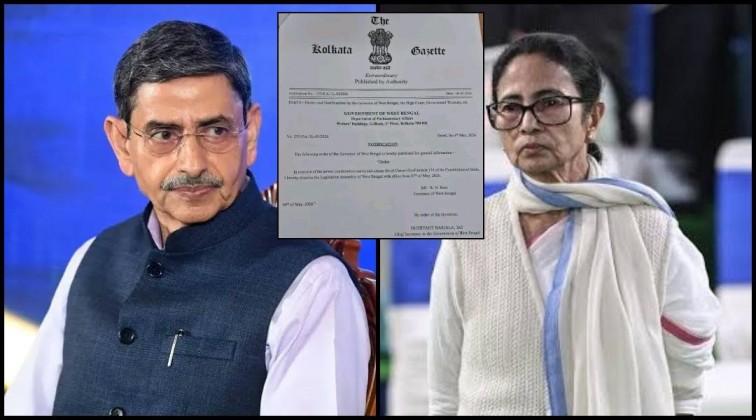
In a significant development that marks the end of an era in West Bengal politics, Governor RN Ravi has dissolved the Bengal Assembly, effective from May 7, 2026. This move comes after a high-stakes political drama triggered by Chief Minister Mamata Banerjee’s unprecedented refusal to resign following her party’s crushing defeat in the recently concluded West Bengal Assembly Elections 2026.
The single-line notification issued by Raj Bhavan stated: “In exercise of the power conferred on me by sub-clause (b) of Clause (2) of Article 174 of the Constitution of India, I hereby dissolve the Legislative Assembly of West Bengal with effect from 07th of May 2026.” This constitutional action has effectively ended Mamata Banerjee’s tenure as Chief Minister, paving the way for the BJP to form its first government in the state.
Background: BJP’s Historic Landslide in West Bengal Assembly Elections 2026
The 2026 West Bengal Assembly elections delivered a seismic shift in the state’s political landscape. The Bharatiya Janata Party (BJP) secured a massive mandate, winning approximately 206-207 seats out of 294, comfortably crossing the majority mark of 148. In contrast, Mamata Banerjee’s Trinamool Congress (TMC) was reduced to around 80 seats, a sharp decline from its previous dominance.
Notably, Mamata Banerjee herself lost her stronghold of Bhabanipur to her former protégé and now BJP leader Suvendu Adhikari. The BJP’s victory was described as historic, ending 15 years of TMC rule and bringing a right-leaning government to power in the state for the first time in decades. High voter turnout of over 92% underscored the electorate’s desire for change amid allegations of governance issues, violence, and economic concerns under the previous regime.
Despite the clear mandate, Mamata Banerjee on Tuesday evening — a day after the results — declared that she had “not lost” and would not tender her resignation. She alleged that the BJP’s win was a result of “loot” and irregularities during the polls. This stance was unprecedented in India’s electoral history and sparked widespread debate, confusion, and political polarization.
The Constitutional Gambit and Governor’s Intervention
Under normal circumstances, as per Article 172 of the Constitution, the assembly would dissolve automatically after its five-year term, with the outgoing Council of Ministers functioning in a caretaker capacity until the new government is sworn in. However, Banerjee’s refusal to resign created an unusual situation, raising questions about the legitimacy of a caretaker government led by a defeated Chief Minister.
Governor RN Ravi exercised his powers under Article 174(2)(b) of the Indian Constitution, which empowers the Governor to dissolve the Legislative Assembly. The Raj Bhavan made the letter public on Thursday evening for general information. This decisive step has been welcomed by BJP leaders, who had been demanding Banerjee’s outright dismissal.
Legal experts note that while a Chief Minister can technically be dismissed by the Governor before election certification is complete, post-certification, the role shifts to caretaker status. In this case, the dissolution brings clarity and prevents any prolonged uncertainty. The BJP is expected to have its cabinet take oath on Saturday, May 10, 2026, possibly at the iconic Brigade Parade Grounds in Kolkata.
Political Reactions and Divide
The development has deepened the political divide in West Bengal. BJP leaders hailed the Governor’s action as a constitutional necessity that respects the people’s mandate. They argued that allowing a defeated government to continue even in caretaker mode would undermine democratic principles.
On the other hand, TMC supporters and some opposition allies rallied behind Mamata Banerjee, criticizing the Governor’s move as partisan. Banerjee’s camp has alleged bias and vowed to fight legally and politically. The refusal to resign was seen by many as a last-ditch effort to buy time or create narrative momentum, but it ultimately ended in an anti-climax with the dissolution.
This episode has also ignited discussions on the role of Governors in Indian federalism, the limits of a Chief Minister’s tenure post-defeat, and the need for smoother power transitions.
Implications for West Bengal’s Future
The dissolution of the Bengal Assembly clears the deck for the new BJP government to focus on governance. Key challenges ahead include addressing post-poll violence allegations, stabilizing the administration, implementing development promises, and navigating the state’s complex socio-political fabric.
For Mamata Banerjee and the TMC, this marks a significant setback. The party will likely regroup in opposition, analyzing the reasons for its defeat — ranging from anti-incumbency, organizational weaknesses, to effective BJP campaigning on issues like infiltration, jobs, and good governance.
Suvendu Adhikari is widely tipped as a strong contender for a key role in the new setup, given his victory over Banerjee and influence in key regions.
What the Constitution Says: A Deeper Look
- Article 174(2)(b): Explicitly grants the Governor the power to dissolve the Legislative Assembly.
- Article 172: Deals with the duration of state legislatures, typically five years, after which dissolution is automatic unless extended in emergencies.
- Caretaker government conventions aim to ensure continuity but prevent major policy decisions.
In this instance, the Governor’s proactive step has resolved a potential constitutional impasse.
Broader Context of West Bengal Politics
West Bengal has long been a hotbed of intense political battles. From the Left Front’s decades-long rule to TMC’s rise in 2011 on the “Ma, Mati, Manush” slogan, and now BJP’s ascent, the state reflects shifting voter aspirations. The 2026 results signal a realignment, with the BJP making deep inroads even in traditional TMC bastions.
Issues like industrial revival, education, healthcare, and law and order are expected to dominate the new government’s agenda. Observers will closely watch how the transition unfolds amid heightened tensions.