Union Budget 2026-27 Highlights: Three Kartavyas Drive Growth, Inclusion, and Textile Sector Boost Under Nirmala Sitharaman
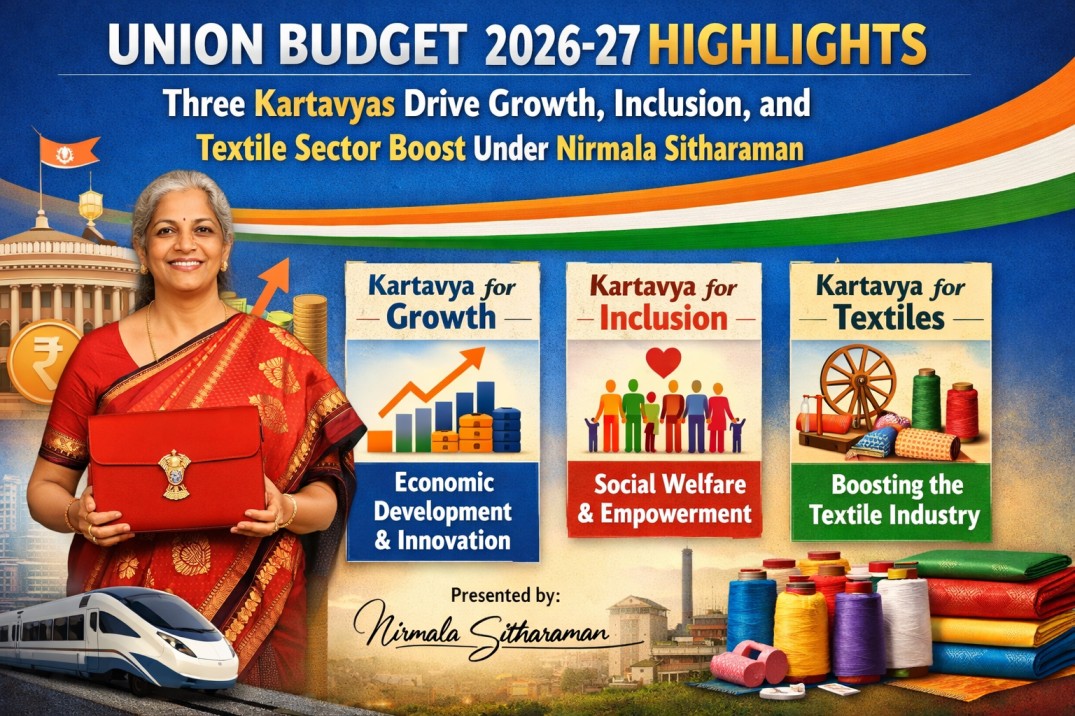
The Union Budget 2026-27, presented by Finance Minister Nirmala Sitharaman on February 1, 2026, marks a historic milestone as her ninth consecutive budget and the first prepared at the newly inaugurated Kartavya Bhawan. Amid persistent global economic uncertainties, geopolitical tensions, and external shocks, the budget outlines a clear, reform-driven roadmap to propel India toward the vision of Viksit Bharat (Developed India) by 2047. Anchored in three core Kartavyas (duties/responsibilities), the budget emphasizes accelerating sustainable economic growth, fulfilling citizens’ aspirations through capacity building, and ensuring inclusive development for every section of society.
Finance Minister Nirmala Sitharaman structured the entire budget around these three Kartavyas, inspired by the government’s sankalp (resolve) to prioritize the poor, underprivileged, and disadvantaged. This Yuva Shakti-driven approach draws from innovative ideas shared in dialogues like the Viksit Bharat Young Leaders Dialogue.
- First Kartavya: Accelerate and Sustain Economic Growth
The primary focus is on enhancing productivity, competitiveness, and resilience against volatile global dynamics. Key interventions include scaling up manufacturing in seven strategic and frontier sectors (such as semiconductors, rare earths, biopharma, and electronics), rejuvenating legacy industrial sectors, creating champion MSMEs, boosting infrastructure, ensuring long-term energy security, and developing city economic regions. The goal is to make India’s economy more robust, self-reliant (Aatmanirbhar), and capable of sustaining high growth rates around 7% despite external challenges. - Second Kartavya: Fulfill Aspirations and Build Capacity
This Kartavya addresses everyday concerns of citizens by prioritizing job creation, income stability, access to essential services, skill development, and human capital investment. It aims to empower youth, workers, and the middle class, turning them into active partners in India’s prosperity journey. Measures include targeted skilling programs, employment generation initiatives, and investments in education and health to build long-term capacity. - Third Kartavya: Ensure Inclusive Development (Sabka Saath, Sabka Vikas)
Aligned with the long-standing vision of inclusive growth, this duty ensures equitable distribution of development benefits to every family, community, region, and economic sector. No one is left behind, with emphasis on balanced progress, social welfare, resource access, amenities, and meaningful participation opportunities. This includes structural reforms for poverty reduction, regional equity, and social justice.
These Kartavyas guide a “Reform Express” of far-reaching structural changes, balancing ambition with inclusion while deepening India’s integration with global markets through trade, multilateral connectivity, and cooperation.
Major Focus: Boost to Indigenous Textile Industry, Weavers, and Artisans
A standout feature of the Union Budget 2026-27 is its comprehensive push for the labor-intensive textile sector, recognizing its role in employment, exports, rural livelihoods, and regional clusters. The government announced an Integrated Programme for the Textile Sector comprising five sub-components to modernize the industry, achieve self-reliance, promote sustainability, and enhance global competitiveness.
- National Fibre Scheme: Targets self-reliance in natural fibres (silk, wool, jute), man-made fibres, and new-age fibres. It boosts silk production to reduce import dependence and strengthens India’s position in global markets.
- Textile Expansion and Employment Scheme: Modernizes traditional clusters with capital support for machinery upgrades, technology adoption, common testing, and certification centers to drive employment and efficiency.
- National Handloom and Handicrafts Programme (NHHP): Integrates and strengthens existing schemes, providing targeted support to weavers and artisans for better production, quality, and market access.
- Tex-Eco Initiative: Promotes sustainable, eco-friendly textiles and apparel to meet global standards for competitiveness and environmental responsibility.
- SAMARTH 2.0: Upgrades the textile skilling ecosystem through industry-academia partnerships, focusing on modern techniques and workforce readiness.
Additional announcements include:
- Establishment of mega textile parks in challenge mode, with emphasis on technical textiles for higher value addition, often in Tier-2/3 cities.
- A five-year cotton productivity mission to improve yields and quality.
- Strengthening Khadi and handloom industries through the Mahatma Gandhi Gram Swaraj Initiative, which enhances global market linkages, branding, skilling, and quality processes.
- Revival of 200 old industrial clusters.
- A top-up of ₹4,000 crore to the Aatmanirbhar Bharat Fund, prioritizing microenterprises in labor-intensive sectors like textiles.
The textile allocation sees a significant jump (nearly 25% in some reports), underscoring its priority for job creation, export growth, and rural empowerment.
Broader Implications and Path to Viksit Bharat
The Union Budget 2026-27 maintains fiscal prudence while delivering a powerful push for manufacturing, infrastructure, MSMEs, agriculture, and emerging technologies. It reflects India’s shift toward resilience, inclusion, and long-term stability. By balancing growth acceleration with people-centric reforms, the budget positions India as a global economic powerhouse amid uncertainties.
Experts view this as a visionary blueprint for the next 25 years, with strong emphasis on youth, manufacturing revival, and equitable progress. The three Kartavyas provide a cohesive direction, ensuring reforms translate into tangible benefits for all citizens.