Group Captain Shubhanshu Shukla Inspires Future Educators at NERIE Shillong: Interactive Session on Space, Science, and Viksit Bharat 2047
The event described occurred recently (around February 2025 or 2026, based on the “Wednesday” reference and current date of February 26, 2026), following Group Captain Shubhanshu Shukla’s historic Axiom-4 mission in 2025.
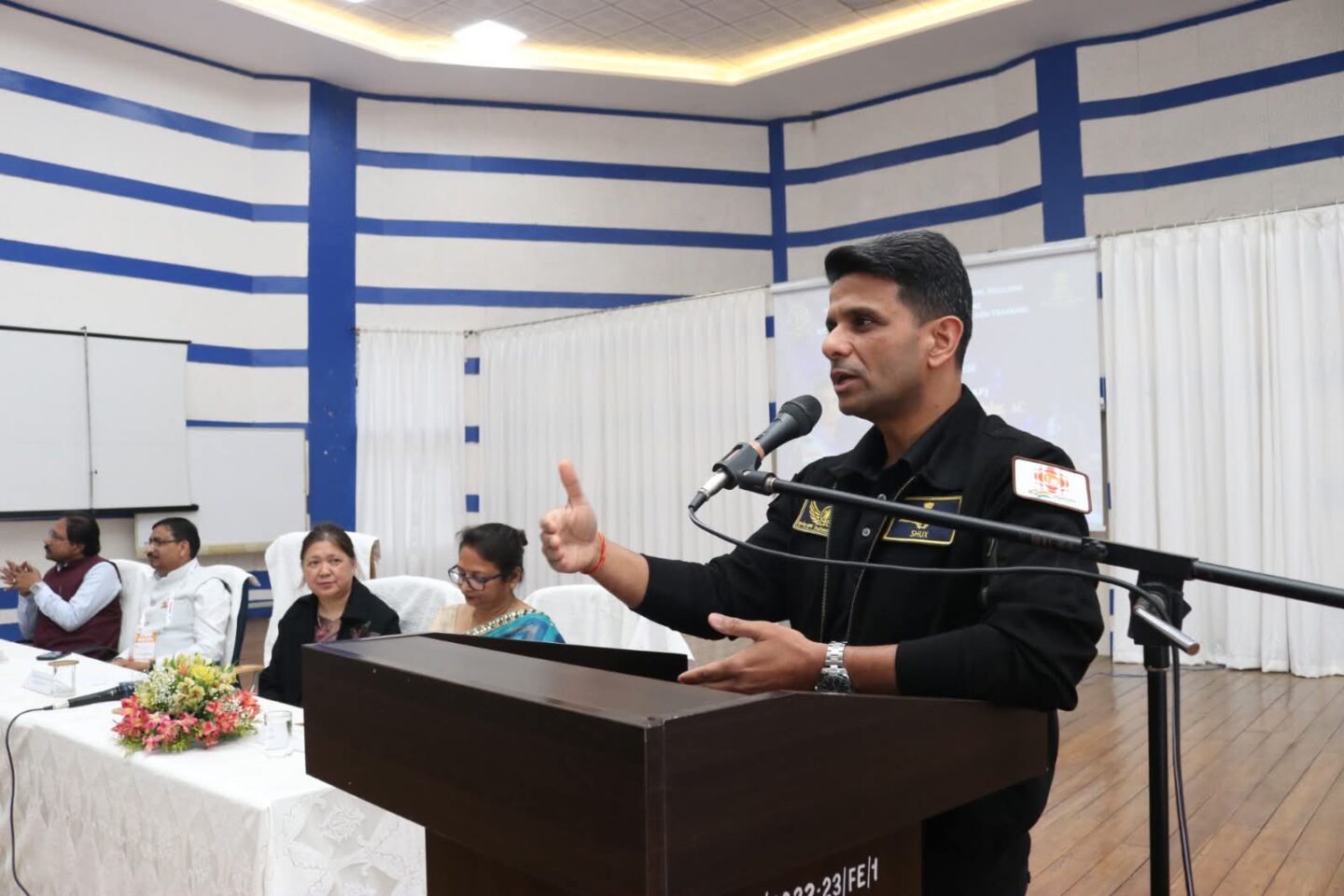
Shillong, Meghalaya – In a landmark event blending space exploration with educational empowerment, the North East Regional Institute of Education (NERIE), Shillong—a constituent unit of the National Council of Educational Research and Training (NCERT)—hosted an engaging interactive session with Group Captain Shubhanshu Shukla on Wednesday. The session aimed to ignite passion among future educators while emphasizing the integration of scientific temper and technological advancements into classroom practices.
Group Captain Shubhanshu Shukla, an esteemed officer of the Indian Air Force (IAF) and a selected Gaganyatri with the Indian Space Research Organisation (ISRO), has etched his name in history as the first Indian to visit the International Space Station (ISS). As the mission pilot for the Axiom-4 (Ax-4) mission—a privately organized spaceflight in collaboration with Axiom Space and SpaceX—he launched on June 25, 2025, and returned safely to Earth on July 15, 2025, after an impactful 18-day orbital stay (with some reports noting around 19-20 days including transit). This achievement made him the second Indian in space after Wing Commander Rakesh Sharma’s 1984 Soyuz mission and the first to step aboard the ISS.
The program, conducted at the Institute Auditorium, drew enthusiastic participation from B.Ed. and M.Ed. trainees, faculty members, administrative staff, and distinguished guests. Among the notables was Dr. S. P. Aggarwal, Director of the North Eastern Space Applications Centre (NESAC), who graced the occasion, underscoring the synergy between space technology and education in India’s northeastern region.
The Historic Journey of Group Captain Shubhanshu Shukla
To fully appreciate the significance of this interaction, it’s essential to revisit Group Captain Shubhanshu Shukla’s extraordinary path. Born on October 10, 1985, in Lucknow, Uttar Pradesh, Shukla is a seasoned test pilot and fighter combat leader in the IAF with extensive experience flying aircraft like the Su-30 MKI. Selected in 2019 as part of ISRO’s first Gaganyaan astronaut cohort (alongside Prasanth Nair, Ajit Krishnan, and Angad Pratap), he underwent rigorous training in Russia and India for India’s indigenous human spaceflight program.
In August 2024, ISRO announced his assignment as mission pilot for Axiom Mission 4, a collaborative effort that provided invaluable hands-on experience ahead of Gaganyaan’s planned crewed launch (targeted post-2025/2026). The Ax-4 crew included veteran NASA astronaut Peggy Whitson as commander, Shukla as pilot, and mission specialists Sławosz Uznański-Wiśniewski (Poland) and Tibor Kapu (Hungary)—marking historic firsts for India, Poland, and Hungary at the ISS.
Launched atop a SpaceX Falcon 9 from Kennedy Space Center’s Launch Complex 39A on June 25, 2025, the Crew Dragon capsule “Grace” docked with the ISS the following day. During his stay, Shukla contributed to over 60 microgravity experiments involving international partners, including ISRO-led studies on muscle regeneration, algal/microbial growth, crop viability, microbial survivability, cognitive performance, and cyanobacteria behavior. These efforts not only advanced scientific knowledge but also bolstered India’s expertise in human spaceflight.
Upon splashdown off San Diego, California, on July 15, 2025, Shukla’s return was celebrated nationwide, with the Indian Cabinet issuing a resolution hailing it as a moment of “pride, glory, and joy.” Prime Minister Narendra Modi and other leaders congratulated him, highlighting how his mission paves the way for Viksit Bharat (Developed India) by 2047.
The NERIE Shillong Interactive Session: A Bridge Between Cosmos and Classroom
The recent session at NERIE Shillong built on this legacy, focusing on the pivotal role of teachers in realizing India’s ambitious vision. Group Captain Shukla delivered a compelling address, stressing that empowered classrooms and forward-thinking educators are the bedrock of a developed nation.
“Every major success story begins in the classroom,” he remarked, urging trainees to stay abreast of scientific and technological progress. He emphasized instilling a scientific temper—curiosity, evidence-based thinking, and innovation—among students, aligning with India’s constitutional mandate and the National Education Policy (NEP) 2020.
Shukla linked personal discipline and big dreams to national goals, drawing from his own journey: from IAF training to astronaut selection, international collaboration, and orbital challenges. He encouraged aspiring teachers to foster resilience, leadership, and a sense of purpose in their pupils, positioning education as a cornerstone of Viksit Bharat 2047—the centenary vision of an economically advanced, self-reliant India.
The interactive Q&A segment proved particularly engaging. Students seized the opportunity to interact directly with the astronaut:
- Nehal Gurung inquired about advancements in space science and their classroom applications.
- Akansha Tiwari asked about leadership qualities essential for high-stakes missions.
- Krishna Dev explored the role of discipline in achieving extraordinary goals.
- Shayanika Sekhar Baishya posed questions on balancing personal aspirations with national service.
Shukla’s responses were thoughtful and motivational, blending technical insights with life lessons. He shared anecdotes from microgravity experiments, the psychological demands of space travel, and the importance of teamwork in multinational crews.
Program Highlights and Dignitaries
The event commenced with a warm welcome address by Dr. Tulika Dey, Associate Professor at NERIE, who also anchored the proceedings seamlessly. Principal Dr. (Mrs.) Flourette G. Dkhar led the felicitation of the guest of honour, presenting mementos symbolizing gratitude and inspiration. Students Tonay Borah and Navajita Bora joined in the felicitation, adding a personal touch from the trainee community.
Dr. Subhas Chandra Roy, Dean of Instructions, and other senior faculty occupied the dais, reflecting the institute’s institutional support. The presence of Dr. S. P. Aggarwal from NESAC highlighted potential collaborations between space applications and teacher training in the Northeast, where satellite-based education and disaster management tools hold immense relevance.
NERIE organizers noted that the program provided holistic exposure to trainees, connecting them with real-life exemplars of leadership and national service. “The interaction successfully motivated young minds and reinforced education’s role in shaping the country’s future,” a statement from the institute read.
Why This Event Matters for Education and Nation-Building
In an era where India aspires to become a global space leader—through Gaganyaan, Chandrayaan missions, and private sector growth—events like this bridge the gap between cutting-edge science and grassroots education. NERIE, dedicated to teacher training in the Northeast, plays a vital role in addressing regional disparities while promoting inclusive development.
Group Captain Shubhanshu Shukla’s visit exemplifies how national heroes can inspire the next generation. By emphasizing scientific temper, he aligns with Dr. APJ Abdul Kalam’s vision of igniting young minds. His message resonates deeply in teacher education: classrooms must evolve into launchpads for innovation, where students learn not just facts but the courage to dream beyond boundaries.
This session also underscores the Northeast’s growing integration into national narratives. Shillong, often called the “Scotland of the East,” hosted a hero whose feats elevate India’s global standing. Such initiatives foster pride and aspiration among regional youth, encouraging them to pursue STEM careers and contribute to Viksit Bharat.
Broader Implications for India’s Space and Education Ecosystem
Group Captain Shubhanshu Shukla’s Axiom-4 experience has direct bearings on Gaganyaan. The mission provided practical insights into living and working in space, crucial for India’s first independent human spaceflight. ISRO’s investment in the Ax-4 seat (reportedly over ₹500 crore) yielded data on microgravity effects, international protocols, and crew health—knowledge transferable to domestic missions.
For educators, the takeaway is clear: integrating space science into curricula can spark curiosity and critical thinking. Topics like orbital mechanics, life support systems, and sustainable technologies offer interdisciplinary opportunities, aligning with NEP’s focus on experiential learning.
As India marches toward 2047, stories like Shukla’s remind us that progress begins with inspired individuals—starting in classrooms nurtured by dedicated teachers.
The NERIE Shillong interactive session with Group Captain Shubhanshu Shukla stands as a beacon of motivation, proving that the journey from Earth to orbit and back can fuel educational transformation. Future educators left the auditorium not just informed but empowered to build a scientifically literate, ambitious India.