Pakistan Launches Operation Ghazab Lil Haq: Over 130 Afghan Taliban Fighters Killed in Retaliatory Strikes Amid Escalating Pakistan Afghanistan Border Clashes
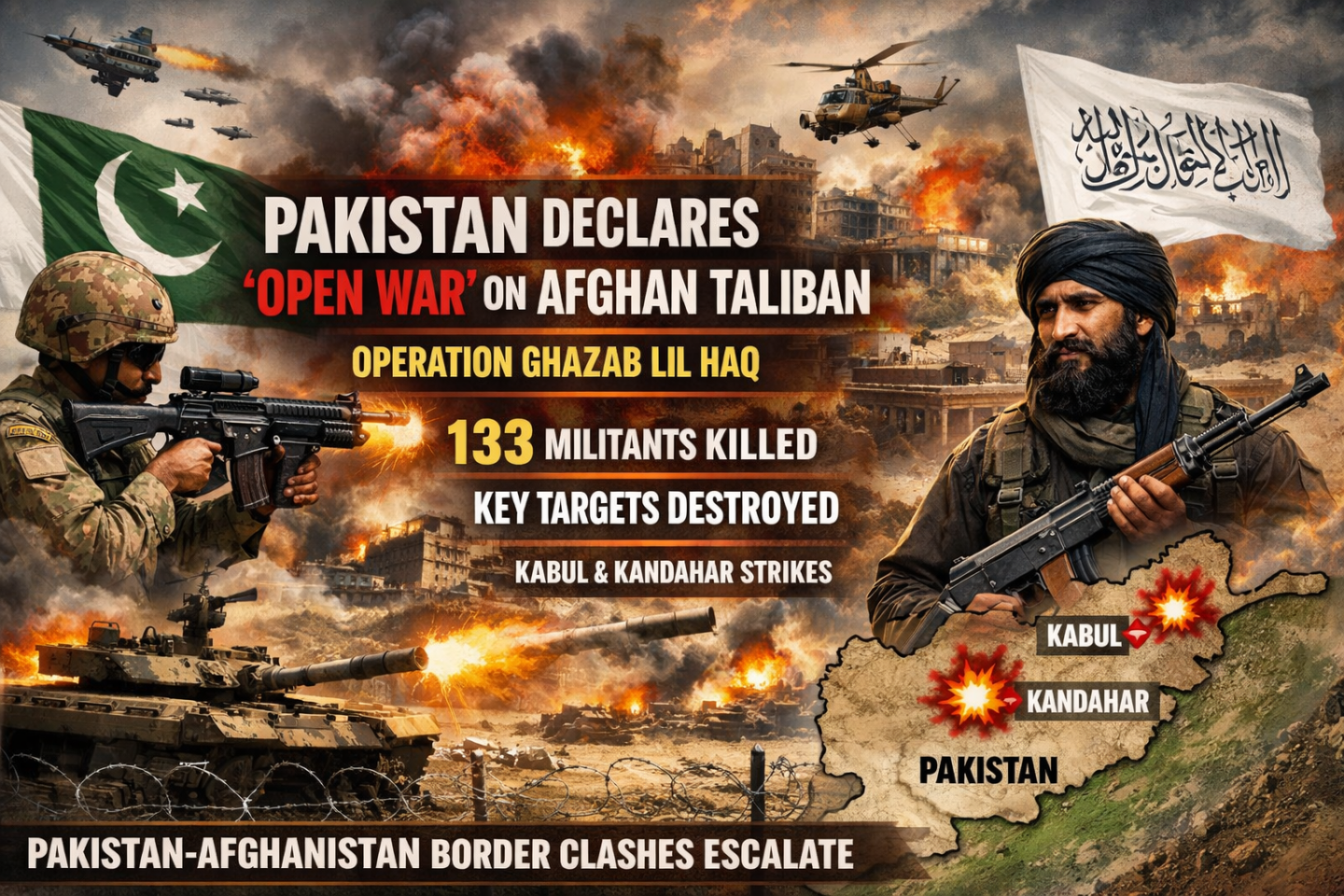
Pakistan-Afghanistan Border Clashes : Pakistan has launched a major retaliatory military operation named Operation Ghazab Lil Haq against the Afghan Taliban, claiming to have killed over 130 Taliban fighters in airstrikes and ground actions targeting key installations in Kabul, Kandahar, and Paktia provinces. This escalation marks a significant intensification in the ongoing Pakistan Afghanistan border clashes, with Pakistani officials declaring it an “open war” and vowing no compromise on national security.
The operation, which translates to “Righteous Fury” or “Wrath of Justice,” began late Thursday night (February 26, 2026) following alleged unprovoked attacks by Afghan Taliban forces on Pakistani border positions along the Durand Line in Khyber Pakhtunkhwa province.
Background of the Escalation in Pakistan-Afghanistan Border Clashes
Tensions between Pakistan and Afghanistan have simmered for years, rooted in disputes over the Durand Line border, accusations of cross-border militant activities, and the presence of groups like the Tehreek-e-Taliban Pakistan (TTP). Pakistan has repeatedly accused the Afghan Taliban government of harboring TTP militants who launch attacks inside Pakistan. The Taliban denies these claims and has accused Pakistan of violating Afghan sovereignty through airstrikes on its territory.
Recent months saw a fragile Qatar-mediated ceasefire, but incidents resumed in early 2026. Pakistani airstrikes earlier in February targeted alleged militant hideouts in Afghan provinces like Nangarhar, Paktika, and Khost, killing several people according to Afghan reports. In response, the Taliban launched what they described as retaliatory operations, leading to the latest flare-up.
On Thursday, Afghan forces reportedly opened fire on multiple Pakistani border posts in sectors including Chitral, Khyber, Mohmand, Kurram, and Bajaur. Pakistan described these as unprovoked aggressions, prompting the launch of Operation Ghazab Lil Haq as a decisive counter-response.
Details of Operation Ghazab Lil Haq
Pakistan’s armed forces, including the Pakistan Air Force (PAF), conducted precision airstrikes on Taliban military infrastructure deep inside Afghanistan. Key targets included:
- Kabul: Two brigade headquarters destroyed.
- Kandahar: One corps headquarters and one brigade headquarters razed, along with ammunition depots.
- Paktia: Additional military installations hit.
According to Pakistan’s Information Minister Attaullah Tarar, the operation resulted in:
- At least 133 Afghan Taliban militants killed.
- More than 200 injured.
- 27 Taliban posts destroyed.
- 9 posts captured.
Further destruction included:
- Two corps headquarters.
- Three brigade headquarters.
- Two ammunition depots.
- One logistics base.
- Three battalion headquarters.
- Two sector headquarters.
- Over 80 tanks, artillery guns, and vehicles.
Defence Minister Khawaja Asif confirmed the ongoing nature of the operation, stating that Pakistani forces are delivering a “strong and decisive” response to Taliban aggression.
Strong Statements from Pakistani Leadership
Pakistan’s top officials have issued stern warnings, emphasizing unity and resolve.
- Interior Minister Mohsin Naqvi condemned the Taliban for targeting civilians under the cover of darkness, calling their actions “despicable” and “cowardly.” He said: “The nation stands shoulder to shoulder with the armed forces. The Afghan Taliban have made a horrific mistake… They will face severe consequences. We will not compromise on our security.”
- President Asif Ali Zardari declared: “Our armed forces’ response has been extensive and decisive. Those who mistake our desire for peace for weakness will face a strong retaliation.” He reiterated Pakistan’s unwavering commitment to peace and territorial integrity.
- Prime Minister Shehbaz Sharif affirmed that Pakistan’s people and military are fully prepared to defend sovereignty: “No aggression will go unanswered… Every provocation will receive an appropriate response.”
- Defence Minister Khawaja Asif accused the Taliban of transforming Afghanistan into a “colony of India” and a hub for exporting terrorism by gathering militants from around the world. He claimed the Taliban have become an Indian proxy and stated: “Our patience has now run out. It is now an open war.” He highlighted Pakistan’s past hospitality toward Afghan refugees but noted that repeated aggressions have exhausted tolerance.
These statements reflect a unified front in Pakistan, with leaders portraying the operation as necessary self-defense amid escalating Pakistan Afghanistan border clashes.
Afghan Taliban’s Response and Conflicting Claims
The Taliban government confirmed Pakistani airstrikes on Kabul, Kandahar, and Paktia but denied significant casualties. Spokesman Zabihullah Mujahid described the strikes as “cowardly” and claimed no losses, stating operations were limited and ineffective.
Afghan sources earlier claimed successes in their Thursday offensive, including killing dozens of Pakistani soldiers and capturing outposts. These claims contrast sharply with Pakistan’s assertions of no major losses on their side and heavy Taliban casualties.
The conflicting narratives highlight the fog of war along the volatile border, where independent verification remains challenging.
Broader Implications and Regional Context
This escalation threatens regional stability in South Asia. The Durand Line dispute dates back to colonial times, and unresolved issues fuel mistrust. Pakistan’s accusations link Taliban actions to external influences, including alleged Indian involvement—a charge Kabul rejects.
The operation raises concerns about humanitarian impacts, potential refugee flows, and risks of wider conflict. International actors, including the United States (post-NATO withdrawal), China, and Qatar (as a mediator), may push for de-escalation.
Pakistan maintains it seeks normal relations but will not tolerate threats to its security. Asif noted post-NATO expectations of Taliban focus on Afghan development were dashed by their alleged support for terrorism.
Conclusion: An Uncertain Future Amid Open War Declarations
Operation Ghazab Lil Haq represents Pakistan’s most assertive response yet to perceived threats from across the border. With claims of heavy Taliban losses and destruction of key infrastructure, Islamabad aims to deter further aggression.
As clashes continue, the international community watches closely. Will this lead to a full-scale conflict, or can diplomacy prevail? For now, Pakistan Afghanistan border clashes have entered a dangerous new phase, with both sides dug in and rhetoric at fever pitch.
The coming days will reveal whether Operation Ghazab Lil Haq achieves its objectives or spirals into prolonged hostilities..