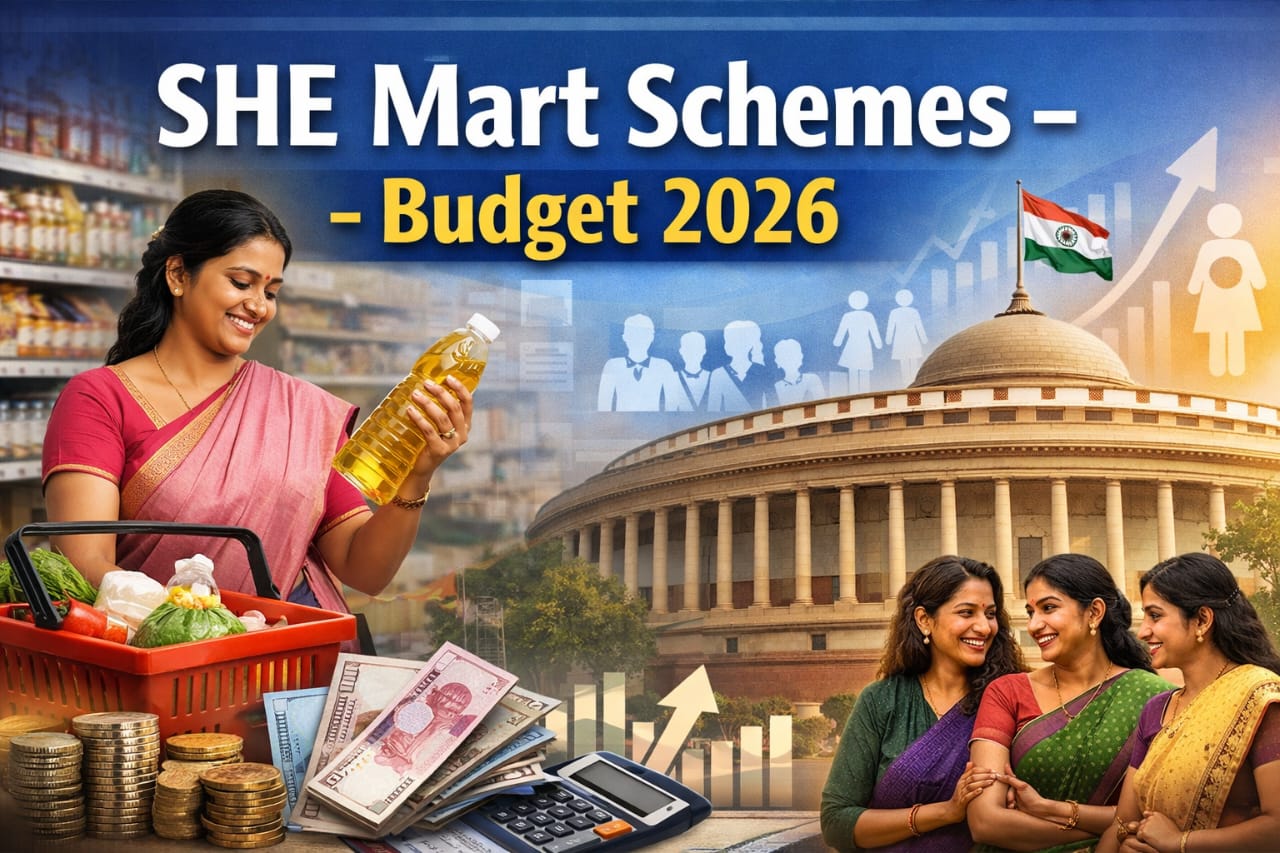
India’s development story is entering a decisive new phase—one where women are no longer positioned merely as beneficiaries of welfare schemes, but as owners, decision-makers, and market leaders. This transition took institutional shape in the Union Budget 2026–27 with the announcement of SHE Marts for Women Entrepreneurs, a nationwide network of community-owned retail outlets designed to give women-led enterprises direct access to markets, capital, and branding power.
Announced by Union Finance Minister Nirmala Sitharaman, the SHE Marts Schemes represent a strategic evolution of the highly successful Lakhpati Didi Yojana, shifting the focus from income generation to enterprise ownership and scale. At its core, the initiative aims to dismantle the long-standing barriers that prevent rural women from moving beyond subsistence entrepreneurship.
This is not just another scheme—it is a structural correction to India’s rural economy.
Table of Contents:
From Livelihood to Leadership: The Vision Behind SHE Marts Schemes
For over a decade, India’s Self-Help Group (SHG) movement has empowered women through access to microcredit, skill development, and financial inclusion. Programmes like the Lakhpati Didi Yojana succeeded in enabling more than two crore women to cross an annual income of ₹1 lakh.
Yet, a hard truth persisted.
Women could produce, but they could not always sell profitably or scale sustainably.
The SHE Marts Schemes were conceived to address this exact gap—market access.
“Building on the success of the Lakhpati Didi programme, we will help women take the next step—from credit-linked livelihoods to ownership of enterprises,” Finance Minister Sitharaman stated during her Budget speech.
With this announcement, the government formally acknowledged that ownership of retail, branding, and distribution is the missing link in women-led rural entrepreneurship.
Three Kartavyas: The Guiding Framework of Union Budget 2026-27
What Are SHE Marts for Women Entrepreneurs?
A New Retail Model Rooted in Community Ownership
SHE Marts for Women Entrepreneurs are permanent, professionally managed, community-owned retail outlets operated by Cluster-Level Federations (CLFs) of women SHGs.
Unlike temporary haats, exhibitions, or seasonal melas, SHE Marts are designed as institutional retail spaces with long-term commercial viability.
Key Characteristics of SHE Marts Schemes
| Feature | Description |
|---|---|
| Ownership | Community-owned through SHG federations |
| Management | Operated by Cluster-Level Federations (CLFs) |
| Product Range | Handicrafts, handlooms, food products, organic produce, FMCG items |
| Market Access | Direct-to-consumer retail, eliminating middlemen |
| Branding | Unified national identity for women-led products |
| Integration | Physical stores + future e-commerce platform |
The SHE Marts Schemes aim to transform women from producers at the margins into retail entrepreneurs at the centre of value chains.
Why Market Access Was the Missing Piece
Despite skill training and credit availability, many SHG women faced structural barriers:
- Dependence on intermediaries
- Low price realization
- Limited bargaining power
- Inconsistent demand
- No brand recognition
As a result, even high-quality products failed to generate sustained income growth.
SHE Marts for Women Entrepreneurs directly solve this by giving women control over pricing, inventory, and profits—a shift that fundamentally alters power dynamics in rural markets.
Lakhpati Didi vs SHE Marts Schemes: A Structural Comparison
| Dimension | Lakhpati Didi Yojana | SHE Marts Schemes |
|---|---|---|
| Objective | Annual income of ₹1 lakh | Enterprise ownership & scalability |
| Focus | Livelihood creation | Market leadership |
| Economic Role | Producer | Entrepreneur & retailer |
| Infrastructure | Skills + credit | Retail outlets + branding |
| Market Access | Indirect | Direct-to-consumer |
| Outcome | Income security | Business growth & wealth creation |
While Lakhpati Didi laid the foundation, SHE Marts for Women Entrepreneurs are designed to build enterprises on top of it.
How the SHE Marts Ecosystem Will Function
Three-Tier Governance Structure
The strength of the SHE Marts Schemes lies in their decentralized but accountable structure.
1. SHG Level
- Women produce goods
- Maintain quality standards
- Act as shareholders in the ecosystem
2. Cluster-Level Federation (CLF)
- Operates SHE Marts
- Manages inventory, pricing, logistics, and profits
- Ensures democratic decision-making
3. Government & Partner Institutions
- Provide policy support
- Offer financing instruments
- Enable capacity building and technology adoption
This model ensures that value and control remain with women, not external contractors.
Financing the Future: Innovative Capital for SHE Marts
A standout feature of the SHE Marts Schemes is their departure from traditional microcredit-only models.
Proposed Financial Instruments
- Venture Capital Funds for SHGs
- Credit Guarantee Mechanisms
- Revolving Working Capital Funds
- Digital Accounting & POS Grants
- Inventory Financing for CLFs
This financial architecture treats women-led enterprises not as risky borrowers, but as investment-worthy businesses.
Beyond Economics: Social and Political Significance
Rural Economic Revitalisation
SHE Marts for Women Entrepreneurs are expected to:
- Increase local employment
- Encourage quality standardisation
- Boost district-level branding
- Strengthen rural supply chains
Each SHE Mart can become a local growth hub, catalysing ancillary jobs in logistics, packaging, and marketing.
Women as a Decisive Electoral Force
The announcement also carries political weight. Women voters have influenced outcomes in states like Bihar, Maharashtra, and Madhya Pradesh. By transitioning from welfare to ownership, the government taps into aspirational politics, not dependency politics.
Complementary Initiatives: Creating a Pipeline of Women Leaders
The Budget 2026 announcement of girls’ hostels in every district complements the SHE Marts Schemes by strengthening access to education, particularly in STEM fields.
This creates a virtuous cycle:
- Educated girls
- Skilled women
- Enterprise owners
- Community leaders
FAQs: Understanding SHE Marts for Women Entrepreneurs
Q1. Where will SHE Marts be located?
SHE Marts Schemes will be rolled out across all districts, prioritising high-footfall zones, tourist centres, and rural economic clusters.
Q2. Who decides which products are sold?
Cluster-Level Federations select products based on quality, uniqueness, and market demand.
Q3. Will urban consumers have access?
Yes. A national e-commerce integration is expected to complement physical SHE Marts.
Q4. When will implementation begin?
Phased rollout is expected after detailed operational guidelines from the Ministry of Rural Development.
Q5. How do SHE Marts align with ‘Vocal for Local’?
SHE Marts Schemes provide branding, retail infrastructure, and scale—allowing local products to compete with national brands.
Opportunities and Challenges Ahead
Opportunities
- Shift from aid to agency
- Creation of a national women-owned retail ecosystem
- Disruption of exploitative supply chains
Challenges
- Ensuring commercial sustainability
- Maintaining quality consistency
- Digital adoption across rural regions
- Preventing elite capture within federations
The long-term success of SHE Marts for Women Entrepreneurs will depend on execution, not intent.
A Defining Moment for Women-Led Development
The launch of SHE Marts Schemes marks a historic shift in India’s development paradigm. For the first time, policy explicitly recognises that true empowerment lies in ownership—of capital, markets, and brands.
As Finance Minister Nirmala Sitharaman charts this vision in her ninth budget, SHE Marts stand as a litmus test of India’s commitment to women-led, community-driven capitalism.
If implemented with integrity and ambition, SHE Marts for Women Entrepreneurs could redefine rural enterprise—not as survival, but as leadership.