Bangladesh Parliamentary Election 2026: A Historic Vote After 2024 Uprising Tests Democracy and Minority Rights
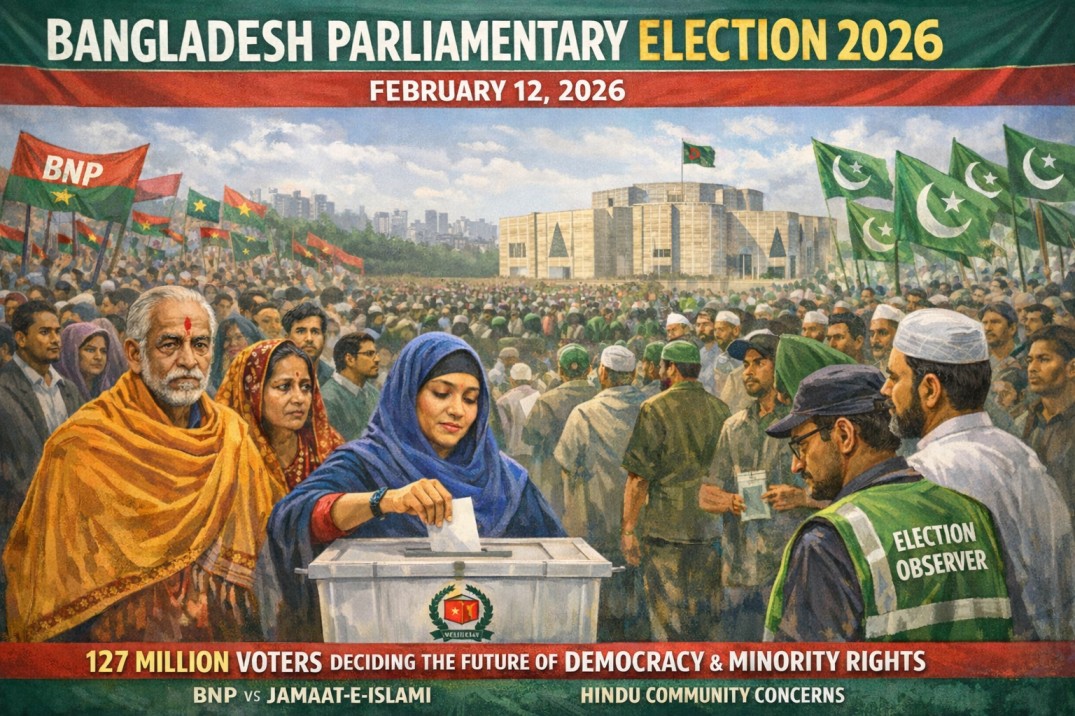
Bangladesh is witnessing one of the most consequential moments in its modern history as millions head to the polls today, February 12, 2026, in the 13th Parliamentary Election—the first general election since the dramatic student-led uprising of 2024 that ended Sheikh Hasina’s 15-year authoritarian rule.
This Bangladesh Election 2026 is not merely about choosing a new government; it represents a critical test for the restoration of democratic values, institutional neutrality, rule of law, and the protection of minority rights in a nation still healing from political violence and deep divisions.
Background: The 2024 Uprising and Path to Elections
In July-August 2024, widespread student protests against job quota reforms escalated into a full-scale mass uprising against Sheikh Hasina’s government. The movement, marked by significant youth sacrifices and widespread demonstrations, forced Hasina to flee to India in August 2024, ending the Awami League’s long dominance that many critics described as increasingly autocratic with disputed elections and suppression of opposition.
Following the uprising, Nobel Peace Prize laureate Dr. Muhammad Yunus was appointed Chief Adviser of the interim government on August 8, 2024. The Yunus-led administration promised comprehensive reforms in key areas—including the constitution, judiciary, electoral system, and police—to create conditions for credible elections.
After months of negotiations involving political parties, student leaders, civil society, and the military, the July Charter emerged as a landmark agreement outlining essential reforms. The interim government committed to holding free, fair, transparent, and peaceful polls, leading to the announcement in December 2025 that the Bangladesh Parliamentary Election 2026 would take place on February 12, alongside a national referendum on implementing the July Charter’s reforms.
Key Features of the 2026 Election
Over 127 million eligible voters (approximately 127.7 million registered, including 64.8 million men, 62.9 million women, and a small number of third-gender voters) are participating across more than 42,000 polling stations. Voting runs from 7:30 AM to 4:30 PM local time, with immediate counting afterward and results expected by February 13.
A total of 1,981 candidates are contesting 300 directly elected seats in the Jatiya Sangsad (national parliament). Additionally, 50 seats remain reserved for women, to be allocated based on party performance.
One groundbreaking change is the introduction of postal voting for Bangladeshi citizens living abroad—the first time expatriates can participate in this manner. Around 767,000 overseas voters and over 584,000 in-country postal voters are eligible, aiming to include Bangladesh’s vast diaspora in the democratic process.
To bolster credibility, nearly 500 international observers from the European Union, Commonwealth, and other bodies are monitoring the process. The interim administration has repeatedly assured that the election will be impartial, festive, and participatory—contrasting sharply with the controversial 2014, 2018, and 2024 polls under Hasina.
Simultaneously, voters will cast a second ballot in a historic national referendum on the July Charter. This includes proposals to fix the prime minister’s term, limit executive powers, strengthen parliamentary oversight, reform the election system, and enhance institutional independence—potentially reshaping Bangladesh’s governance framework.
Major Political Contenders
The political landscape has shifted dramatically since 2024. The Awami League has been banned from participating, and Sheikh Hasina remains in exile in India. A special tribunal under the interim government sentenced her to death in absentia on charges related to crimes against humanity during the 2024 crackdown. Hasina has dismissed the proceedings as a “kangaroo court” and condemned her party’s exclusion.
The main contest is between two major forces:
- Bangladesh Nationalist Party (BNP) — Led by Tarique Rahman (son of former Prime Minister Khaleda Zia), who returned from 17 years of self-exile in December 2025. The BNP has positioned itself as the frontrunner, promising to rebuild democratic institutions, restore the rule of law, revive the economy, and ensure accountability for past abuses.
- Jamaat-e-Islami-led 11-party Alliance — This coalition challenges the BNP and includes the National Citizen Party (NCP), formed by student leaders from the 2024 uprising. Jamaat-e-Islami, previously banned under Hasina but revived post-uprising, brings a religiously conservative platform.
The absence of the Awami League has created a bipolar contest, but the influence of youth-led groups and new parties adds unpredictability.
Concerns Over Minority Rights and Security
A significant shadow over the Bangladesh Parliamentary Election 2026 is the growing anxiety among religious minorities, particularly the Hindu community, which constitutes about 8% of the population (with Muslims over 90%).
Reports of increased violence, insecurity, and targeted attacks on minorities have surfaced since the 2024 uprising. The rising visibility of hardline Islamist groups, especially within the Jamaat-e-Islami alliance, has fueled fears that a shift in power could worsen protections for Hindus and other minorities.
Analysts warn that the election’s outcome could either reinforce inclusive democracy or deepen communal tensions. The interim government and observers emphasize that maintaining peace and minority safety is essential for the vote’s legitimacy.
What This Election Means for Bangladesh’s Future
After decades dominated by the rivalry between the Awami League and BNP families, and periods of military rule and flawed elections since independence in 1971, this vote is a make-or-break moment.
Will Bangladesh achieve genuine democratic transformation—strong institutions, accountable governance, and safeguards for all citizens? Or will it see only a superficial rearrangement of power?
The results will shape political stability, economic recovery, minority protections, and Bangladesh’s international standing. A credible process could mark a new chapter; any irregularities or post-poll violence could trigger fresh instability.
As polling progresses under heavy security, the world watches closely. The Bangladesh Parliamentary Election 2026 is more than an election—it’s a referendum on the aspirations of a generation that fought for change in 2024.
Stay tuned for live updates, results analysis, and expert commentary on this historic day for Bangladesh democracy and minority rights.