Shocking Bihuna and Husari Blunder Sparks Massive 2-Word Outrage
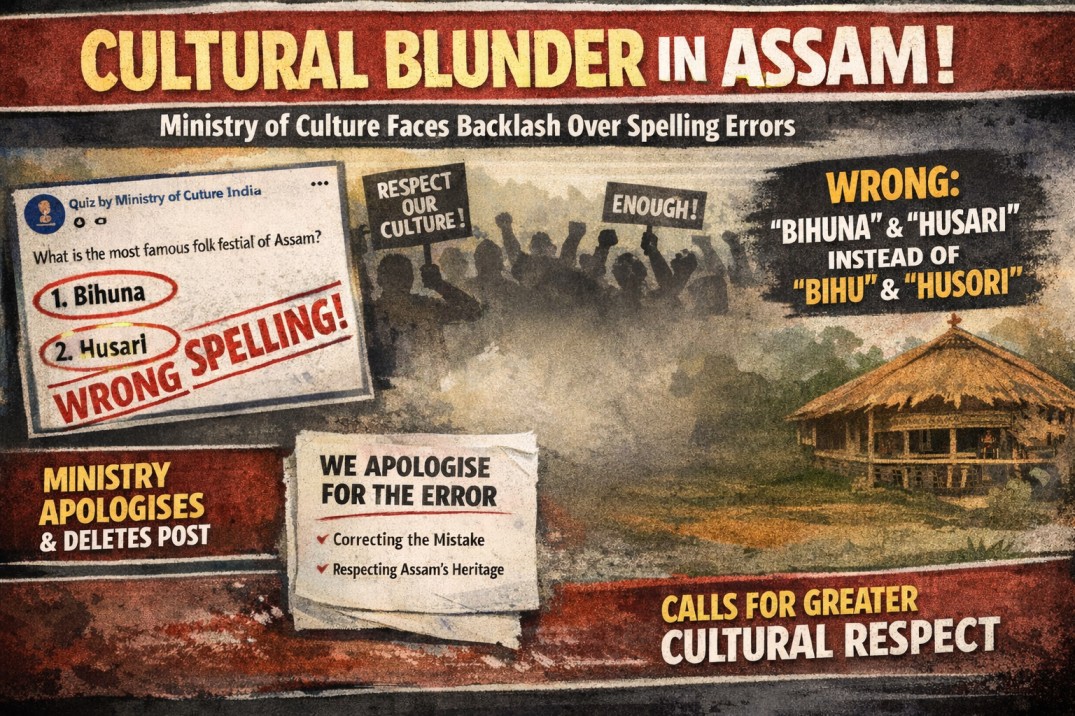
New Delhi/Guwahati, February 24, 2026 — In a surprising turn of events that has ignited widespread anger across Assam and drawn attention nationwide, the Union Ministry of Culture has found itself at the center of a major controversy following a seemingly innocuous social media quiz post. The post, shared on the Ministry’s official Facebook page, incorrectly referred to two of Assam’s most cherished cultural traditions— Bihu and Husori —as “Bihuna’ and ‘Husari’ respectively. What was intended as an educational engagement quickly escalated into a heated debate about cultural accuracy, regional sensitivity, and the responsibility of central government bodies in representing India’s diverse heritage.
The incident, which unfolded on February 22-23, 2026, has highlighted ongoing concerns among Northeastern communities regarding how their unique identities are portrayed—or often misrepresented—at the national level. Netizens, cultural figures, and political voices in Assam have described the error not as a mere typo but as a symbol of deeper ignorance or neglect toward the state’s rich traditions.
The Controversial Quiz Post: What Went Wrong?
The now-deleted Facebook post posed a simple quiz question: ‘Bihuna’ and ‘Husari’ are traditional folk dance forms of which state?” Accompanying the query was a hint: the state is renowned for producing some of the world’s finest teas—a clear nod to Assam, India’s premier tea-growing region. The post included an image of a young woman in traditional Assamese attire, performing what appeared to be a Bihu dance step, and multiple-choice options including Rajasthan, Telangana, Uttarakhand, and Assam (with Assam marked as correct).
Despite getting the state right, the spellings triggered immediate outrage. In Assamese culture:
- Husori (sometimes spelled Huchori) is a vibrant group singing and performance tradition during Bohag Bihu (the Assamese New Year in April). Troupes of singers and dancers visit homes door-to-door, performing rhythmic songs and dances while blessing families with prosperity and joy.
- Bihu refers to both the festival cycle and its signature dance (often called Bihu Naas or Bihu dance). Celebrated in three forms—Rongali Bihu (spring harvest), Kongali/Kati Bihu (autumn, lean period), and Bhogali/Magh Bihu (winter harvest)—Bihu is the heartbeat of Assamese identity, blending music, dance, and community spirit.
The erroneous “Husari” and especially “Bihuna” (a term with no basis in Assamese lexicon) struck a raw nerve. Social media erupted with comments like “What is Bihuna?” and accusations of cultural erasure. Many users argued that such mistakes from a national ministry entrusted with preserving India’s heritage were unacceptable.
Immediate Backlash from Netizens and Cultural Icons
Within hours, the post went viral in Assam and beyond. Thousands of comments flooded the Ministry’s page, demanding corrections and accountability. Prominent voices amplified the criticism:
- Noted filmmaker, journalist, and cultural commentator Utpal Borpujari was among the first to publicly condemn the lapse. He emphasized that government social media teams must rigorously fact-check content before publication. “Such small errors create unnecessary controversy and spread misinformation,” Borpujari stated. He further noted that while the apology was a step forward, it should have explicitly used the correct term “Bihu Naas” (where “Naas” means dance in Assamese), to fully address the issue.
- Political reactions were swift. The Assam Pradesh Congress Committee labeled the misspelling a “deeply disturbing insult to Assam’s identity,” accusing the Ministry of shocking negligence toward Northeastern heritage. Posts on X (formerly Twitter) highlighted perceived double standards, contrasting the outrage with past incidents where regional symbols were fiercely defended.
- Ordinary Assamese users expressed personal hurt, noting that Bihu and Husori are not abstract concepts but living embodiments of joy, resilience, and community. One viral comment read: “For us, these aren’t random words—they are identity, heritage, emotion.”
The backlash extended to broader discussions on how central institutions often overlook or simplify Northeastern cultures, reducing them to stereotypes or errors.
Ministry’s Response: Apology Issued, Post Removed
Facing mounting pressure, the Union Ministry of Culture acted quickly. The post was deleted, and an official statement was issued:
“We sincerely apologise for the error in our earlier post, where ‘Bihuna’ was mistakenly written. We deeply regret the mistake. We hold India’s rich cultural traditions in the highest respect. The post has been removed, and measures are being taken to exercise greater care in the future to prevent such errors.”
While the apology acknowledged the mistake, it drew mixed reactions. Some praised the prompt response, but others criticized it for not explicitly correcting to “Bihu Naas” or “Bihu dance.” Commenters on the Ministry’s page continued pointing out that even the clarification referred to a non-existent “Bihunas,” further fueling frustration.
Deeper Context: Why This Matters for Assam’s Cultural Identity
To understand the intensity of the reaction, one must appreciate the centrality of Bihu in Assamese life. Bihu transcends religion, caste, and class—it’s a festival for all. Rongali Bihu welcomes spring with energetic dances, dhol drumming, pepa (buffalo hornpipe), and gogona (mouth harp). Husori adds a devotional, community-bonding layer, with lyrics invoking blessings from elders.
These traditions have UNESCO intangible cultural heritage potential and represent Assam’s distinctiveness amid India’s mosaic. Misrepresentations, even unintentional, can feel like diminishment—especially when Assam has long fought for visibility against mainland-centric narratives.
This isn’t the first time Northeastern elements have faced such scrutiny. Past controversies over map errors, costume mislabeling, or festival portrayals have sparked similar debates. The current row underscores the need for inclusive cultural education in national bodies.
Broader Implications: Calls for Cultural Sensitivity in Governance
The incident raises larger questions:
- Training for Social Media Teams — Government handles reach millions. Mandatory cultural sensitivity workshops, especially for diverse regions, could prevent repeats.
- Regional Representation — Including Northeastern experts in content approval could ensure accuracy.
- Digital Heritage Preservation — As India promotes “Ek Bharat Shreshtha Bharat,” accurate digital portrayal is vital.
Assam’s people demand more than apologies—they seek systemic change. Many urge the Ministry to launch corrective campaigns celebrating correct Bihu and Husori forms.
Reactions from Across India and Political Spectrum
The controversy transcended Assam. National media outlets like India Today NE covered it extensively, with headlines like “‘What is Bihuna?’: Row Erupts Over Centre’s Facebook Post on Assam’s Folk Heritage.” Political figures weighed in, some using it to critique central oversight, others calling for unity in diversity.
Even as some dismissed it as a “normal spelling mistake,” Assamese voices countered that heritage deserves precision.
Conclusion: A Wake-Up Call for Cultural Respect
The Ministry of Culture Bihu Husori misspelling controversy may seem minor, but it has exposed fault lines in how India’s central institutions engage with regional identities. While the apology marks accountability, true resolution lies in sustained respect and accuracy.
For Assam, Bihu and Husori are lifelines to ancestors and hopes for the future. Preserving them correctly honors not just one state but India’s pluralistic soul. As the dust settles, this episode reminds all: in celebrating diversity, details matter profoundly.