8th Pay Commission 2026: Major Salary Revision for State Employees Under Subhash Chandra Das Leadership
8th Assam Pay Commission 2026: A Landmark Move for Salary Revision and Employee Welfare in Assam
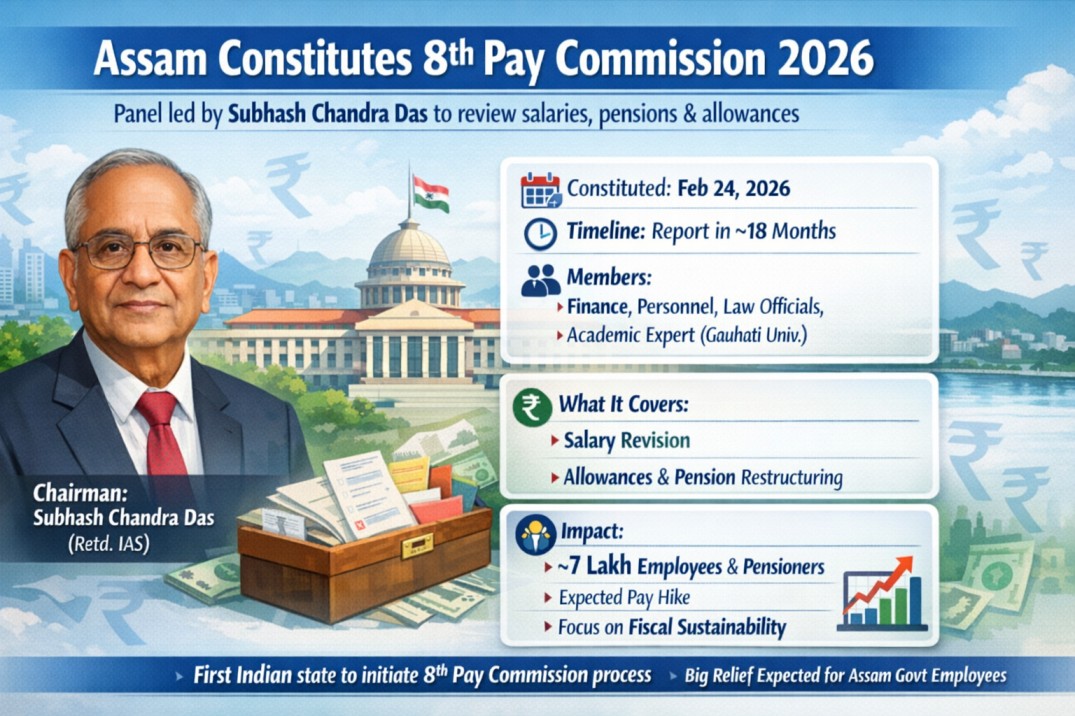
In a significant development that has brought cheer to lakhs of state government employees and pensioners across Assam, the state government has officially constituted the 8th Pay Commission 2026. This move comes after a decade-long gap since the last pay revision under the 7th Assam Pay and Productivity Pay Commission, which was implemented effective from April 1, 2016. The gazette notification, issued by the Governor of Assam and announced on February 24, 2026, marks Assam as one of the proactive states aligning its pay structures with evolving economic realities, administrative reforms, and the impending recommendations of the central 8th Pay Commission.
The constitution of the 8th Pay Commission is seen as a timely and employee-centric decision by the Assam government, led by Chief Minister Himanta Biswa Sarma. It aims to review and recommend comprehensive changes to pay scales, allowances, pensions, and service conditions while ensuring fiscal responsibility and long-term sustainability for the state’s finances.
Background: Why the 8th Assam Pay Commission Was Needed
The last major pay revision in Assam occurred nearly 10 years ago following the recommendations of the 7th Pay Commission. Since then, inflation, rising cost of living, changes in national economic policies, and the implementation of the 7th Central Pay Commission (CPC) have created a pressing need for an updated review at the state level.
Government employees in Assam, numbering in the lakhs (approximately 4.5 lakh active employees and a substantial number of pensioners), have long awaited this revision. The delay has led to demands from employee unions and associations for a fresh look at pay structures to address disparities, improve living standards, and align with national benchmarks.
The announcement of the 8th Pay Commission 2026 comes at a crucial juncture when the central government’s 8th Pay Commission is also in motion, with expectations of implementation from January 1, 2026 (though central recommendations are still under process). Assam’s early action positions the state to potentially adopt or adapt central guidelines while tailoring them to local fiscal conditions and developmental priorities.
Leadership and Composition of the 8th Assam Pay Commission
The commission is headed by retired IAS officer Subhash Chandra Das as Chairman. Das, a seasoned administrator with extensive experience in various key departments, brings credibility and expertise to lead this important exercise.
The full composition includes:
- Chairman: Retired IAS officer Subhash Chandra Das
- Members:
- Senior-most Secretary, Personnel Department
- Senior-most Secretary, Administrative Reforms, Training, Pension, and Public Grievances (ARTPPG) Department
- Senior-most Secretary, Finance Department
- Legal Remembrancer-cum-Commissioner & Special Secretary, Judicial Department
- Special Director of Finance (Budget) or a nominee senior-most Secretary from the Finance Department
- Special Invitee: Professor Ratul Mahanta, Gauhati University (an academic expert likely to provide insights on economic and policy aspects)
- Member Secretary: Secretary, Finance (Pay Research Unit) Department
This multi-departmental representation ensures a balanced approach, incorporating administrative, financial, legal, and academic perspectives. The inclusion of Professor Ratul Mahanta as a special invitee adds an external, scholarly dimension to the deliberations.
Mandate and Scope of the 8th Assam Pay Commission
The commission’s terms of reference are broad and forward-looking. It will undertake a thorough review of the existing pay structure while integrating structural reforms. Key areas include:
- Historical Evolution of Assam’s pay structures
- Prevailing Macro-Economic Conditions at national and state levels
- Impact of Development Planning and Employment Expansion
- State’s Revenue Resources and Medium-Term Fiscal Framework
- Recommendations of the 8th Central Pay Commission
- Assam Fiscal Responsibility and Budget Management Laws
- Projected Annual Fiscal Implications under various implementation scenarios
Beyond mere salary hikes, the commission will emphasize:
- Structural Reforms for better governance
- Fiscal Sustainability to avoid undue burden on state finances
- Digital Transformation and adoption of modern tools like HRMS (Human Resource Management System)
- Administrative Efficiency, manpower rationalization, performance-based evaluations, and skill development
This holistic approach signals the government’s intent to link pay revisions with productivity enhancements and digital governance, ensuring that salary increases are sustainable and tied to improved service delivery.
Timeline, Headquarters, and Submission of Report
The 8th Assam Pay Commission will have its headquarters in Guwahati, facilitating easy access for stakeholders and consultations.
The commission is mandated to submit its report as soon as possible, with a maximum timeline of 18 months from the date of constitution (i.e., by mid-2027 at the latest). This allows sufficient time for extensive consultations with employee unions, departments, economists, and the public.
While the exact effective date for any recommended revisions is yet to be determined, historical precedents suggest potential retrospective application, possibly from January 1, 2026, or another benchmark date aligned with central revisions.
Expected Impact: Salary Hike, Allowances, and Pensions
The formation of the 8th Assam Pay Commission 2026 has generated optimism among state employees. Potential benefits include:
- Revised pay matrices with higher basic pay scales
- Updated allowances (HRA, DA, TA, etc.) reflecting current costs
- Pension revisions for retirees
- Performance-linked incentives and structural adjustments
Experts estimate that, depending on fiscal space and central guidelines, salary increases could range significantly, potentially bringing Assam’s pay structures closer to neighboring states or national averages. However, the commission’s focus on fiscal sustainability means recommendations will balance employee welfare with the state’s revenue constraints.
Employee associations have welcomed the move, viewing it as a step toward fair compensation amid rising inflation and economic pressures.
Broader Context: Assam’s Proactive Stance and National Alignment
Assam’s decision to constitute its state pay commission ahead of full central implementation highlights proactive governance. While the central 8th Pay Commission (notified in 2025) is expected to benefit over 1 crore central employees and pensioners, states like Assam are moving swiftly to prepare their own frameworks.
This initiative aligns with the government’s broader agenda of administrative reforms, digital India integration at the state level, and sustainable development. By tying pay revisions to efficiency and fiscal discipline, the commission aims to create a win-win for employees and the exchequer.
Conclusion: A Positive Step for Assam’s Workforce
The constitution of the 8th Assam Pay Commission 2026 under Subhash Chandra Das is undoubtedly good news for lakhs of dedicated state government employees who serve Assam day in and day out. It promises a much-needed update to salaries, allowances, and service conditions after a long hiatus, while ensuring the state’s financial health remains intact.
As the commission begins its work, stakeholders await detailed consultations and recommendations that could reshape the future of public service in Assam. This development not only boosts morale but also reinforces the government’s commitment to employee welfare in a balanced, responsible manner.
Stay tuned for more updates on the 8th Assam Pay Commission, including member activities, public hearings, and final recommendations. For Assam government employees, this is a beacon of hope for better compensation and improved working conditions in the coming years.