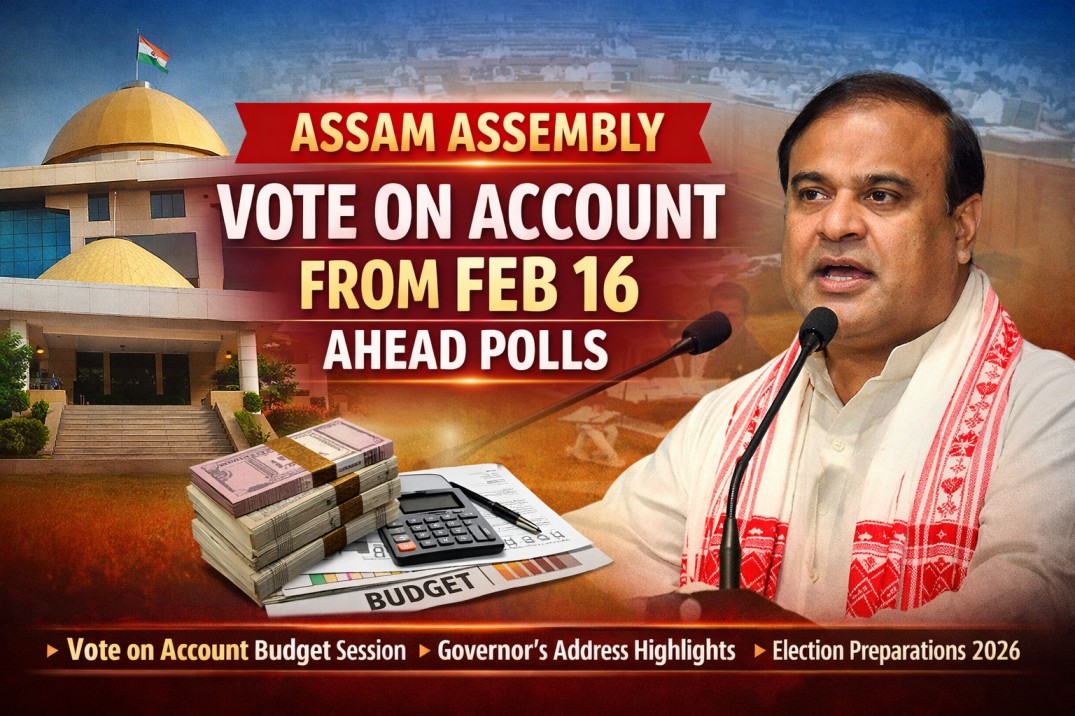
Assam Assembly Final Session 2026: Vote on Account Budget to Begin on February 16 Ahead of Elections – Full Details
The Assam Legislative Assembly is set to hold its final session of the current term under Chief Minister Himanta Biswa Sarma, commencing on February 16, 2026. This four-day interim session, often referred to as the Vote on Account session, will pave the way for smooth governance until the upcoming Assam Assembly elections in 2026.
The Assam Legislative Assembly, the unicameral house representing the people of Assam, is gearing up for a crucial milestone in its current 15th term. The final session of this Assembly, led by Chief Minister Dr. Himanta Biswa Sarma and the BJP-led government, will commence on Monday, February 16, 2026. This session, spanning four days, has been officially designated as the Budget Session in the form of a Vote on Account, a constitutional mechanism to ensure uninterrupted financial operations of the state government during the transitional period leading up to the general elections.
Summoned by Assam Governor Lakshman Prasad Acharya under Article 174(1) of the Indian Constitution (often referenced alongside Article 176(1) for the address provisions), the session will kick off at 9:30 AM in the Assembly Chamber at Dispur, Guwahati. The Governor is expected to deliver his customary address to the House on the opening day, outlining the government’s achievements, priorities, and vision in the run-up to the polls.
According to official notifications from the Assam Legislative Assembly Secretariat and statements by Secretary Dulal Pegu, the Business Advisory Committee (BAC) has finalized the schedule after detailed deliberations. The four-day duration—from February 16 to February 19, 2026—reflects the focused and interim nature of the proceedings. No major legislative agenda involving extensive new bills is anticipated, keeping the session streamlined for essential fiscal and administrative approvals.
What is Vote on Account? Why It Matters in 2026
A Vote on Account is a special budgetary provision enshrined in the Indian Constitution (primarily under Articles 116 for Parliament and analogous provisions for state legislatures). It allows the government to withdraw funds from the Consolidated Fund of the state to cover essential and day-to-day expenses for a limited period—typically a few months—when a full annual budget cannot be presented due to impending elections or other transitional reasons.
In Assam’s case, this interim arrangement is critical. The current Assembly’s term ends on May 20, 2026, and the Assam Assembly elections 2026 are widely expected to take place in March–April 2026, as per constitutional timelines and Election Commission preparations. A full-fledged budget for the financial year 2026-27 cannot be tabled now, as the incoming government post-elections will handle it. Instead, the Vote on Account will authorize expenditure from February/March 2026 up to around May/June 2026, ensuring no financial deadlock disrupts salaries, pensions, welfare schemes, developmental projects, and routine administrative functions.
Finance Minister Ajanta Neog is likely to present this Vote on Account on the second day of the session (February 17, subject to BAC confirmation). This partial budget will cover only unavoidable and committed expenditures, preventing any fiscal crisis during the election period and the formation of the new government.
Key Agenda Items in the Final Session
While the session is primarily fiscal in nature, a few other important items are on the table:
- Value Added Tax (VAT) Amendment Bill: One amendment bill related to the Assam Value Added Tax has been received and is expected to be introduced and possibly discussed. This could involve updates to taxation norms, compliance, or revenue measures aligned with evolving economic policies.
- Supplementary Demands for Grants: The House will consider and approve additional funds required for ongoing schemes or unforeseen needs in the current fiscal year.
- Governor’s Address and Discussions: The session opens with the Governor’s speech, followed by a motion of thanks, which often becomes a platform for debate on state issues, government performance, and opposition critiques.
No other major legislation is listed, emphasizing the session’s role as a bridge to the post-election phase.
Context: Assam’s Political Landscape Ahead of 2026 Elections
This final session assumes added significance amid the high-stakes buildup to the Assam Assembly elections 2026. The 126-member House, elected in 2021, has seen the BJP-led NDA consolidate power under Chief Minister Himanta Biswa Sarma’s dynamic leadership. The government has focused on infrastructure, flood management, women’s empowerment, tea garden welfare, and anti-encroachment drives, often highlighting these in public discourse.
Opposition parties, including Congress, AIUDF, and regional outfits like Raijor Dal and Asom Jatiya Parishad, are attempting alliances, though seat-sharing talks remain fluid. Recent developments, such as voter list revisions (with deletions of doubtful names), officer transfers for fair polls, and delimitation impacts, have intensified political activities. CM Sarma has been vocal on issues like land rights, immigration, and national security, setting the tone for the electoral battle.
The post-session full budget for 2026-27 is tentatively slated for July 2026, after the new government assumes office following election results.
Historical Perspective on Assam Assembly Sessions
The 15th Assam Legislative Assembly has witnessed numerous productive sessions since 2021, including budget sessions, monsoon sessions, and winter sessions addressing key laws on land, education, health, and anti-corruption. This interim Vote on Account session marks its culmination, ensuring continuity.
Assam Legislative Assembly Secretary Dulal Pegu has played a pivotal role in coordinating logistics, with the BAC’s decisions shaping the agenda. Official sources confirm the session’s smooth conduct, with preparations underway at the Dispur complex.
Implications for Governance and Economy
By approving the Vote on Account, the Assembly safeguards essential services:
- Payment of salaries and pensions to government employees.
- Continuation of welfare programs like Orunodoi, tea tribe benefits, and farmer support.
- Ongoing infrastructure projects and emergency expenditures.
- Avoidance of any stoppage in state machinery during the election code of conduct period.
This mechanism, used routinely in election years across Indian states, upholds fiscal discipline while respecting democratic transitions.
In summary, the Assam Assembly final session starting February 16, 2026, is more than a procedural formality—it’s a constitutional safeguard ensuring stability as the state heads into one of its most anticipated electoral contests. With Chief Minister Himanta Biswa Sarma at the helm, the proceedings will likely reflect the government’s confidence in its track record while setting the stage for fresh mandates.
Stay tuned for live updates, detailed coverage of the Governor’s address, Vote on Account highlights, and post-session analysis as Assam’s political calendar intensifies. For the latest on Assam politics, elections 2026, and legislative developments, bookmark this page.