Assam HS First Year Pass Percentage 2026 Increased to 33%: Full Details on ASSEB New Pass Marks Criteria & Subject-Wise Breakdown
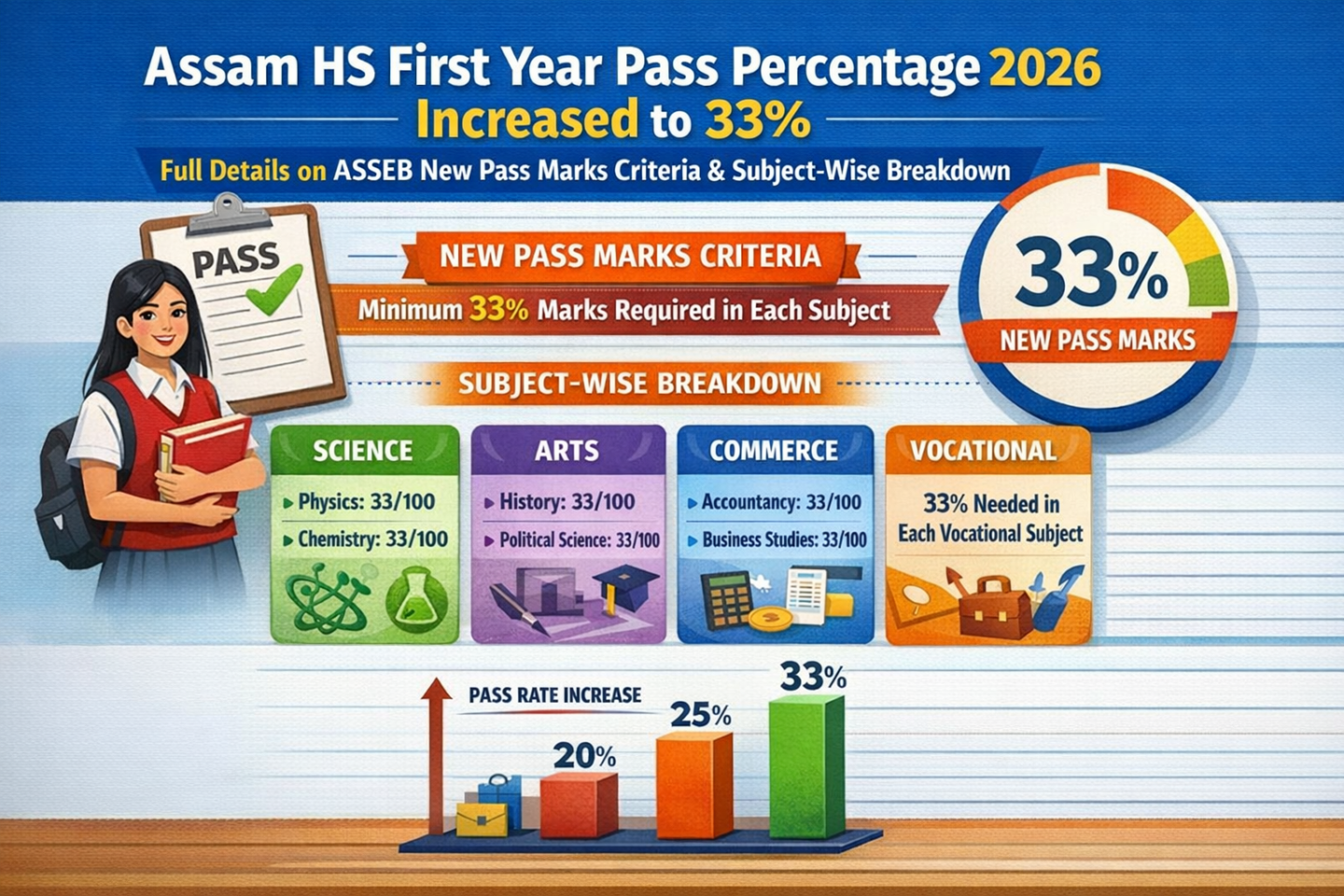
Guwahati, March 07, 2026: In a significant update for higher secondary students across Assam, the Assam State School Education Board (ASSEB) Division-II has officially raised the minimum pass percentage for the Higher Secondary First Year Examination 2026 (commonly known as HS 1st Year or Class 11 board exam) from 30% to 33%. This change, announced through an official notification, aims to elevate academic standards and better prepare students for the challenges of higher education and competitive examinations.
The revision applies with immediate effect and will govern the evaluation of students appearing in the HS First Year Examination 2026. Previously, a score of 30 marks out of 100 was sufficient to pass a subject, but students will now need at least 33 marks out of 100 in subjects without practical components. The board has provided a detailed breakdown for subjects involving practical examinations, ensuring proportional requirements across theory and practical sections.
This move comes at a time when educational reforms in Assam are focusing on quality over quantity, aligning with national trends to strengthen foundational learning in intermediate education. The Assam HS First Year Pass Percentage 2026 change has sparked discussions among educators, parents, and students about its implications for performance, preparation strategies, and overall pass rates in the upcoming exams.
Official Notification and Rationale Behind the Change
The ASSEB (formerly AHSEC for higher secondary) issued the notification detailing the updated pass criteria. According to the board, the increase to 33% is part of broader academic guidelines to promote rigorous learning and reduce the number of students passing with minimal effort. The notification directs all heads of higher secondary institutions, junior colleges, and schools to guide students accordingly and provide additional support to help them meet the new standards.
The board emphasized that this adjustment will encourage better conceptual understanding and consistent performance throughout the academic year. While the exact rationale isn’t elaborated in depth in the circular, education experts suggest it aligns with efforts to bridge the gap between school-level assessments and university/competitive exam expectations, where cut-offs are often higher.
A separate notification from the board also mentions provisions allowing certain categories of students to appear in the HS First Year Examination 2026, though specific eligibility details (such as for compartmental or improvement candidates) were not outlined in the current update. Students and institutions are advised to refer to the official ASSEB website (ahsec.assam.gov.in) for further clarifications.
Detailed Subject-Wise Pass Marks Breakdown for HS First Year 2026
The board has clarified the application of the revised 33% pass requirement based on the marking scheme of individual subjects. Here’s a comprehensive breakdown:
- Subjects with 100 marks theory (no practical): Minimum 33 marks in theory required to pass.
- 70 marks theory + 30 marks practical: Students must secure at least 23 marks in theory and 10 marks in practical, totaling 33 marks.
- 90 marks theory + 10 marks practical: Minimum 30 marks in theory and 3 marks in practical.
- 80 marks theory + 20 marks practical: At least 26 marks in theory and 7 marks in practical.
- 50 marks theory + 50 marks practical: Students need 17 marks in theory and 16 marks in practical (note: this reflects a slightly adjusted threshold to meet the overall 33% while respecting the equal split).
These proportional allocations ensure fairness across science streams (with heavy practical components like Physics, Chemistry, Biology) and commerce/arts subjects that may have lower or no practicals. For vocational or elective subjects following different patterns, institutions are instructed to apply the same logic proportionally.
Importantly, students must pass both theory and practical components separately where applicable, similar to existing rules but now calibrated to the new aggregate threshold.
Impact on Students and Preparation Strategies
The hike in Assam HS First Year Pass Percentage 2026 from 30% to 33% may seem marginal (just 3 additional marks), but it could significantly affect borderline students. In previous years, many students scraped through with 30-32 marks in challenging subjects. This change pushes them to aim higher, potentially reducing failure rates in the long run but increasing short-term pressure.
For the lakhs of students enrolled in Class 11 under ASSEB-affiliated institutions, this means intensified focus on syllabus completion, regular assessments, and doubt-clearing sessions. Principals and teachers have been tasked with organizing remedial classes, mock tests, and counseling to support weaker students.
Tips for students to meet the new ASSEB HS 1st Year Minimum Pass Marks 33%:
- Understand the syllabus thoroughly: Prioritize high-weightage chapters as per the latest ASSEB curriculum.
- Practice previous years’ papers and model questions: Focus on achieving consistent scores above 40-50 to create a buffer.
- Balance theory and practicals: For science students, lab records, viva, and experiments are crucial—don’t neglect the practical portion.
- Time management in exams: Allocate time wisely to attempt all questions and review answers.
- Seek help early: Utilize school resources, online platforms, and peer study groups.
Parents are encouraged to monitor their ward’s progress and maintain open communication with teachers.
Comparison with Previous Years and National Trends
Historically, the pass percentage for HS First Year exams in Assam has been relatively high compared to final year (Class 12) due to internal assessments and lenient marking in some cases. However, with the shift to 33%, the board appears to be standardizing criteria closer to national boards like CBSE, which requires 33% in Class 12 for passing (with separate criteria for theory/practicals in some cases).
In recent Assam HS results (Class 12 equivalent), pass percentages have fluctuated: around 79-88% in recent years, with variations across streams (Science often higher, Arts lower). The HS First Year results typically mirror or exceed these figures. The new rule may lead to a slight dip in pass rates initially but could improve overall quality.
This aligns with national education policies emphasizing competency-based learning under NEP 2020, where Assam has been proactive in implementing reforms.
What Students and Parents Should Do Next
- Regularly check the official ASSEB website for updates, exam timetables, and admit card releases.
- Download the full notification PDF for reference.
- Attend awareness programs organized by the board or schools (as mentioned in related ASSEB initiatives).
- Prepare for the exams tentatively scheduled in early 2026 (exact dates to be announced).
The Assam HS First Year Pass Percentage 2026 update underscores the board’s commitment to academic excellence. While it raises the bar, it also provides clearer guidelines for success.
Stay tuned to our website for more updates on ASSEB HS 1st Year Minimum Pass Marks 33%, exam routines, syllabus changes, and result announcements. For queries, comment below or visit ahsec.assam.gov.in.