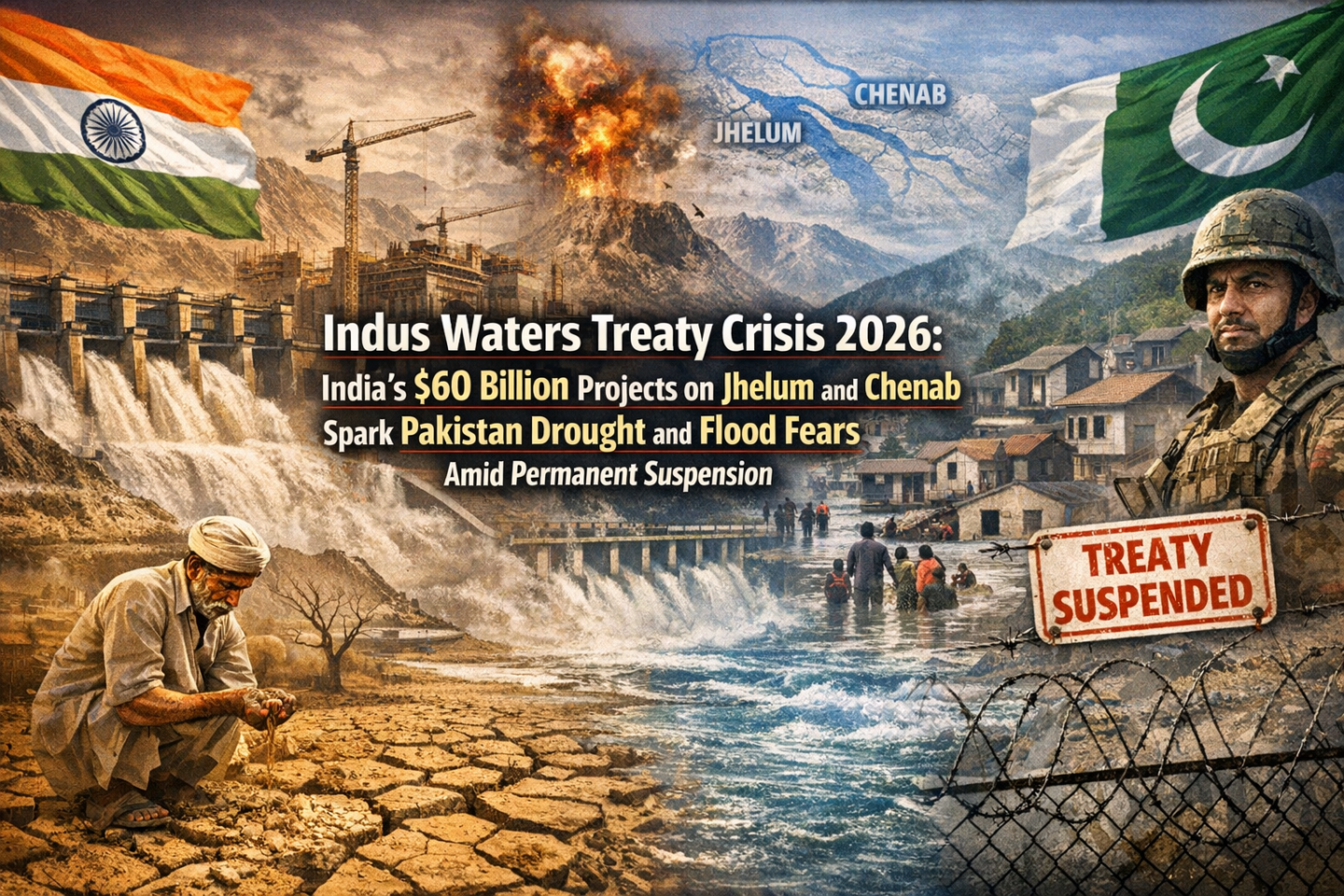
Indus Waters Treaty Crisis 2026: India’s $60 Billion Projects on Jhelum and Chenab Spark Pakistan Drought and Flood Fears Amid Permanent Suspension
The Indus Waters Treaty has once again become the epicenter of escalating tensions between India and Pakistan, threatening regional stability in South Asia. With India accelerating large-scale hydropower and storage initiatives on the western rivers—primarily the Jhelum (Vitasta) and Chenab (Chandrabhaga)—Pakistan has voiced grave concerns over potential manipulation of water flows, leading to fears of engineered droughts and floods downstream.
The Indus Waters Treaty, signed on September 19, 1960, under the mediation of the World Bank between India’s first Prime Minister Jawaharlal Nehru and Pakistan’s President General Ayub Khan, has long been hailed as one of the most resilient bilateral agreements in a conflict-ridden region. It survived multiple wars (1965, 1971, 1999) and countless diplomatic crises, providing a framework for equitable sharing of the Indus River system’s waters.
Under the treaty’s provisions, the six major rivers of the Indus Basin are divided: India gained unrestricted control over the three eastern rivers—Beas (Vipasha), Ravi (Iravati), and Sutlej (Satadru)—amounting to roughly 20% of the total flow. Pakistan was allocated the three western rivers—Indus, Jhelum, and Chenab—accounting for about 80% of the waters, essential for its agriculture, which sustains over 80% of its farmland, and hydropower generation.
Crucially, while Pakistan holds primary consumptive rights to the western rivers’ waters, the treaty explicitly permits India to develop “non-consumptive” uses, such as run-of-the-river hydropower projects, without significantly altering downstream flows. Storage is strictly limited to about 3.6 million acre-feet on the western rivers to prevent major diversions.
This delicate balance has now unraveled. In April 2025, a deadly terrorist attack in Pahalgam, Kashmir, killed 26 tourists and civilians. India attributed the assault to Pakistan-based militants, prompting a swift and unprecedented response: the suspension—or placement “in abeyance”—of the Indus Waters Treaty. This marked the first time since 1960 that the agreement has been formally sidelined, with India conditioning its revival on Pakistan’s verifiable cessation of support for cross-border terrorism.
Since the suspension, New Delhi has accelerated infrastructure development on the western rivers, viewing it as a sovereign right to harness resources originating within its territory. A key flashpoint is India’s reported launch of massive storage and hydropower projects on the Jhelum and Chenab, estimated at $60 billion (approximately ₹5.48 lakh crore). These initiatives aim to significantly boost India’s water retention capacity.
According to Lieutenant General (Retd.) Muhammad Saeed, Chairman of Pakistan’s Water and Power Development Authority (WAPDA), India’s current storage on the Indus system and its tributaries stands at roughly 15 days. Upon completion of the proposed projects, this could expand to 55–60 days. Saeed warned in a recent statement during a federal-provincial dialogue that this enhanced capacity poses an existential threat to Pakistan.
He argued that if India withholds normal river flows for nearly two months—particularly during critical Kharif cropping seasons—Pakistan could face catastrophic drought, devastating agriculture in Punjab and Sindh provinces. Conversely, during monsoons or heavy rainfall, deliberate release of stored water could trigger artificial flooding, overwhelming Pakistan’s irrigation canals and urban centers. Even with the existing limited capacity, Saeed alleged recent manipulations have caused acute shortages of drinking and irrigation water in downstream areas.
Pakistan’s leadership, including Prime Minister Shehbaz Sharif and Army Chief Asim Munir, has issued repeated warnings, labeling potential water diversion as an “act of war.” Islamabad has sought international intervention, including appeals to the World Bank (the treaty’s guarantor) and forums like the United Nations, while pursuing legal recourse through mechanisms like the Permanent Court of Arbitration.
India, however, remains firm. Union Home Minister Amit Shah has unequivocally stated that the old terms of the Indus Waters Treaty “will never be implemented again.” In interviews and public remarks, Shah emphasized diverting waters previously flowing to Pakistan for domestic use, such as irrigation in Rajasthan via new canals. This stance reflects a broader policy shift under the Narendra Modi government, framing water as a national security and developmental priority amid alleged Pakistani-backed terrorism.
A concrete manifestation of this approach came in December 2025, when India’s expert appraisal committee under the Ministry of Environment approved the 260 MW Dulhasti Stage-II hydropower project on the Chenab in Kishtwar, Jammu and Kashmir. This run-of-the-river extension of the existing Dulhasti complex, estimated at over ₹3,200 crore, aligns with efforts to maximize hydropower potential on western rivers—permissible under the treaty but now expedited post-suspension.
Other projects, including desilting operations at existing dams like Salal on the Chenab and potential expansions, signal India’s intent to fully utilize its entitlements without prior consultations previously required under the treaty framework.
The broader implications are profound. Pakistan’s economy relies heavily on the Indus Basin for irrigation, supporting crops like wheat, rice, and cotton that form the backbone of its GDP. Disruptions could exacerbate food insecurity, economic instability, and internal displacement. For India, enhanced storage offers benefits in flood control, hydropower (targeting renewable energy goals), and irrigation in water-stressed regions like Jammu, Kashmir, and Rajasthan.
Yet, experts caution that weaponizing water between nuclear-armed neighbors risks catastrophic escalation. Climate change compounds the crisis: erratic monsoons, glacial melt, and changing precipitation patterns already strain the basin. The treaty, designed in a pre-climate era, lacks provisions for these variables, making rigid adherence challenging even before the suspension.
The World Bank’s role remains pivotal, though its mediation options are limited amid India’s refusal to restore the status quo. Diplomatic channels have seen limited progress, with both sides trading accusations while a fragile ceasefire holds post-2025 escalations.
As 2026 unfolds, the Indus Waters Treaty saga underscores the intersection of water, security, and geopolitics in South Asia. Whether through renewed dialogue, legal arbitration, or unilateral actions, the outcome will shape not just bilateral ties but regional water security for generations.