Rajya Sabha Elections 2026: ECI Announces Polls for 37 Seats on March 16 – Full Schedule, State-Wise Vacancies & Retiring Members List
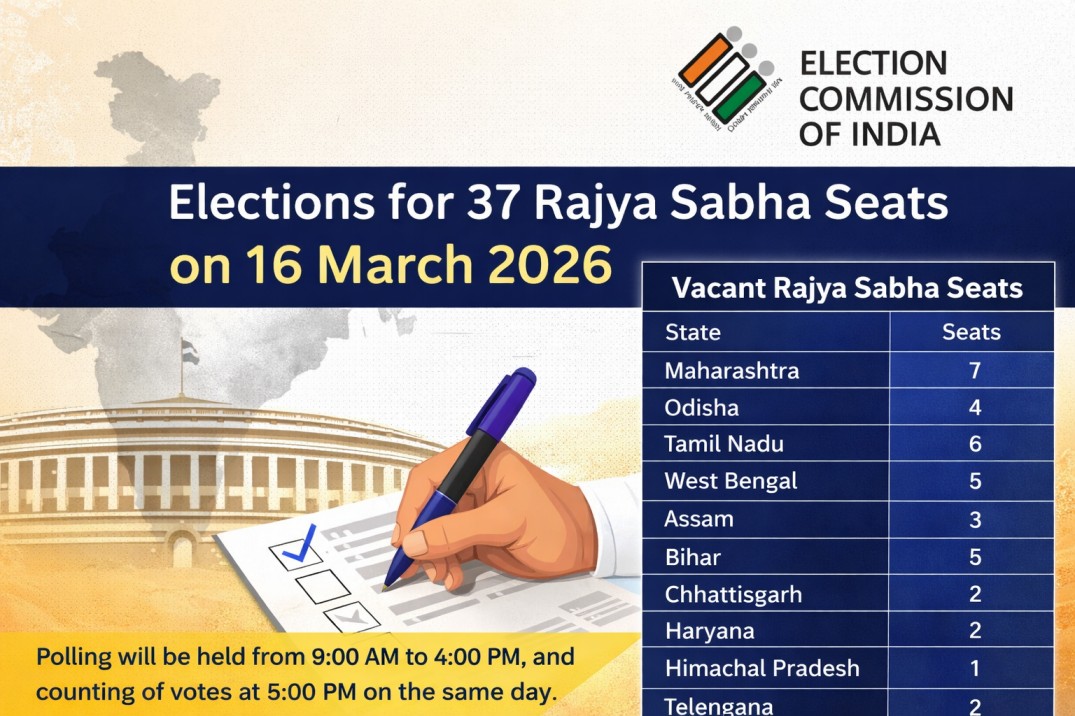
The Election Commission of India (ECI) has officially announced the schedule for the biennial Rajya Sabha elections in 2026 to fill 37 vacant seats across 10 states. These elections, set for March 16, 2026, come as the terms of several prominent Rajya Sabha members expire in April 2026. This biennial process is a key event in India’s parliamentary calendar, ensuring the continuous renewal of the upper house of Parliament.
What Are Biennial Rajya Sabha Elections?
Rajya Sabha, or the Council of States, is a permanent body not subject to dissolution. One-third of its members retire every two years after serving a six-year term. Elections are indirect—conducted by elected members of state legislative assemblies (MLAs) using the single transferable vote (STV) system with proportional representation. Voters (MLAs) mark preferences on ballot papers, and results are determined through vote value calculations to ensure fair representation.
The upcoming Rajya Sabha elections 2026 will fill 37 seats from states including Maharashtra, Tamil Nadu, Bihar, West Bengal, Odisha, Assam, Chhattisgarh, Haryana, Telangana, and Himachal Pradesh. This batch is part of the larger 2026 Rajya Sabha elections cycle, which may involve more seats in phases, but the ECI has specifically scheduled this tranche for March.
Official Election Schedule Announced by ECI
On February 18, 2026, the Election Commission issued a detailed press note outlining the timeline:
- Issue of Notification: February 26, 2026 (Thursday)
- Last Date for Filing Nominations: March 5, 2026 (Thursday)
- Scrutiny of Nominations: March 6, 2026 (Friday)
- Last Date for Withdrawal of Candidature: March 9, 2026 (Monday)
- Date of Poll: March 16, 2026 (Monday)
- Hours of Poll: 9:00 AM to 4:00 PM
- Counting of Votes: March 16, 2026 (Monday) at 5:00 PM
- Completion of Election Process: March 20, 2026 (Friday)
The Commission has mandated the use of integrated violet colour sketch pens (provided by the Returning Officer) for marking preferences on ballot papers—no other pens will be allowed—to prevent disputes over markings.
Observers will be appointed for close monitoring to ensure free, fair, and transparent elections, in line with ECI’s commitment to electoral integrity.
State-Wise Breakdown of Vacant Seats
The 37 seats are distributed as follows:
- Maharashtra: 7 seats (highest number in this batch)
- Tamil Nadu: 6 seats
- Bihar: 5 seats
- West Bengal: 5 seats (including one vacancy effective from January 5, 2026)
- Odisha: 4 seats
- Assam: 3 seats
- Chhattisgarh: 2 seats
- Haryana: 2 seats
- Telangana: 2 seats
- Himachal Pradesh: 1 seat
These vacancies arise from retirements in April 2026, with members’ terms concluding on various dates that month.
List of Retiring Rajya Sabha Members (Key Highlights)
Several notable figures are among those retiring. Here are some prominent names by state:
Maharashtra (7 seats):
- Dr. Bhagwat Kishanrao Karad
- Dr. (Smt.) Fauzia Tahseen Ahmed Khan
- Priyanka Vikram Chaturvedi
- Sharadchandra Govindrao Pawar
- Dhananjay Bhimrao Patil
- Rajani Ashokrao Patil
- Ramdas Bandu Athawale
Tamil Nadu (6 seats):
- N.R. Elango
- P. Selvarasu
- M. Thambidurai
- Tiruchi Siva
- Dr. Kanimozhi NVN Somu
- G.K. Vasan
Bihar (5 seats):
- Amarendra Dhari Singh
- Prem Chand Gupta
- Ramnath Thakur
- Upendra Kushwaha
- Harivansh Narayan Singh
West Bengal (5 seats):
- Saket Gokhale
- Ritabrata Banerjee
- Bikash Ranjan Bhattacharya
- Mausam Noor (vacant w.e.f. January 5, 2026)
- Subrata Bakshi
Odisha (4 seats):
- Mamata Mohanta
- Muzibulla Khan
- Sujeet Kumar
- Niranjan Bishi
Assam (3 seats):
- Rameswar Teli
- Bhubaneswar Kalita
- Ajit Kumar Bhuyan
Other States: Includes members like Kavi Tejpal Singh Tuli and Phulo Devi Netam (Chhattisgarh), Kiran Choudhry and Ram Chander Jangra (Haryana), Indu Bala Goswami (Himachal Pradesh), and Dr. Abhishek Manu Singhvi and K.R. Suresh Reddy (Telangana).
These retirements span major political parties, including BJP, Congress, DMK, TMC, and others, making the elections politically significant.
Political Implications and What to Expect
The Rajya Sabha biennial elections 2026 will influence the composition of the upper house, where the government often needs support for passing key legislation. With Maharashtra and Tamil Nadu having the largest chunks, parties with strong assembly majorities in those states (such as alliances in Maharashtra or DMK-led in Tamil Nadu) are likely to dominate outcomes.
In Assam, the retirement of Rameswar Teli, Bhubaneswar Kalita, and Ajit Kumar Bhuyan could see BJP aiming to retain or strengthen its position. Similarly, in Bihar and West Bengal, regional dynamics involving RJD, JD(U), TMC, and others will play a role.
Since Rajya Sabha polls are indirect and often uncontested if parties reach consensus, many seats may see candidates elected unopposed. However, cross-voting or multi-cornered contests in hung assemblies could add intrigue.
The ECI’s emphasis on monitoring and violet pens underscores efforts to maintain transparency amid past concerns over ballot integrity.
Why This Matters for India’s Democracy
Biennial Rajya Sabha elections reinforce federalism by giving state legislatures a direct say in the upper house. They ensure diverse regional voices in national law-making and provide continuity in parliamentary functioning.
As the process unfolds from late February to mid-March 2026, political parties will finalize candidates, negotiate alliances, and strategize based on assembly strengths.
Stay tuned for updates on nominations, candidate lists, and potential outcomes as the Rajya Sabha elections 2026 progress.