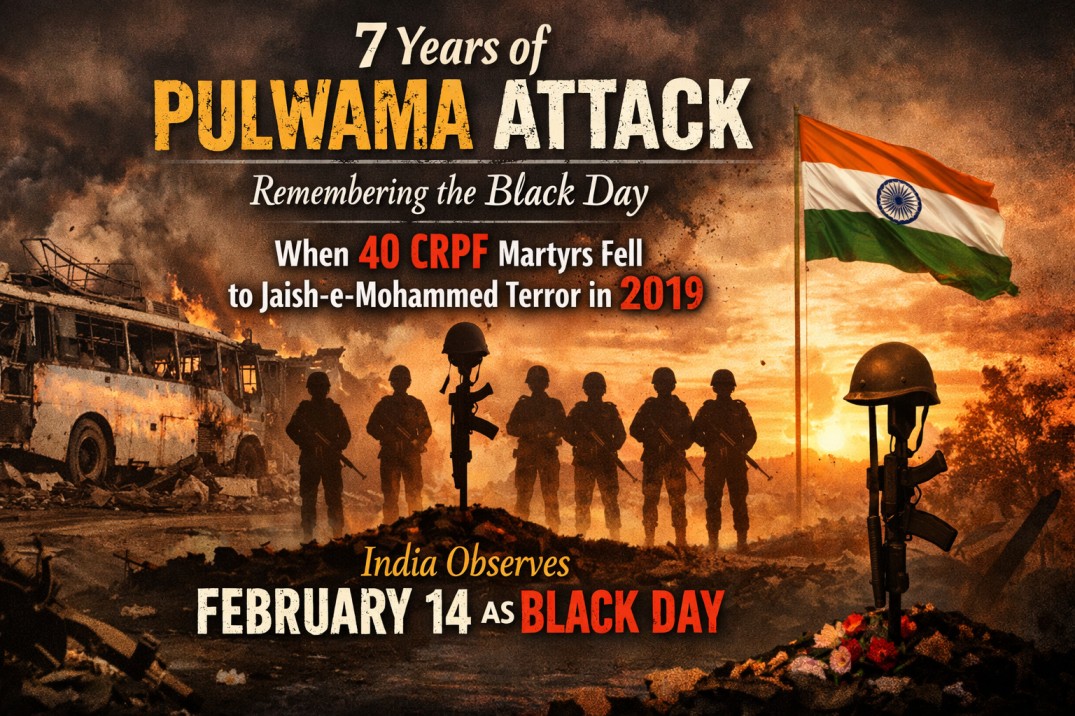
7 Years of Pulwama Attack: Remembering the Black Day When 40 CRPF Martyrs Fell to Jaish-e-Mohammed Terror in 2019 – India Observes February 14 as Black Day
The entire world celebrates February 14 as Valentine’s Day, a symbol of love and romance. However, for India, this date has been etched in collective memory as a somber Black Day ever since the tragic Pulwama attack in 2019. Today, on the 7th anniversary of that devastating terrorist incident, the nation once again pays tribute to the 40 brave CRPF personnel who made the ultimate sacrifice in the line of duty.
The Pulwama attack remains one of the deadliest terrorist strikes on Indian security forces in recent history. On February 14, 2019, a suicide bomber affiliated with the Pakistan-based terrorist group Jaish-e-Mohammed (JeM) rammed an explosives-laden vehicle into a convoy of Central Reserve Police Force (CRPF) personnel traveling along the Jammu-Srinagar National Highway (NH-44) in the Lethpora area of Pulwama district, Jammu and Kashmir.
The convoy comprised 78 vehicles carrying over 2,500 CRPF jawans who were being rotated from Jammu to Srinagar. Due to bad weather and road closures in prior days, the large convoy was moving together, making it a vulnerable target. Around 3:15 PM IST, the attacker, identified as Adil Ahmad Dar, a 20-22-year-old local from Kakapora village in Pulwama (previously a school dropout radicalized by JeM), drove a Maruti Eeco car packed with approximately 300-350 kg of explosives (including RDX) straight into one of the buses.
The massive blast tore through the vehicle, instantly killing 40 CRPF personnel and injuring over 35 others, some critically. The explosion was so powerful that it left a crater on the highway and scattered debris, body parts, and wreckage across the scene. Eyewitness accounts described a scene of utter devastation, with smoke billowing and cries for help echoing in the valley.
Jaish-e-Mohammed swiftly claimed responsibility, releasing a video of Adil Ahmad Dar in combat gear, vowing to target Indian forces and expressing his intent to “reach heaven” through martyrdom. The group, founded by Maulana Masood Azhar and long accused by India of operating with support from elements across the border, had previously been involved in attacks like the 2001 Indian Parliament assault and others.
The news of the Pulwama attack spread like wildfire, plunging the nation into grief and outrage. Families across India received the heartbreaking news of losing their loved ones—sons, husbands, fathers—who were dutifully serving the country in one of its most challenging regions. Social media flooded with tributes, candles, and calls for justice. Protests erupted in several cities, and political leaders from all parties condemned the barbaric act.
India’s response was swift and resolute. The government blamed Pakistan for harboring terrorist groups like JeM, demanding that Islamabad dismantle terror infrastructure on its soil. International condemnation poured in from the United Nations, the United States, Russia, France, Australia, Saudi Arabia, and others, who expressed solidarity with India in its fight against terrorism.
The most significant retaliation came on February 26, 2019, when the Indian Air Force launched Operation Bandar—a pre-emptive airstrike on a confirmed JeM terrorist training camp in Balakot, Khyber Pakhtunkhwa province, Pakistan. Twelve Mirage 2000 jets crossed the Line of Control (LoC) for the first time since 1971 and dropped precision-guided munitions, reportedly eliminating a large number of terrorists (Indian claims ranged from 300+ casualties at the camp, though disputed). India described it as a non-military, intelligence-led strike to neutralize imminent threats of further suicide attacks.
The Balakot airstrike escalated tensions dramatically. The next day, February 27, 2019, Pakistani aircraft attempted a retaliatory strike, leading to an aerial dogfight. Pakistan shot down an Indian MiG-21, capturing Wing Commander Abhinandan Varthaman, who ejected over Pakistani territory. India claimed to have downed a Pakistani F-16 in the engagement. Abhinandan was released days later as a goodwill gesture amid de-escalation efforts.
The Pulwama episode highlighted deep-rooted issues in the Kashmir conflict, ongoing since 1989, involving separatism, cross-border terrorism, and the human cost borne by security forces and civilians alike. It also sparked debates on intelligence failures—reports indicated prior warnings about potential IED attacks and vehicle-borne threats, yet the convoy proceeded without adequate sanitization or splitting.
Seven years on, in 2026, the 7th anniversary of the Pulwama attack is observed with solemn tributes across India. Security remains heightened in Jammu and Kashmir to prevent any copycat incidents. Ex-servicemen associations, political leaders including Prime Minister Narendra Modi and Home Minister Amit Shah (in past years), and citizens pay homage through candlelight vigils, social media campaigns with hashtags like #NeverForgetPulwama, #SaluteToMartyrs, and #IndiaRemembers, and moments of silence.
Families of the martyrs continue to grieve, many receiving gallantry awards posthumously and government support. The attack reinforced India’s zero-tolerance policy toward terrorism, leading to stronger anti-terror laws, diplomatic isolation of Pakistan-based groups, and enhanced border security measures.
February 14 as Black Day symbolizes the contrast: while the world exchanges roses and chocolates, India bows its head in remembrance of sacrifice. It serves as a stark reminder that peace and freedom come at a heavy price, paid by bravehearts in uniform. The martyrs of Pulwama—ordinary men from humble backgrounds who chose to serve the nation—embody unwavering patriotism.
Their names live on in memorials, school textbooks, and national consciousness. As India commemorates this day, the resolve remains firm: to honor the fallen by eradicating the roots of terrorism, ensuring no such tragedy repeats, and building a secure future for generations.
The Pulwama attack was not just an assault on security forces; it was an attack on India’s sovereignty and spirit. Seven years later, the nation stands united in grief, gratitude, and determination. Jai Hind. 🇮🇳