Prime Minister Narendra Modi Inaugurates ‘Seva Teerth’: PMO Gets New Address in Historic Central Vista Shift
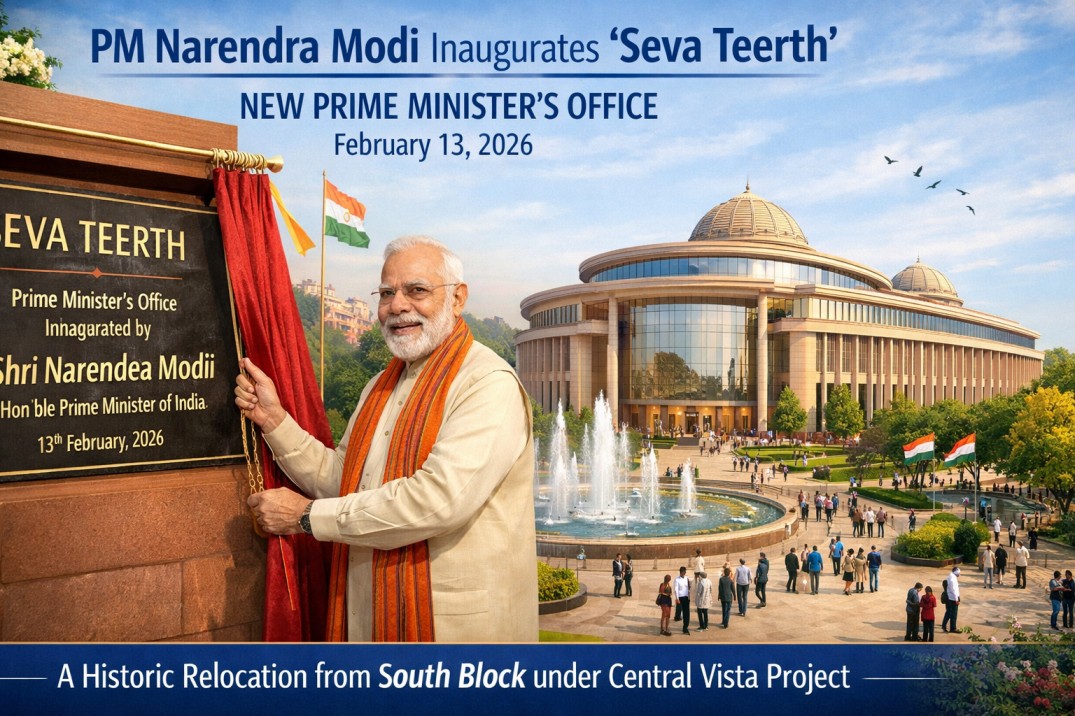
In a landmark event symbolizing India’s transition to modern, efficient, and citizen-centric governance, Prime Minister Narendra Modi formally inaugurated ‘Seva Teerth’ on February 13, 2026. This new complex now serves as the official address for the Prime Minister’s Office (PMO), ending its nearly 79-year tenure at the historic South Block on Raisina Hill since India’s Independence in 1947.
The inauguration, held in the heart of New Delhi’s Kartavya Path, also included the opening of Kartavya Bhavan-1 and Kartavya Bhavan-2. These developments are key components of the ambitious Central Vista Redevelopment Project, aimed at consolidating scattered government offices, enhancing operational efficiency, and creating an eco-friendly administrative ecosystem.
The Historic Relocation: From South Block to Seva Teerth
The Prime Minister’s Office has been located in the South Block—a British-era structure completed in 1931—since Independence. This building, part of the iconic North and South Blocks designed by Edwin Lutyens, has witnessed countless pivotal decisions shaping modern India. On February 13, 2026, Prime Minister Modi presided over what is believed to be the last Union Cabinet meeting in the South Block before the shift.
At approximately 1:30 PM, the Prime Minister unveiled the name ‘Seva Teerth’, which translates to ‘Place of Service’, emphasizing service to the nation and its citizens. This renaming occurred after the complex was previously referred to as the Executive Enclave. By evening, around 6 PM, Modi formally inaugurated the Seva Teerth complex and addressed a public programme at the site, highlighting its role in fostering a modern governance framework.
The relocation is more than a physical move; it represents a symbolic break from colonial legacies. As noted by Union Minister Jitendra Singh, the date February 13 coincides with 1931 when the British declared New Delhi as their capital—a poignant reminder of India’s journey toward self-reliance and confidence under the current leadership.
What is Seva Teerth? Key Features and Infrastructure
Seva Teerth serves as the central hub for high-level executive functions. It houses:
- The Prime Minister’s Office (PMO) in Seva Teerth-1
- The National Security Council Secretariat
- The Cabinet Secretariat
These offices, previously dispersed across the Central Vista area, are now consolidated under one roof to eliminate fragmentation, reduce coordination challenges, and lower maintenance costs.
Spanning approximately 226,203 square feet (around 5 acres), the complex was constructed by Larsen & Toubro at a cost of ₹1,189 crore. It comprises multiple buildings designed with state-of-the-art features:
- Digitally integrated offices for seamless operations
- Well-organized public interface spaces to enhance citizen engagement
- Centralized reception facilities
- Advanced security systems, including smart access control, enhanced surveillance, and emergency response infrastructure
The buildings adhere to 4-star GRIHA (Green Rating for Integrated Habitat Assessment) standards, incorporating:
- Renewable energy systems
- Water conservation measures
- Efficient waste management
- High-performance structural designs
These green initiatives not only boost operational efficiency but also minimize environmental impact, aligning with India’s sustainability goals.
Kartavya Bhavan-1 and Kartavya Bhavan-2: Accommodating Key Ministries
Alongside Seva Teerth, Prime Minister Modi inaugurated Kartavya Bhavan-1 and Kartavya Bhavan-2. These buildings host several crucial ministries, including:
- Finance
- Defence
- Health and Family Welfare
- Corporate Affairs
- Education
- Culture
- Law and Justice
- Information and Broadcasting
- Agriculture and Farmers Welfare
- Chemicals and Fertilisers
- Tribal Affairs
Similar to Seva Teerth, these structures feature modern amenities like digitally integrated workspaces, public interaction zones, and centralized facilities. This consolidation addresses long-standing issues of scattered offices leading to inefficiencies and higher costs.
For context, Kartavya Bhavan-3 was inaugurated in August 2025 and houses ministries such as Home Affairs, External Affairs, Rural Development, MSME, Electronics and IT, and Petroleum and Natural Gas.
The Broader Central Vista Redevelopment Project
The Central Vista Redevelopment Project is a comprehensive overhaul of New Delhi’s central administrative district, stretching approximately 3 kilometers from Rashtrapati Bhavan to India Gate along Kartavya Path (formerly Rajpath).
Key elements include:
- The new Parliament building (already operational)
- MPs’ chambers
- Central Vista Avenue
- 10 common Central Secretariat buildings
- National Archives redevelopment
- New IGNCA (Indira Gandhi National Centre for the Arts) building
- Enhanced security facilities
- Residences for the Vice President and Prime Minister
A notable aspect is the planned conversion of the North and South Blocks into public museums, preserving their architectural heritage while opening them to citizens.
Construction of the Prime Minister’s new official residence, ‘Executive Enclave Part 2’, is ongoing. Upon completion, the Prime Minister will relocate from 7 Lok Kalyan Marg to this new residence.
Significance: A Step Toward Modern, Citizen-Centric Governance
The PMO described the inauguration as a “transformative milestone in India’s administrative governance architecture.” It reflects Prime Minister Modi’s vision of a governance system that is:
- Modern and technology-driven
- Efficient and collaborative
- Accessible to citizens
- Focused on employee well-being
By centralizing offices, the project reduces bureaucratic delays, improves inter-ministerial coordination, and promotes a more responsive administration. The eco-friendly design underscores India’s commitment to sustainable development.
This shift also carries symbolic weight, moving away from colonial-era structures toward buildings designed for a self-reliant, confident India. As public programmes and addresses during the event emphasized, ‘Seva Teerth’ embodies the ethos of service (‘seva’) at the core of governance.
Looking Ahead
With Seva Teerth now operational as the new Prime Minister’s Office address, the Central Vista project continues to reshape India’s administrative landscape. As more components are completed, New Delhi’s Kartavya Path is set to become a symbol of efficient, inclusive, and forward-looking governance.
This historic inauguration on February 13, 2026, not only changes the address of the PMO but also marks a new chapter in India’s democratic journey—one rooted in service, sustainability, and citizen empowerment.