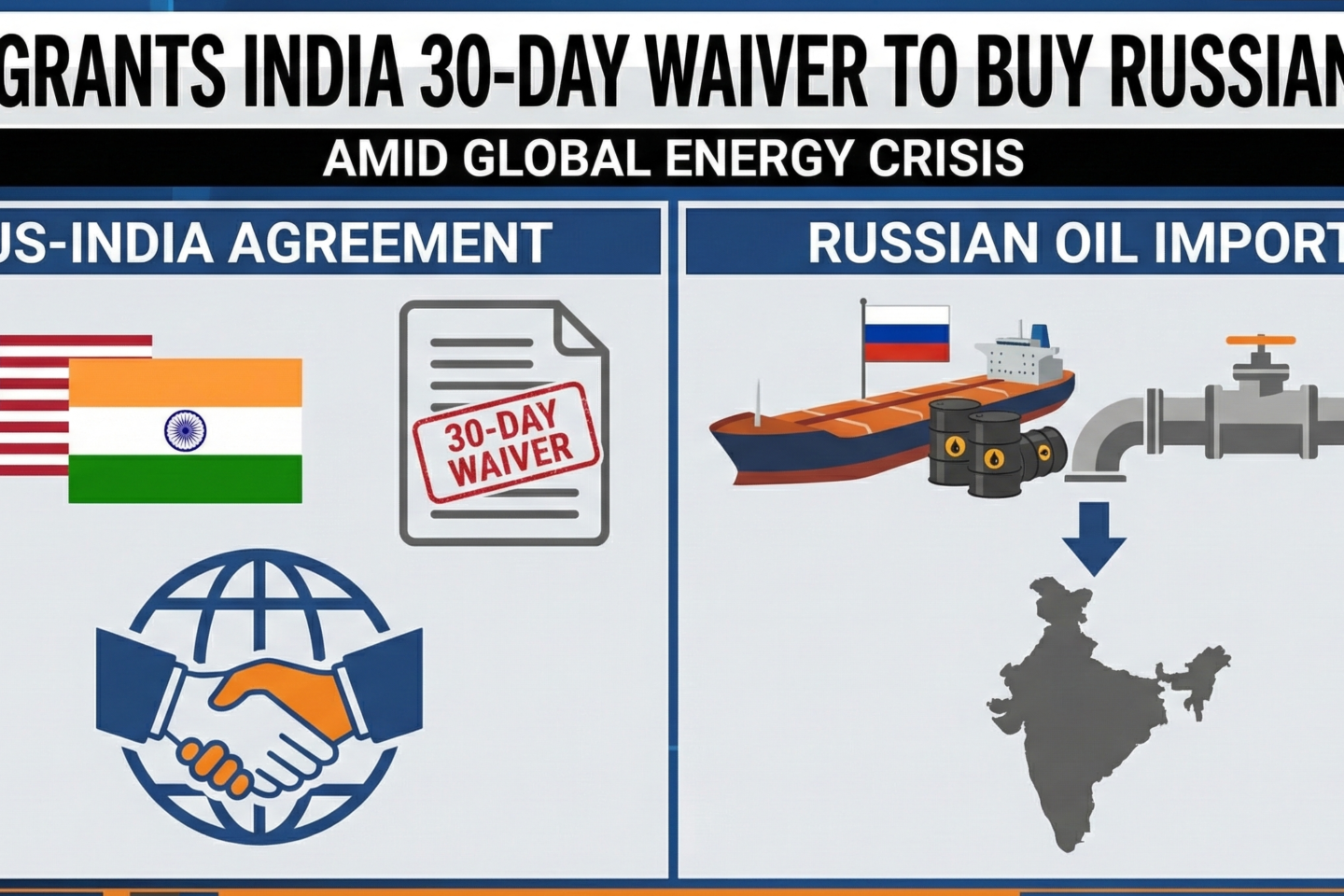
Russian Oil Breaking : In a significant diplomatic and economic development, the United States has granted India a temporary 30-day waiver to purchase Russian oil, providing a crucial buffer for Indian refiners amid escalating tensions in the Middle East and a volatile global energy landscape.
The authorization, issued by the Treasury Department’s Office of Foreign Assets Control (OFAC), allows Indian refiners to receive and sell crude oil and petroleum products of Russian Federation origin that were loaded onto vessels as of March 5, 2026. The waiver remains effective until the end of the day on April 3, 2026.
According to a Treasury statement, the license specifically authorizes transactions involving oil from vessels that may have been blocked by various sanctions regimes, effectively unlocking “stranded” supplies at sea.
Why the US Granted the Waiver: Energy Security and Geopolitics
The decision comes as the administration of former President Donald Trump seeks to prevent a global energy shock. While the US had previously imposed sanctions on Russian oil majors like Lukoil and Rosneft in November 2024 to pressure Moscow over its invasion of Ukraine, the current crisis in the Middle East has forced a recalibration of strategy.
Scott Bessent, the US Treasury Secretary, highlighted the importance of the bilateral relationship, describing India as an “essential partner” of the United States.
In a post on X (formerly Twitter), Bessent framed the waiver as a direct result of America’s energy independence. “President Trump’s energy agenda has resulted in oil and gas production reaching the highest levels ever recorded,” he wrote. “To enable oil to keep flowing into the global market, the Treasury Department is issuing a temporary 30-day waiver to allow Indian refiners to purchase Russian oil.”
He emphasized that the measure is deliberately short-term and designed to prevent financial benefit to the Russian government by targeting oil that was already at sea and stranded due to sanctions.
India’s Role and the Shift Toward US Oil
The waiver is not just about Russia; it is also a strategic move to deepen energy ties with New Delhi. Bessent noted that the US fully anticipates that India will ramp up purchases of American oil in the near future.
This stop-gap measure provides immediate relief to Indian refiners, who had begun diversifying away from Russian crude in recent months. Industry data previously indicated that India’s imports of Russian crude fell to approximately 1.1 million barrels per day in January—the lowest since November 2022—pushing Moscow’s share of overall Indian oil imports down to 21.2%. However, sources suggest that share rebounded to around 30% in February, and this waiver is likely to solidify that trend in the short term.
The Middle East Crisis and the Strait of Hormuz
The urgency of the US decision is underscored by the deteriorating situation in the Middle East. Global energy supplies are facing a double whammy of direct strikes on infrastructure and a strategic blockade.
Key developments impacting global oil supply include:
- Strait of Hormuz Blockade: Iran has blockaded the Strait of Hormuz, a narrow maritime chokepoint through which 20% of the world’s oil supplies pass. This has effectively choked a major artery of global energy trade.
- Attacks on Critical Infrastructure: Major oil facilities have come under fire, including Saudi Aramco’s Ras Tanura refinery and Iraq’s Rumaila oil field. These strikes have raised fears of sustained supply disruptions.
Impact on Global Oil Prices
The combination of the US-Israel conflict with Iran and the closure of the Strait of Hormuz has sent shockwaves through the commodity markets.
Brent crude prices surged to $83.07 per barrel this morning, reflecting the heightened risk premium now embedded in the market.
What This Means for Indian Consumers
Despite the sharp hike in global crude prices, sources have ruled out any immediate increase in petrol and diesel prices in India. The temporary waiver on Russian oil allows Indian refiners to secure supply at potentially discounted rates, providing a cushion against the volatile international market and helping to keep domestic retail prices stable for now.
As the 30-day window progresses, all eyes will be on how much stranded Russian oil India can secure and whether New Delhi begins to pivot toward increased imports of US oil as anticipated by Washington.