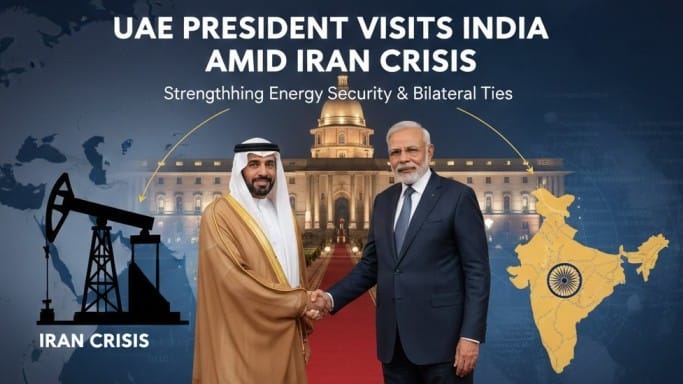
UAE President Sheikh Mohamed bin Zayed Visits India Amid Iran Crisis: Strengthening Energy Security and Bilateral Ties in Turbulent Middle East
New Delhi, January 19, 2026 — In a significant diplomatic development amid heightened regional instability in the Middle East, particularly surrounding the Iran crisis, United Arab Emirates (UAE) President His Highness Sheikh Mohamed bin Zayed Al Nahyan arrived in India today on January 19, 2026. The visit comes at the personal invitation of Prime Minister Narendra Modi and marks the UAE President’s third official state visit to India since assuming office, as well as his fifth trip to the country over the past decade.
The timing of this high-level engagement is particularly noteworthy, as the Iran crisis continues to fuel concerns over energy security, with ongoing tensions involving Israel, potential disruptions in the Strait of Hormuz, and broader geopolitical volatility in West Asia. Analysts view the visit as a strategic move to reinforce India-UAE coordination on energy supplies, trade stability, and regional cooperation, ensuring uninterrupted oil and gas flows critical for global markets, including India’s energy needs.
Deepening the Comprehensive Strategic Partnership
India and the UAE share one of the most dynamic and multifaceted relationships in the world today. Elevated to a Comprehensive Strategic Partnership, the ties encompass political, economic, cultural, and defense dimensions. Bilateral trade has surged dramatically, crossing the $100 billion milestone well ahead of targets, thanks in large part to the Comprehensive Economic Partnership Agreement (CEPA) signed in 2022.
During the upcoming meetings, leaders are expected to focus on expanding trade under CEPA, which has already eliminated tariffs on over 80% of goods and diversified the trade basket beyond traditional energy exports. Key sectors like gems and jewelry, automobiles, electronics, food processing, and pharmaceuticals stand to benefit further from enhanced market access.
Energy cooperation remains the cornerstone of the partnership. The UAE is one of India’s largest and most reliable suppliers of crude oil, liquefied natural gas (LNG), and other petroleum products. Amid the Iran crisis and associated risks to energy routes, discussions will likely emphasize long-term supply agreements, renewable energy collaboration, and joint ventures in clean energy transitions to safeguard mutual interests.
Local Currency Settlements and Investment Boom
A major highlight of the agenda will be the promotion of transactions in local currencies (Local Currency Settlement – LCS). This mechanism, which allows settlements in Indian Rupees and UAE Dirhams, has already reduced dependency on the US dollar for a portion of bilateral trade. It enhances economic resilience for both nations, particularly in volatile global financial conditions influenced by Middle East tensions.
Mutual investments are another priority. UAE investments in India have reached substantial levels, with billions committed in infrastructure, technology, renewable energy, and food security. The recent Bilateral Investment Treaty further protects and encourages such flows. New opportunities in advanced sectors like nuclear energy, AI, digital infrastructure, and the India-Middle East-Europe Economic Corridor (IMEEC) are poised for deeper exploration.
Recent High-Level Exchanges and Momentum
This visit builds on strong momentum from prior engagements. In September 2024, the Crown Prince of Abu Dhabi visited India, followed by the Crown Prince of Dubai (also Deputy Prime Minister and Defence Minister) in April 2025. These interactions have consistently advanced defense, technology, and economic cooperation.
Prime Minister Modi has visited the UAE multiple times, underscoring the personal rapport between the leaders. Cultural symbols, such as the BAPS Hindu Temple in Abu Dhabi, reflect the inclusive ethos strengthening people-to-people ties, with a large Indian diaspora contributing significantly to the UAE economy.
Geopolitical Significance Amid Iran Crisis
The Iran crisis has intensified in early 2026, with protests in Iran, economic pressures, and lingering risks from previous military escalations involving Israel and the US. Threats to the Strait of Hormuz — through which a significant portion of global oil passes — have raised alarms about potential supply disruptions.
In this context, the India-UAE dialogue assumes added importance. Both nations prioritize energy security and regional stability. The UAE, with its pragmatic foreign policy and strong ties across the Gulf, serves as a key partner for India in navigating Middle East complexities. Discussions are anticipated to cover strategies for ensuring stable energy supplies, diversifying sources, and promoting de-escalation in the region.
This high-profile visit not only solidifies bilateral relations but also sends a powerful message about the enduring India-UAE partnership as a stabilizing force in a turbulent world. By focusing on economic integration, energy resilience, and strategic alignment, the two countries aim to turn regional challenges into opportunities for mutual prosperity.
As Prime Minister Modi and President Sheikh Mohamed bin Zayed hold talks, the world watches closely. This engagement could pave the way for enhanced cooperation between the Middle East and South Asia, fostering peace, security, and growth in an uncertain era.