Iran Agrees to Two-Week Ceasefire with US: Safe Passage through Strait of Hormuz Opens as Trump Accepts 10-Point Proposal for Peace Negotiations
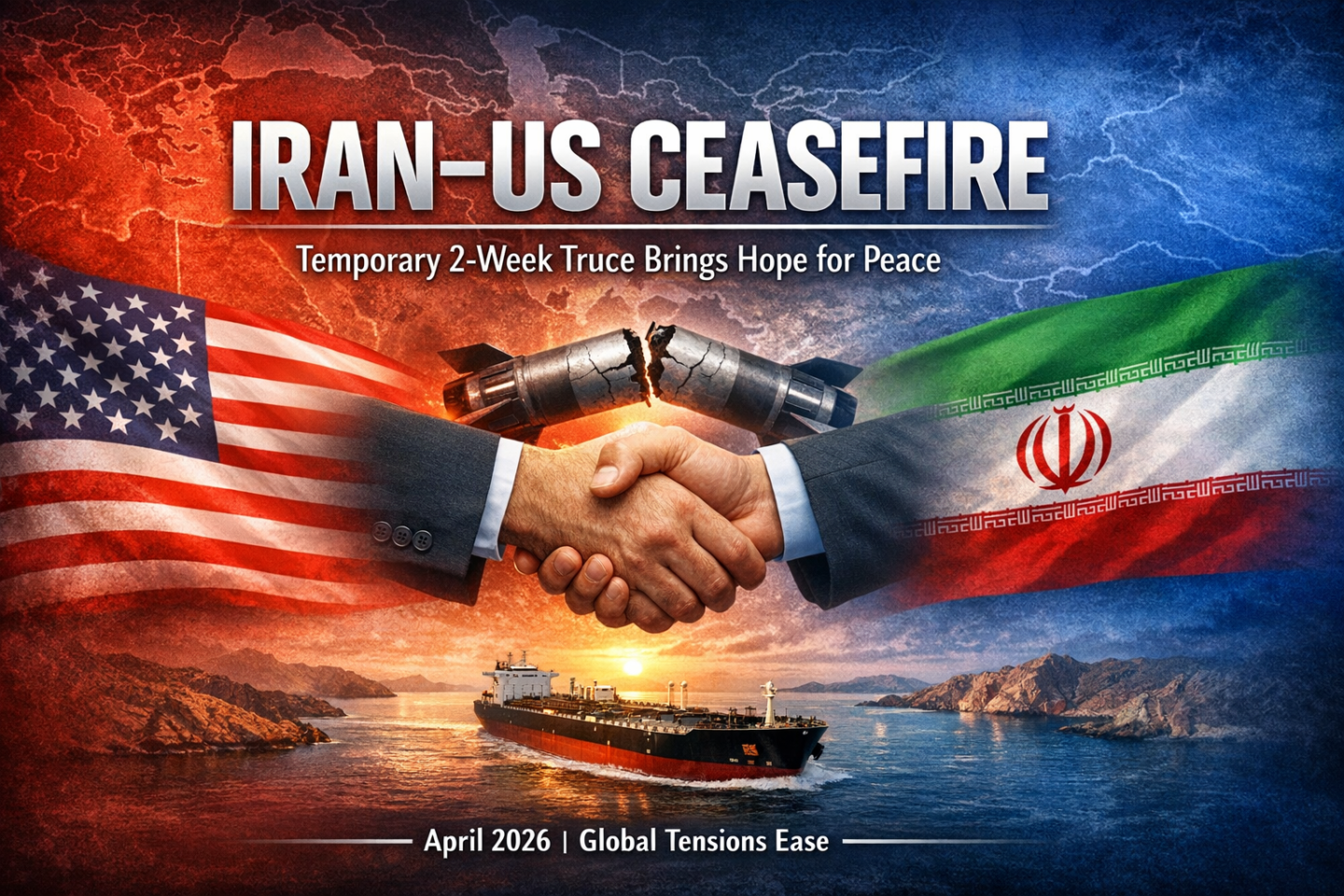
Iran US Ceasefire : In a significant development that brings hope for de-escalation in the ongoing conflict in West Asia, Iran has accepted US President Donald Trump’s peace overture, agreeing to a two-week pause in military operations and safe passage for shipping through the critical Strait of Hormuz. This breakthrough comes amid intense diplomatic efforts, particularly mediated by Pakistan’s Prime Minister Shehbaz Sharif and Field Marshal Asim Munir, and could pave the way for comprehensive negotiations and a possible peace summit in Islamabad.
The announcement marks a potential turning point in the conflict that intensified since late March 2026, with both sides signaling willingness to halt hostilities under specific conditions. Global markets are expected to react positively as fears of prolonged disruption to oil supplies ease, while regional players watch closely for long-term stability in the Middle East.
Details of Iran’s Response and Foreign Minister Araghchi’s Statement
Iranian Foreign Minister Seyed Abbas Araghchi took to X (formerly Twitter) to formally convey Tehran’s position on behalf of the Islamic Republic’s Supreme National Security Council. Expressing gratitude to Pakistani leaders for their “tireless efforts to end the war in the region,” Araghchi highlighted the brotherly request from PM Sharif and the US overture based on negotiations.
Araghchi stated: “In response to the brotherly request of PM Sharif in his tweet, and considering the request by the U.S. for negotiations based on its 15-point proposal as well as announcement by POTUS about acceptance of the general framework of Iran’s 10-point proposal as a basis for negotiations, I hereby declare… If attacks against Iran are halted, our Powerful Armed Forces will cease their defensive operations. For a period of two weeks, safe passage through the Strait of Hormuz will be possible via coordination with Iran’s Armed Forces and with due consideration of technical limitations.”
This conditional ceasefire underscores Iran’s defensive posture while opening the door for dialogue. The two-week window is seen as a critical breathing space to address longstanding issues, including sanctions, regional security, and nuclear concerns, without immediate escalation.
Trump’s Announcement on Truth Social: Suspending Attacks and Embracing Negotiations
US President Donald Trump made the parallel announcement via a detailed post on Truth Social, confirming the suspension of US “bombing and attack” operations against Iran for two weeks. Trump emphasized that the decision followed direct conversations with Pakistan’s PM Shehbaz Sharif and Field Marshal Asim Munir, who urged him to hold off planned strikes.
Trump wrote: “Based on conversations with Prime Minister Shehbaz Sharif and Field Marshal Asim Munir, of Pakistan, and wherein they requested that I hold off the destructive force being sent tonight to Iran, and subject to the Islamic Republic of Iran agreeing to the COMPLETE, IMMEDIATE, and SAFE OPENING of the Strait of Hormuz, I agree to suspend the bombing and attack of Iran for a period of two weeks. This will be a double-sided CEASEFIRE!”
He further noted that the US has “already met and exceeded all Military objectives” and described Iran’s 10-point proposal as “a workable basis on which to negotiate.” Trump added that “almost all of the various points of past contention have been agreed to between the United States and Iran,” with the two-week period allowing time to finalize a permanent agreement. He framed the move as an “Honor” for the US and Middle East countries, bringing a “long-term problem close to resolution.”
The US leader reiterated that Iran has agreed to key elements from previous disputes, positioning the pause as a pathway to broader Middle East peace.
Role of Pakistan’s Mediation: Sharif and Munir’s Crucial Intervention
Pakistan has emerged as a key diplomatic bridge in this crisis. Both Trump and Araghchi credited PM Shehbaz Sharif and Field Marshal Asim Munir for their proactive role. Sharif’s public appeals, including tweets urging restraint, reportedly helped avert immediate escalation just hours before a US deadline.
This mediation highlights Pakistan’s strategic position and its interest in regional stability, given its borders and economic ties. Analysts suggest the involvement could lead to a formal peace summit in Islamabad as early as this week or next, providing a neutral venue for US-Iran talks. Such a summit would build on the current two-week framework and address Iran’s 10-point proposal alongside US demands.
Background of the Conflict: From Escalation to the March 28 Turning Point
The current tensions escalated significantly after military actions began involving US and Israeli forces against Iranian targets, with Iran responding by restricting access through the Strait of Hormuz—a chokepoint carrying roughly one-fifth of global oil supplies. Reports indicate disruptions started intensifying around March 28, 2026, when Iran asserted greater control, impacting shipping, insurance rates, and energy prices worldwide.
Prior exchanges included US threats of further strikes on Iranian infrastructure if the strait remained closed, alongside Iranian insistence on a permanent resolution rather than temporary pauses. Earlier proposals, such as a 45-day ceasefire draft, faced rejections from Tehran, which sought guarantees against future attacks, sanctions relief, and broader regional de-escalation.
The shift to a mutual two-week ceasefire represents a pragmatic compromise: Iran maintains coordination over Hormuz transit (acknowledging technical limits), while the US halts offensive operations, citing achieved military goals. Israel has reportedly aligned with the pause, though concerns remain in some quarters about unresolved issues like Iran’s nuclear program and proxy activities.
Strategic Importance of the Strait of Hormuz and Global Economic Implications
The Strait of Hormuz remains the lifeline for energy markets. Safe passage during the two-week period, coordinated with Iranian forces, is expected to ease immediate pressures on global oil supplies, potentially lowering prices that spiked amid fears of prolonged closure.
Experts note that even limited reopening could stabilize shipping insurance and reduce risks for tankers. However, “technical limitations” mentioned by Araghchi suggest controlled rather than fully unrestricted flow, requiring careful coordination to avoid incidents.
Broader economic ripple effects include impacts on Asian economies heavily reliant on Gulf oil, European energy security, and global inflation trends. A successful extension into permanent arrangements could usher in a new phase of energy market predictability in the Middle East.
What Lies Ahead: Path to Comprehensive Negotiations and Peace Summit
The two-week ceasefire is widely viewed as a foundation for deeper talks. Key agenda items likely include:
- Finalizing elements from Iran’s 10-point proposal and any US 15-point framework.
- Addressing nuclear enrichment concerns and verification mechanisms.
- Regional security arrangements involving proxies and neighboring states.
- Sanctions relief and economic reconstruction steps.
- Long-term guarantees for freedom of navigation in the Strait of Hormuz.
A potential peace summit in Islamabad could accelerate these discussions, leveraging Pakistan’s neutral facilitation. Both sides have expressed optimism, with Trump highlighting progress on “past contention” points and Iran stressing defensive restraint if unprovoked.
Skeptics caution that historical mistrust between the US and Iran, plus involvement of other actors like Israel, could complicate implementation. Monitoring will be intense in the coming days for any violations or confidence-building measures.
Reactions and Expert Analysis on the Ceasefire Breakthrough
International observers have welcomed the pause as a relief for global stability. Energy analysts predict short-term oil price corrections, while diplomats emphasize the need for verifiable compliance.
Pakistani officials are expected to build on their mediation success, potentially earning recognition for preventing wider conflict. For the US, the move aligns with Trump’s stated goal of achieving peace through strength after meeting military objectives. Iran positions it as a demonstration of resilience and readiness for equitable dialogue.
As the clock starts on the two-week window, the world watches whether this temporary halt evolves into lasting peace in West Asia. The involvement of high-level figures and mutual acknowledgments of proposals signal serious intent, offering a rare diplomatic opening in a volatile region.
This development not only addresses immediate humanitarian and economic concerns but also holds potential to reshape Middle East geopolitics if negotiations bear fruit. Updates will continue as further details on the Islamabad talks emerge.