Galgotias University Robotic Dog Controversy at India AI Impact Summit 2026: Chinese Unitree Go2 Misrepresented as ‘Orion’ Sparks Backlash, University Booted Out
The Galgotias University robotic dog controversy has erupted into one of the most talked-about scandals in India’s higher education and AI ecosystem following the India AI Impact Summit 2026 held in New Delhi. What began as an enthusiastic showcase at a prestigious government-backed event quickly turned into widespread mockery, accusations of misrepresentation, and eventual expulsion from the summit expo.
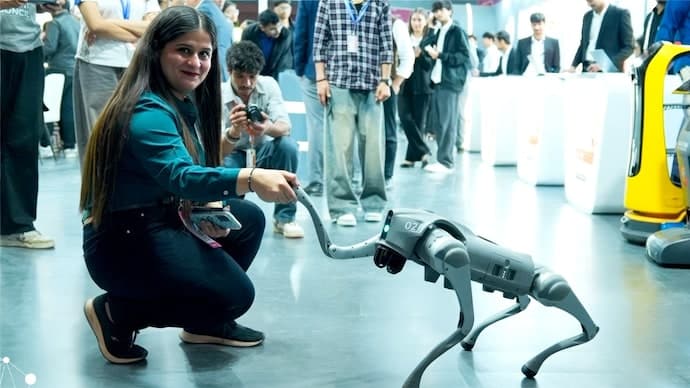
At the heart of the storm is a quadruped robotic dog displayed at Galgotias University’s pavilion, branded as “Orion” and initially presented as an innovation from the university’s “Centre of Excellence.” However, internet sleuths and tech enthusiasts swiftly identified it as the commercially available Unitree Go2, a product manufactured by China’s Unitree Robotics—a company known for affordable, high-performance quadruped robots used globally in research, education, and entertainment.
This incident not only embarrassed the Greater Noida-based private university but also prompted a strong reaction from the Ministry of Electronics and Information Technology (MeitY), highlighting the government’s push for genuine innovation amid India’s ambition to lead in artificial intelligence.
How the Controversy Unfolded at India AI Impact Summit 2026
The India AI Impact Summit 2026, held at Bharat Mandapam in New Delhi, aimed to showcase India’s advancements in AI, robotics, and emerging technologies. It featured pavilions from universities, startups, corporations, and government bodies, drawing attention from policymakers, industry leaders, and the media.
Galgotias University, known for its engineering and technology programs, set up a stall to highlight its AI initiatives. During a live interview with state broadcaster DD News, Professor Neha Singh, from the Department of Communications, enthusiastically introduced the robotic dog.
“You need to meet Orion,” Singh said, as the robot performed tricks like waving and standing on its hind legs. She described it as “developed by the Centre of Excellence at Galgotias University,” implying it was an in-house creation from one of the institution’s specialized AI or robotics hubs.
The clip went viral almost immediately. Social media users, many with backgrounds in robotics and engineering, noticed striking similarities to the Unitree Go2—a popular model from Unitree Robotics priced starting around ₹2-3 lakh (approximately $2,200–$3,600 USD) in India. The robot’s design, movements, branding (visible Unitree markings), and capabilities matched exactly.
Critics accused the university of passing off imported Chinese technology as indigenous innovation, especially ironic at an event promoting India’s AI self-reliance. Memes flooded platforms like X (formerly Twitter), Reddit, and Instagram, with users joking about “made in China, claimed in Greater Noida.”
Professor Neha Singh’s Defense and the Famous “Six Can Be My Nine” Remark
Facing intense scrutiny, Professor Singh addressed the media on Wednesday via PTI. She attributed the uproar to “miscommunication” and her own lack of eloquence under pressure.
“The controversy happened because things may not have been expressed clearly. I take accountability that perhaps I did not communicate properly, as it was done with a lot of energy and enthusiasm and very quickly, in a jiffy,” she explained.
Singh emphasized that the robot retained its original branding and was never claimed as manufactured by the university. “One important thing is that the robodog clearly has its branding on top, we have not changed that. So, how can we claim that we manufactured it? I have told everyone that we introduced it to our students to inspire them to create something better on their own.”
When pressed further on potential misinterpretation, she quipped, “Your six can be my nine”—a phrase suggesting perspectives can flip depending on viewpoint. This remark backfired spectacularly, becoming fodder for memes and criticism labeling it as evasive or dismissive.
Galgotias University’s Official Apology and Blame Game
The university swiftly distanced itself from the incident in a formal statement, apologizing “profusely for the confusion” at the summit.
It described Professor Singh as “ill-informed” about the product’s origins and unauthorized to speak to the press. “One of our representatives, manning the pavilion, was ill-informed. She was not aware of the technical origins of the product and in her enthusiasm of being on camera, gave factually incorrect information even though she was not authorised to speak to the press,” the statement read.
Galgotias insisted there was “no intent to misrepresent” and reaffirmed commitment to “academic integrity, transparency, and responsible representation.” It confirmed vacating the pavilion as directed by organizers.
The university later clarified that “Orion” was procured from Unitree as a demonstrative tool to inspire students, not presented as their development.
Centre’s Response: MeitY Secretary S Krishnan on Misinformation
MeitY Secretary S Krishnan addressed the issue directly, underscoring the need for authenticity at such platforms.
“We want genuine and actual work to be reflected in the way that people exhibit in expos. The idea is not to sort of use this as an opportunity in any other fashion. So we don’t want a controversy around exhibits which are presented here,” Krishnan stated.
He stressed that “misinformation cannot be encouraged” and exhibitors should follow a code of conduct. However, he clarified no pre-certification is required for demos, as that would stifle innovation.
“The exhibit was not for sale… When somebody is demonstrating a product, you presume that they know what they are talking about. If we have to certify even what has to be exhibited, then you’ll say we are stifling innovation. Our intention is not to stifle innovation,” he added.
The organizers promptly asked Galgotias to clear its pavilion, which it did, ending its participation.
Broader Implications for AI Education and Innovation in India
This episode raises serious questions about transparency in India’s private higher education sector, especially in emerging fields like AI and robotics.
Private universities like Galgotias often partner with global firms and showcase imported tech to demonstrate capabilities. However, mislabeling can damage credibility, particularly when national events push “Atmanirbhar Bharat” (self-reliant India) narratives.
The controversy also spotlights challenges in verifying claims at large expos. With hundreds of exhibitors, organizers rely on self-declarations, but viral social media scrutiny acts as a rapid fact-check mechanism.
Interestingly, reports emerged that another major player, Wipro, displayed a similar Unitree Go2 at its pavilion—though without claiming in-house development—highlighting how common such demos are.
For students and researchers, incidents like this underscore the importance of ethical representation. Galgotias maintains its focus on inspiring innovation, but rebuilding trust will take time.
Unitree Go2: What Is the Robot at the Center of the Storm?
The Unitree Go2 is a compact, agile quadruped robot from Unitree Robotics, a leading Chinese firm. Key features include:
- Advanced AI-driven locomotion for walking, running, jumping, and obstacle navigation.
- Payload capacity, voice commands, and app control.
- Used in education, research, inspection, and entertainment.
- Priced accessibly compared to competitors like Boston Dynamics’ Spot.
In India, it’s popular among universities and hobbyists for AI experiments—making the mix-up understandable but the presentation problematic.
Social Media Backlash and Public Reaction
The row dominated online discussions, with hashtags like #GalgotiasRobodog and #OrionFiasco trending. Users criticized it as emblematic of “jugaad” culture gone wrong or pressure to appear innovative.
Opposition voices called it “truly embarrassing for India,” while supporters argued it was an overblown misunderstanding.
Conclusion: Lessons from the Galgotias University Robotic Dog Controversy
The Galgotias University robotic dog controversy serves as a cautionary tale for institutions participating in high-profile events. While enthusiasm for technology is welcome, clarity and honesty are non-negotiable—especially in AI, where India aims for global leadership.
As the dust settles, the incident reinforces that genuine innovation, not borrowed glory, will define India’s AI future. Galgotias has apologized and moved on, but the episode will linger in discussions about ethics in education and exhibition practices.