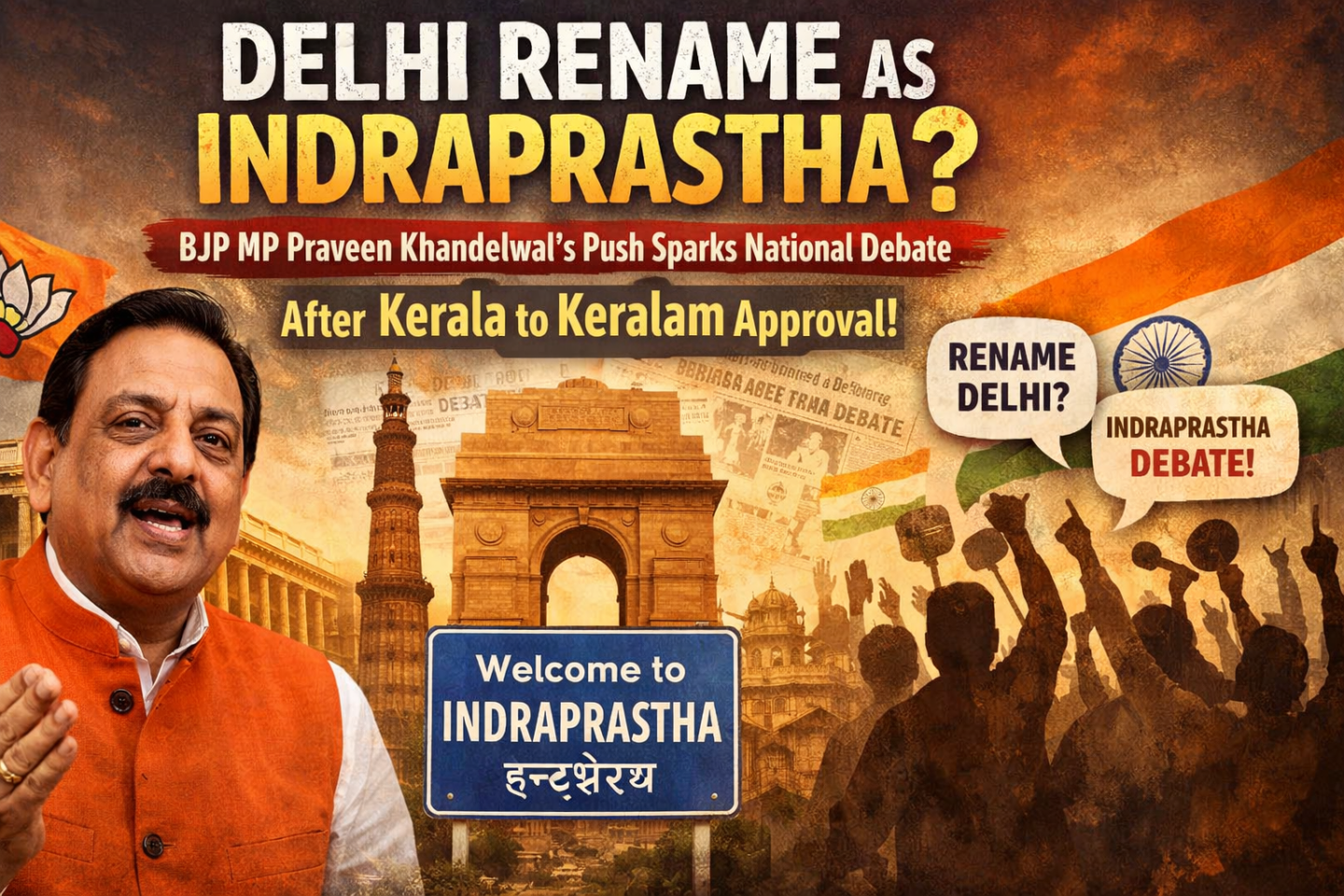
Delhi Rename as Indraprastha: BJP MP Praveen Khandelwal’s Push Sparks National Debate After Kerala to Keralam Approval
The demand to rename Delhi as Indraprastha has intensified following recent developments in state renaming initiatives across India. BJP MP from Chandni Chowk, Praveen Khandelwal, has formally urged the Central Government to restore the ancient name, citing deep historical, mythological, and archaeological ties.
In a significant development that has reignited discussions on cultural identity and historical reclamation in India, the demand for Delhi rename as Indraprastha has surged into the national spotlight. On February 25, 2026, BJP MP Praveen Khandelwal from the Chandni Chowk constituency wrote letters to Union Home Minister Amit Shah and Delhi Chief Minister Rekha Gupta, formally requesting the renaming of India’s national capital from Delhi to Indraprastha. This move comes hot on the heels of the Union Cabinet’s approval on February 24, 2026, to rename the state of Kerala as Keralam, aligning its official English name with its traditional Malayalam pronunciation.
The proposal has triggered widespread debate, with supporters hailing it as a step toward honoring India’s ancient civilizational legacy, while critics question its practicality and potential for controversy. This comprehensive article delves into the historical background, archaeological evidence, political context, potential implications, and public reactions surrounding the Delhi rename as Indraprastha demand.
Historical Roots: Indraprastha in the Mahabharata
The name Indraprastha traces its origins to the ancient Indian epic, the Mahabharata. According to the epic, Indraprastha was the magnificent capital city established by the Pandavas—Yudhishthira, Bhima, Arjuna, Nakula, and Sahadeva—after their exile and the division of the kingdom. Built on the banks of the Yamuna River with divine assistance from Lord Indra (hence the name, meaning “City of Indra” or “Prosperous City of Indra”), it was described as a prosperous, well-planned metropolis adorned with palaces, gardens, and advanced architecture.
The Mahabharata portrays Indraprastha as a symbol of dharma, prosperity, and cultural excellence. The famous Sabha Parva details its construction by the divine architect Maya Danava, featuring illusions like crystal floors and shimmering halls that even disoriented visitors. This ancient city is believed to have been a center of governance, trade, and spirituality during the Dvapara Yuga.
Scholars and historians have long associated the geographical location of modern Delhi with this legendary city. The Yamuna River’s course remains consistent, and the region’s fertile plains match the epic’s descriptions. Proponents of the Delhi rename as Indraprastha argue that reverting to this name would reconnect the modern capital with its primordial civilizational identity, predating medieval and colonial influences.
Why ‘Delhi’ and the Call for Change
The name “Delhi” is believed to have evolved over centuries. Historical records link it to various origins, including “Dhillika” from the Tomar Rajputs in the 8th-9th centuries, or influences from Persian and Turkic rulers during the Delhi Sultanate era (starting in the 12th century). Names like Yoginipura, Dhillipur, and Shahjahanabad (for Old Delhi) have been used at different points.
Critics of the current name, including MP Praveen Khandelwal, contend that “Delhi” represents a later medieval phase dominated by foreign invasions and sultanates, rather than India’s indigenous Vedic and epic heritage. In his letter to Amit Shah, Khandelwal emphasized that India, as one of the world’s oldest living civilizations, deserves a capital name reflecting its deepest roots. He stated that renaming would “reconnect the capital of modern India with its ancient civilizational foundation.”
This is reportedly the second such letter from Khandelwal in recent months, indicating persistent advocacy. He has also proposed additional symbolic measures, such as installing statues of the Pandavas at key sites like Purana Qila and renaming landmarks, including Old Delhi Railway Station as “Indraprastha Junction.”
Archaeological Evidence Supporting the Claim
A key pillar of the Delhi rename as Indraprastha argument is archaeological findings from sites in Delhi. The Archaeological Survey of India (ASI) has conducted extensive excavations at Purana Qila (Old Fort), widely regarded as the core of ancient Indraprastha.
Discoveries include Painted Grey Ware pottery dated to around 1000 BCE, aligning with the late Vedic and Mahabharata period. Other artifacts, such as terracotta figurines, beads, seals, and structural remains, indicate continuous habitation from the pre-Mauryan era through medieval times. Excavations have revealed layers of settlements predating the Delhi Sultanate by over a millennium.
These findings bolster claims that present-day Delhi overlays the ancient Indraprastha site. Historians note that while definitive proof linking every artifact directly to the Mahabharata is challenging due to the epic’s mythological elements, the continuity of settlement and geographical match provide strong circumstantial evidence.
Political Context: Triggered by Kerala to Keralam
The timing of Khandelwal’s renewed push is no coincidence. On February 24, 2026, the Union Cabinet, chaired by Prime Minister Narendra Modi, approved the Kerala government’s long-standing proposal to change the state’s name from Kerala to Keralam. This aligns the English name with the Malayalam “Keralam,” meaning “land of coconuts” or simply the local pronunciation.
The Kerala Assembly had passed a unanimous resolution in June 2024 urging the change, emphasizing cultural and linguistic pride. Union Minister Ashwini Vaishnaw confirmed the approval, noting it reflects the people’s will. The process now involves constitutional amendments, including referral to the Kerala Assembly under Article 3.
This precedent has encouraged similar demands elsewhere. West Bengal Chief Minister Mamata Banerjee has advocated renaming her state to “Bangla.” In this wave of identity reclamation, the Delhi rename as Indraprastha proposal has found fertile ground, especially among those favoring decolonization of names (e.g., Bombay to Mumbai, Madras to Chennai, Calcutta to Kolkata).
Delhi’s unique status as the national capital adds complexity. Any name change would require parliamentary approval and constitutional amendments, as it affects the Constitution’s First Schedule.
Reactions and Differing Opinions
The proposal has elicited mixed responses. Supporters, including cultural activists and some BJP leaders, view it as a celebration of Sanatan Dharma and national pride. They argue it would inspire younger generations to connect with epics like the Mahabharata.
However, opponents raise concerns about administrative disruption—updating maps, documents, signage, currency references, and international recognition. Some see it as politically motivated or unnecessary, given Delhi’s global brand as a modern metropolis. Critics from opposition parties have questioned the focus on symbolic changes amid pressing issues like infrastructure and pollution.
Public opinion remains divided, with social media buzzing with polls and debates: “Should Delhi become Indraprastha?” has trended, reflecting broader conversations on heritage vs. modernity.
Potential Implications if Implemented
Should the Delhi rename as Indraprastha proceed, it could symbolize a broader cultural renaissance. It might boost tourism to sites like Purana Qila and Hastinapur, promote mythological education, and reinforce India’s narrative as a civilizational powerhouse.
Practically, the transition would involve phased implementation: updating official records, public awareness campaigns, and international notifications. Precedents from other renamings suggest minimal long-term disruption.
As of now, no official decision has been announced. The Central Government has yet to respond formally to Khandelwal’s letters, leaving the proposal in the realm of discussion.
Conclusion: A Step Toward Reclaiming Heritage?
The demand for Delhi rename as Indraprastha encapsulates a larger quest to align modern India with its ancient glory. Sparked by the Kerala to Keralam change, it highlights ongoing efforts to honor linguistic, cultural, and historical identities.
Whether this becomes reality depends on political will, public consensus, and constitutional processes. For now, it fuels vital conversations about who we are as a nation and how our capital should reflect that identity.
As developments unfold, this story continues to evolve. Stay tuned for updates on the Delhi rename as Indraprastha debate.