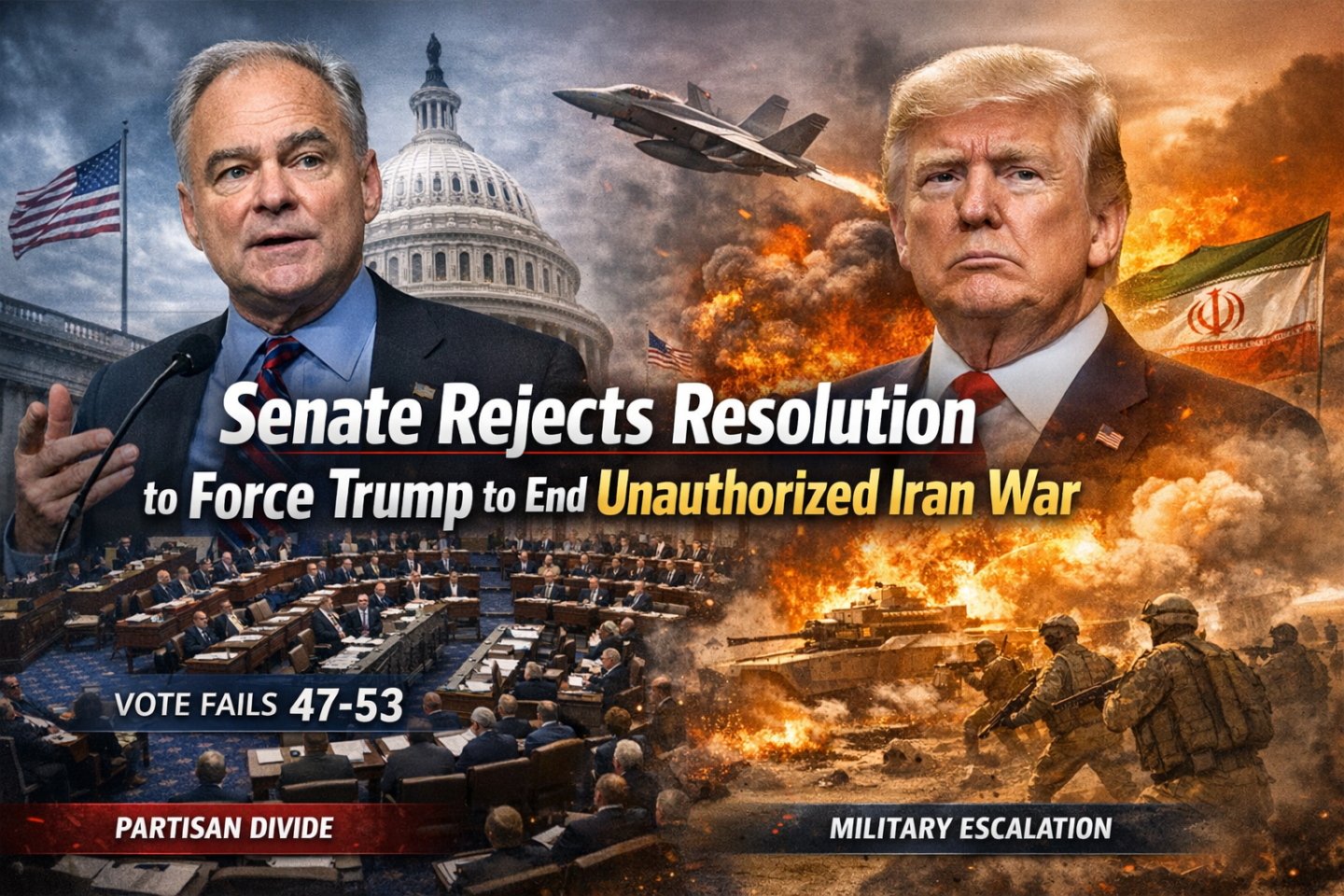
The U.S. Senate has rejected a War Powers Resolution introduced by Sen. Tim Kaine (D-VA) that aimed to curb President Donald Trump’s authority to continue military operations against Iran without explicit congressional approval. The vote, which fell largely along party lines on Wednesday, March 4, 2026, leaves the president’s military actions in the ongoing conflict largely unchecked as the operation enters its fifth day.
Senate Rejects Resolution to Force Trump to End Unauthorized Iran War
In a significant display of partisan division amid an escalating international crisis, the United States Senate voted down a bipartisan War Powers Resolution on Wednesday, March 4, 2026, effectively endorsing President Donald Trump’s unchecked authority to prosecute military actions against the Islamic Republic of Iran. The resolution, spearheaded by Sen. Tim Kaine (D-VA) and supported by a coalition of Democrats along with Republican Sen. Rand Paul (R-KY), sought to direct the removal of U.S. Armed Forces from hostilities against Iran unless explicitly authorized by Congress through a declaration of war or specific Authorization for Use of Military Force (AUMF).
The final tally was 47-53, with nearly all Democrats voting in favor and Republicans overwhelmingly opposed, barring Paul’s lone crossover support. This outcome mirrors previous failed attempts, including a similar resolution in June 2025 following earlier U.S. strikes on Iranian nuclear facilities, underscoring the persistent partisan rift over executive war powers.
The vote arrives against the backdrop of Operation Epic Fury, the codename for the U.S.-led (and allied with Israel) military campaign launched in late February/early March 2026. The operation began with airstrikes targeting Iranian nuclear sites, ballistic missile arsenals, naval assets, and proxy networks, rapidly expanding into broader hostilities. By the fifth day of direct U.S. involvement, reports indicate hundreds of targets struck, significant Iranian casualties (over 900 reported by Iran’s health ministry), and at least six U.S. service members killed with others injured. The conflict has spread regionally, involving Israeli operations, Iranian missile and drone responses, and incidents such as the U.S. sinking of an Iranian warship via submarine torpedo—the first such naval action since World War II.
Sen. Richard Blumenthal (D-CT), a vocal critic, warned of severe political repercussions for Republicans. “Republicans are on record today and they’re going to be held accountable,” Blumenthal stated. “Elections have consequences. This widening war, I fear, puts us on the precipice of American troops on the ground.” His comments reflect broader Democratic concerns that the conflict risks becoming another prolonged Middle East quagmire, reminiscent of Iraq and Afghanistan, with potential for boots-on-the-ground escalation despite administration assurances to the contrary.
Most Republican senators defended the administration’s position, arguing that the current operations are limited in scope, defensive in nature, and do not trigger the full requirements of the 1973 War Powers Resolution. That law mandates congressional approval for sustained hostilities beyond 60 days (with a possible 30-day extension), but proponents of the president’s authority contend that ongoing actions fall under existing executive prerogatives, including self-defense of U.S. interests, allies like Israel, and prevention of imminent threats such as Iran’s nuclear ambitions or proxy attacks.
The Pentagon has provided no fixed end date for the campaign. Defense Secretary Pete Hegseth, in remarks Wednesday, emphasized flexibility: “The only limits we have in this is President Trump’s desire to achieve specific effects on behalf of the American people,” Hegseth said. “That’s why we don’t talk about, you can say, four weeks, but it could be six. It could be eight, it could be three.” Hegseth has repeatedly framed the operation as decisive and finite—not an “endless” war like past conflicts—while acknowledging likely additional U.S. casualties. He has highlighted achievements, such as the elimination of key Iranian figures involved in alleged plots against Trump and the degradation of Tehran’s military capabilities.
On the House side, Speaker Mike Johnson (R-LA) is actively working to defeat a parallel War Powers Resolution sponsored by Rep. Thomas Massie (R-KY), scheduled for a vote Thursday, March 5, 2026. “We know, and history will record we did the right thing,” Johnson said. “I think passage of a War Powers Resolution right now would be a terribly dangerous idea.” Like the Senate measure, the House version is expected to fail along party lines, further solidifying congressional acquiescence to executive action in the short term.
The resolution’s failure highlights ongoing debates over constitutional war powers. Critics, including Kaine, argue that Trump’s initiation of hostilities without prior congressional authorization violates Article I of the Constitution, which vests Congress with the power to declare war. Kaine has long championed restraints on unauthorized military engagements, having pushed similar measures in past administrations. Supporters of the president counter that modern threats—rapid missile capabilities, proxy warfare, and nuclear proliferation—necessitate swift executive response without legislative delay.
The conflict’s origins trace to heightened tensions following Iran’s alleged attempts on Trump’s life (as cited by administration officials), longstanding support for terrorism, nuclear program advancements, and regional aggression. The White House describes Operation Epic Fury as a “peace through strength” effort to eliminate nuclear threats, destroy missile stockpiles, dismantle proxy networks, and potentially foster regime change, though messaging has shifted from precise strikes to broader objectives.
Public opinion remains divided, with polls showing limited support for prolonged engagement amid concerns over energy prices, economic fallout, and American lives. Democrats warn of a “forever war” draining resources better spent domestically, while Republicans portray it as necessary to prevent greater threats.
As the House prepares its vote and military operations intensify, the Senate’s rejection sends a clear signal: for now, President Trump’s authority over the Iran campaign remains largely intact. Whether this changes amid battlefield developments, mounting casualties, or shifting political winds remains uncertain, but the vote ensures Congress has formally declined to intervene—at least in this instance.
This developing story will continue to unfold as the conflict progresses. Stay tuned for updates on the House vote, Pentagon briefings, and any international diplomatic responses.