Operation Sindoor Shines at Republic Day 2026 Tableau
Operation Sindoor, India’s decisive military response to Pakistan-backed terrorism, emerged as one of the most striking highlights of the 77th Republic Day Parade held on January 26, 2026, in New Delhi. The tri-services tableau, boldly titled “Victory Through Jointness,” vividly captured the seamless integration of the Indian Army, Navy, and Air Force during the high-stakes operation launched in May 2025. This display not only commemorated a swift and successful campaign but also projected India’s evolving military doctrine of rapid, technology-driven, and unified warfare to the world.
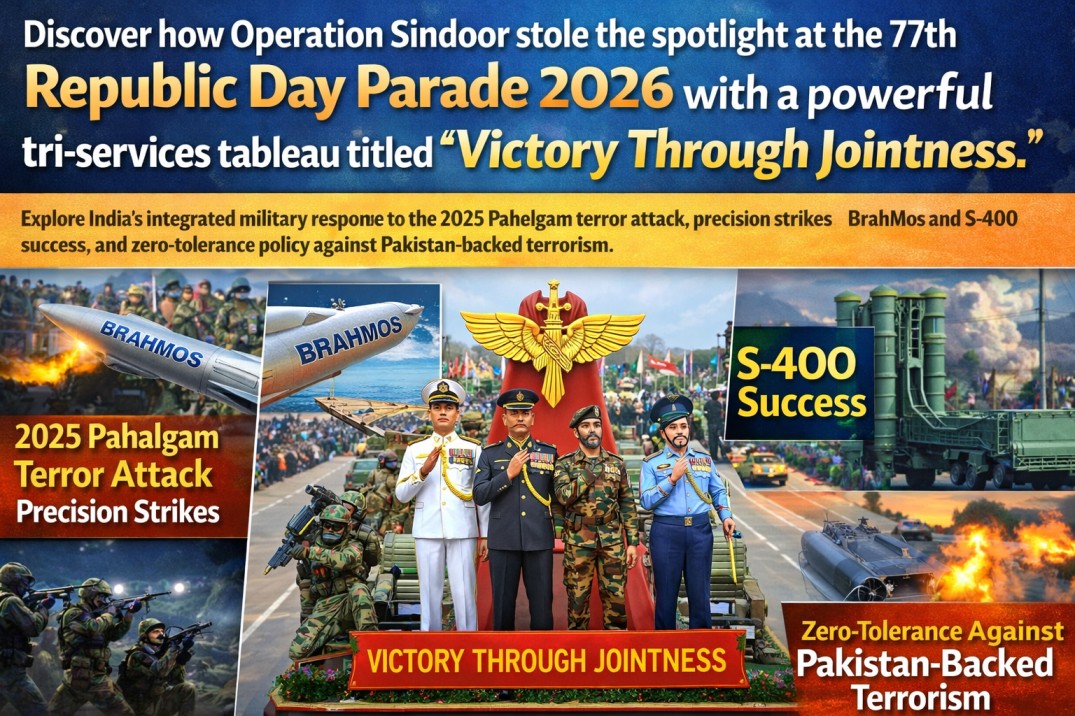
The Republic Day celebrations, a symbol of India’s sovereignty and military pride, featured this special tableau rolling down Kartavya Path amid cheers from thousands of spectators and dignitaries. The theme “Victory Through Jointness” encapsulated the core message: in an era of complex threats, India’s armed forces achieve dominance through unparalleled coordination across land, sea, and air domains. The tableau illustrated precision airstrikes by the Indian Air Force, the Navy’s rapid maritime dominance maneuvers, and the Army’s ground operations in perfect sync—demonstrating readiness to counter any aggression decisively.
Operation Sindoor began in the early hours of May 7, 2025, as a direct retaliatory action following a brutal terrorist attack in Pahalgam, Jammu and Kashmir, on April 22, 2025. The attack, attributed to Pakistan-supported groups, claimed the lives of 26 innocent civilians, mostly tourists, sending shockwaves across the nation. In line with Prime Minister Narendra Modi’s reiterated stance of zero tolerance toward terrorism, the Indian Armed Forces executed precise, non-escalatory strikes targeting terrorist infrastructure in Pakistan and Pakistan-occupied Kashmir (PoK).
Advanced weaponry played a pivotal role in the operation’s success. BrahMos supersonic cruise missiles, known for their speed and accuracy, were deployed effectively alongside the S-400 Triumf air defense systems, which provided robust protection against aerial threats. Reports from international think tanks, including Swiss and European defense analyses, highlighted how India’s achievement of air superiority by May 10 forced Pakistani commanders to seek a ceasefire amid mounting losses. The four-day conflict ended on May 10, 2025, without targeting military installations, underscoring India’s calibrated yet firm approach—focusing solely on dismantling terror networks.
The Republic Day 2026 tableau went beyond mere celebration of past victories. It emphasized the future trajectory of India’s defense posture: mission-oriented, technology-centric, and rapid-response capabilities. Symbolic elements depicted integrated command centers, real-time data sharing, and the use of stand-off weapons, reflecting lessons learned from Operation Sindoor. This operation has been hailed by military experts as a turning point, establishing a new doctrine where any cross-border terror strike invites heavy, proportionate retaliation.
The display featured scaled models and dynamic visuals of key assets like Rafale jets delivering precision strikes, naval assets enforcing maritime control, and army units conducting synchronized ground maneuvers. The integration showcased how the three services operated under unified theater commands, a reform pushed in recent years to enhance jointness. BrahMos launchers and S-400 batteries took center stage, symbolizing indigenous and acquired technological edge that proved decisive in the conflict.
Experts and analysts view the tableau as a strategic signal to adversaries and allies alike. It reaffirmed that India’s “zero tolerance” policy is not rhetoric but backed by demonstrated capability. Post-operation assessments from global sources, such as the Carnegie Endowment and Stimson Center, noted India’s ability to conduct sustained stand-off attacks across vast areas while maintaining escalation control. This has bolstered India’s image as a responsible yet resolute power in South Asia.
The inclusion of Operation Sindoor in the Republic Day Parade also highlighted broader defense reforms. The emphasis on jointness aligns with the creation of integrated theater commands and increased focus on indigenous defense production. The operation’s success has accelerated investments in advanced munitions, air defense networks, and multi-domain operations, preparing the forces for future challenges.
For the Indian public, the tableau evoked national pride. Spectators witnessed a powerful reminder that the armed forces stand united to protect sovereignty and civilian lives. As one defense analyst observed, “Operation Sindoor marked the beginning of a new India—one that responds to terror with clarity, force, and unity.”
In a broader geopolitical context, the 2026 Republic Day celebrations, with the European Union as a key participant, underscored India’s growing global stature. The tableau’s message resonated internationally: threats to India’s security will meet a unified, technologically superior response.
As India marches forward, Operation Sindoor’s legacy—symbolized so prominently on this historic day—serves as both inspiration and warning. It reinforces that the nation’s defense is not just about weapons but about the unbreakable spirit of jointness and resolve. The 77th Republic Day Parade, through this unforgettable display, has etched Operation Sindoor into the annals of modern Indian military history, heralding an era of “Victory Through Jointness.”