Nepal’s 2026 Election:: Historic Polls on March 5 After 2025 Anti-Corruption Uprising – Key Contenders, Jhapa-5 Battle & What’s at Stake
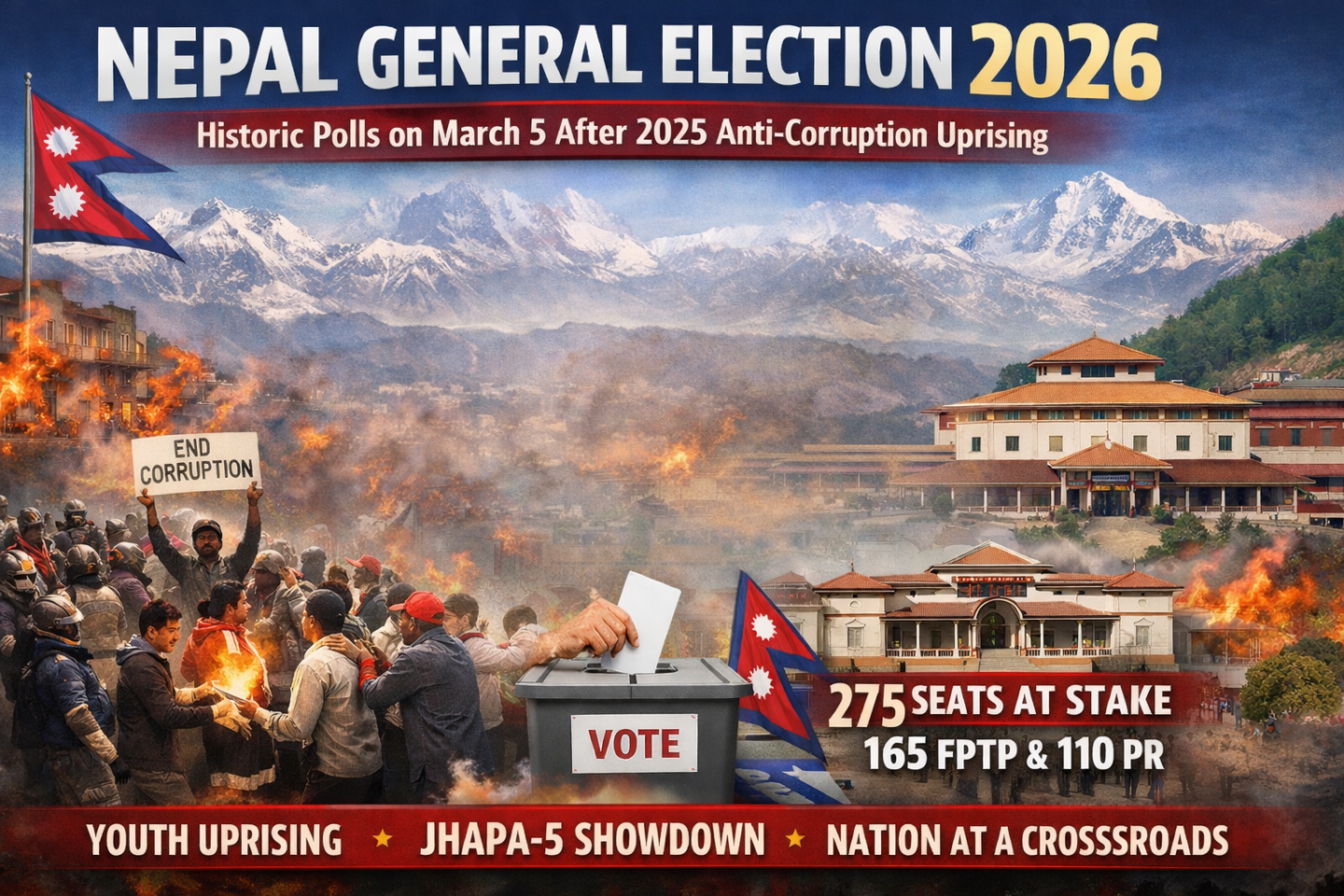
Nepal is gearing up for a historic general election on March 5, 2026, marking the country’s ninth national poll and the first since the dramatic youth-led anti-corruption uprising in September 2025 that toppled the government. This snap election to the 275-member House of Representatives comes amid heightened anticipation for change in the landlocked Himalayan nation of approximately 30 million people, strategically positioned between India and China (via Tibet).
The polls follow the collapse of Prime Minister KP Sharma Oli’s administration after massive protests demanding an end to corruption, nepotism, and governance failures. The unrest, primarily driven by Generation Z and young citizens, resulted in dozens of deaths (reports indicate at least 19-77 fatalities in clashes) and hundreds injured, leading to Oli’s resignation on September 9, 2025. An interim government under former Supreme Court Chief Justice Sushila Karki was installed on September 12, 2025, with the House of Representatives dissolved by President Ram Chandra Poudel, paving the way for elections within six months.
Nepal’s Election Commission has confirmed robust preparations, including 18,903,689 eligible voters (9,240,131 women) casting ballots in a single-day process using paper ballots. Security is tight, with nearly 350,000 personnel deployed across 10,967 polling stations and 23,112 booths, plus reserves for emergencies. The mixed electoral system per the 2015 Constitution remains: 165 seats via First-Past-The-Post (FPTP) direct candidate voting and 110 via Proportional Representation (PR) for party lists, designed to ensure inclusivity for minorities and smaller parties while preventing any single group from dominating.
This election is widely seen as a generational showdown, pitting entrenched veteran leaders against emerging figures promising reform, transparency, and youth-focused governance.
Key Contenders and the High-Stakes Jhapa-5 Battle
At least three figures are positioned as prime ministerial frontrunners in this pivotal vote.
Veteran communist leader Khadga Prasad Sharma Oli (74), head of the Communist Party of Nepal–Unified Marxist-Leninist (CPN-UML), seeks re-election from his traditional stronghold of Jhapa-5 in eastern Nepal, bordering India. A four-time former prime minister, Oli resigned amid the 2025 protests but quickly regrouped, mobilizing party workers. Jhapa-5 has long been a safe seat for him, with multiple past victories, but this time faces unprecedented challenge.
His direct rival in the same constituency is Balendra Shah (popularly known as Balen), the 35-year-old former mayor of Kathmandu Metropolitan City. A structural engineer turned rapper turned politician, Balen rose to prominence through his successful tenure as mayor, earning praise for road expansions, efficient garbage management, and city-wide cleanliness drives. He resigned as mayor recently to join the Rastriya Swatantra Party (National Independence Party), led by TV journalist-turned-politician Rabi Lamichhane.
Balen enjoys massive popularity among social media-savvy Nepalis and youth, who view him as a symbol of fresh, corruption-free leadership. Though no official opinion polls are allowed, public sentiment positions him as a strong contender for the 16th prime minister post-election. His campaign pledges include a corruption-free administration, good governance, and creating 1.2 million jobs for Nepali youth to curb the massive exodus abroad—over 3 million Nepalis live, work, or study in more than 100 countries. Notably, non-resident Nepalis remain disenfranchised despite constitutional guarantees, unable to vote from overseas.
Balen has drawn international attention by dropping a China-sponsored mega industrial project—the Damak Industrial Park in Jhapa district—from his party’s election manifesto. The project, linked to Beijing’s Belt and Road Initiative and foundational stone laid five years ago, has been a concern for India due to its proximity to the strategic Siliguri Corridor (Chicken’s Neck). This move underscores potential shifts in Nepal’s foreign policy balancing act between its giant neighbors.
The third major contender is Gagan Kumar Thapa (50) from the Nepali Congress, the country’s oldest party and a former ally in the collapsed Oli government. Thapa, who replaced veteran five-time PM Sher Bahadur Deuba (79, who opted not to contest), leads his party’s charge. Senior leaders like former PM Jhala Nath Khanal (CPN-UML) also stayed out, amid lingering tensions from the protests that targeted figures like Deuba and Khanal.
The Jhapa-5 contest has become the election’s focal point, transforming the India-bordering area into a hotspot of rallies, debates, and voter mobilization in recent weeks. A win for Balen here could signal a broader rejection of old-guard politics.
Broader Context: From Protests to Polls
The September 2025 anti-corruption mass uprising, sparked initially by a social media ban but fueled by deep-seated anger over graft, inequality, and elite display of wealth, marked a turning point. Protesters, largely young and urban, defied curfews, clashed with security forces, and even set parts of parliament ablaze. The deadly crackdown drew international condemnation, including from the UN, urging calm and dialogue.
The interim administration under Karki has emphasized peaceful, inclusive voting. In recent addresses, Karki and President Poudel called on citizens to participate actively, framing the election as a “historic” opportunity to shape Nepal’s future amid challenges like economic stagnation, youth unemployment, and geopolitical sensitivities.
With a record 3,484 candidates from 68 parties and independents contesting—many younger faces emerging post-protests—the vote tests whether Nepal’s democracy can translate public disillusionment into meaningful change. Analysts note a generational reckoning, with cults of personality and promises of reform dominating over traditional party loyalties.
As polling day approaches, Nepal stands at a crossroads. The outcome could redefine governance, anti-corruption efforts, job creation, and foreign relations in this strategically vital South Asian nation.