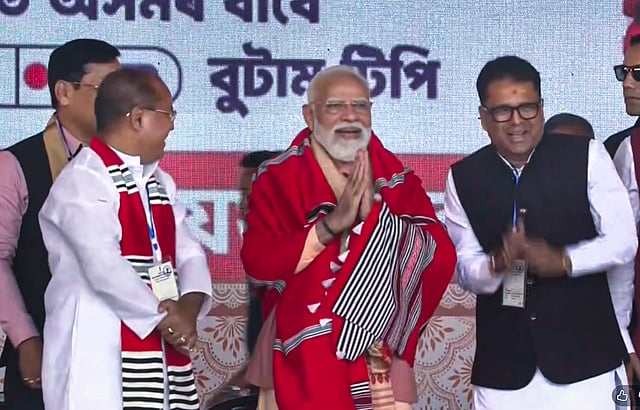
As the political juggernaut rolls into its final phase, the stakes in the Assam Assembly Election have reached a fever pitch. In a high-octane show of strength, Prime Minister Narendra Modi took center stage on Wednesday, addressing a massive rally in Gogamukh, Dhemaji. This marked his first public meeting in the state since the Election Commission announced the poll dates, and he used the platform to deliver a powerful message: the BJP-led National Democratic Alliance (NDA) is not just fighting an election; it is securing a “definite hat-trick.”
Addressing a sea of supporters in the upper Assam district, Modi’s speech was a strategic blend of Assamese cultural connect, ambitious developmental promises, and a fierce critique of the opposition Congress. With the Assam Assembly Election poised to decide the fate of the state for the next five years, the Prime Minister’s appearance signaled the BJP’s all-out offensive to consolidate its gains and overcome the anti-incumbency that naturally accompanies a decade-long rule.
This article provides a comprehensive breakdown of Modi’s promises, his sharp political attacks, and what his vision for a third consecutive BJP term means for the people of Assam.
“This Time, a Hat-Trick is Definite”: Narendra Modi’s Opening Salvo
The Prime Minister began his address with a touch of numerology and symbolism that resonated with the crowd. “This time, a hat-trick is definite,” Modi declared, drawing cheers from the thousands gathered. He cleverly linked his personal visits to Dhemaji with the political outcome, noting that just as this was his third visit to the region, the BJP government was poised to return to power for a third consecutive term.
This framing of the Assam Assembly Election as a quest for a “hat-trick” serves a dual purpose. Firstly, it normalizes the idea of BJP dominance in a state historically known for revolving-door governments. Secondly, it frames the election not as a choice between parties, but as a referendum on the pace of development initiated since 2016. For the party, a hat-trick would be a historic validation of its “double-engine” governance model, where a synchronized government at the Centre and state accelerates growth.
The Sankalp Patra: A ₹5 Lakh Crore Roadmap
A significant portion of Modi’s speech was dedicated to the BJP’s Sankalp Patra (manifesto), unveiled just a day earlier in Guwahati by Union Finance Minister Nirmala Sitharaman. Modi described it not as a list of empty promises but as a “clear roadmap” for Assam’s transformation.
Infrastructure and Jobs: The ₹5 Lakh Crore Push
The centerpiece of this roadmap is a massive investment of ₹5 lakh crore in infrastructure. For a state that has long battled connectivity issues due to its challenging geography and the mighty Brahmaputra river, this investment is transformative. Modi emphasized that this infusion of capital would generate massive employment across sectors—from construction and logistics to manufacturing and services.
This promise directly addresses a core pain point for Assam’s burgeoning youth population: unemployment. By tying infrastructure spending directly to job creation, the BJP is positioning itself as the party that can provide not just welfare, but sustainable livelihoods.
Housing for All: From 22 Lakh to 37 Lakh Families
Highlighting the BJP’s focus on welfare, Modi noted that over 22 lakh families in Assam have already received pucca (permanent) houses under central schemes. He then raised the bar, promising to extend this benefit to an additional 15 lakh beneficiaries. In a state prone to floods and where rural poverty remains a challenge, the promise of a secure home is a powerful electoral tool. It signals continuity of welfare and a commitment to ensuring no family is left without shelter.
Free Education from KG to PG
In a move aimed at the state’s vast student population and their parents, Modi announced a push for free education from kindergarten to postgraduate level for children from underprivileged backgrounds. This is a significant policy shift that could alleviate the financial burden on lower-income families, making higher education accessible and reducing dropout rates. It aligns with the national National Education Policy (NEP) 2020 and positions the BJP as a party invested in human capital development.
Women-Centric Governance: The “Lakhpati Baideo” Vision
Recognizing the crucial role women play as voters and decision-makers in Assamese households, Modi placed a strong emphasis on women-centric initiatives. He celebrated that over three lakh women in Assam had already become “lakhpati baideo”—a term meaning “sisters who are lakhpatis”—through self-help groups and government schemes that have boosted their annual income.
But the Prime Minister didn’t stop there. He set an ambitious new target: scaling this up to 40 lakh women in the next five years. This goal is designed to transform rural economies by empowering women financially. By making them stakeholders in the economic growth story, the BJP is aiming to build a loyal voter base that directly benefits from its governance model.
The Congress Attack: “Dangerous Conspiracy” and the Infiltration Charge
While the manifesto outlined a vision for the future, Modi’s speech was also notable for its sharp political offensive against the opposition Congress. In the high-stakes environment of the Assam Assembly Election, the Prime Minister sought to polarize the electorate by painting the Congress as a party that prioritizes vote-bank politics over the welfare of indigenous Assamese communities.
The “Communal Violence Law” Allegation
Modi launched a scathing attack, referring to a proposed “communal violence law” discussed during the United Progressive Alliance (UPA) era. He termed it a “dangerous conspiracy,” alleging that it was designed for appeasement politics. According to Modi, such a law would have harmed the constitutional framework envisioned by B.R. Ambedkar. He credited the BJP for opposing it in Parliament and warned that similar ideas were being discussed again by Congress leaders in Assam.
Illegal Infiltration and Indigenous Rights
Perhaps the most charged section of his speech dealt with the issue of illegal infiltration. Modi accused the Congress of historically allowing illegal immigration into the state, alleging that such policies had adversely affected indigenous communities and their identity.
“Congress wants to protect foreigners and turn locals into a minority,” Modi asserted, a line that drew loud cheers from the crowd. In contrast, he positioned the BJP government as the protector of Assamese identity, committed to removing illegal encroachers. This narrative taps into deep-seated anxieties in Assam about demographic changes and land rights, issues that have historically defined the state’s political discourse.
A Jab at the “Prince” in Delhi
Adding a touch of political ridicule, Modi took a swipe at the Congress leadership, remarking that the party’s “prince sitting in Delhi” was heading towards a “century of defeats.” This was a clear reference to Rahul Gandhi and the Congress’s electoral record in recent years. By framing the opposition as out-of-touch and consistently rejected by voters, Modi sought to project the BJP as the only viable alternative for stable governance.
From Tea to Tech: Assam’s New Identity
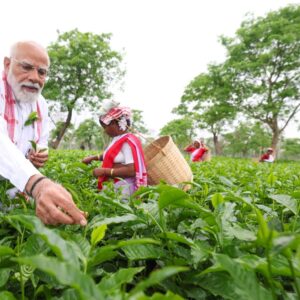
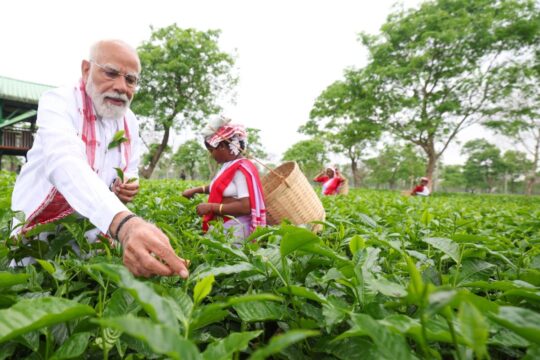
Beyond the political attacks, Modi painted a compelling picture of a state in transition. He acknowledged Assam’s historical identity—globally known for its tea—but argued that the state was now ready for a new chapter.
“There was a time when Assam was known globally only for tea. Now, along with tea, Assam will be known for semiconductor chips,” he said.
This reference to upcoming technological investments, particularly the semiconductor unit coming up in the state, is central to the BJP’s campaign. It signals to the electorate that the BJP is not just about roads and bridges but about transforming Assam into a hub for high-tech industry. This appeal is aimed at the youth and the aspirational middle class who want to see their state compete on a global stage.
Addressing Floods: An ₹18,000 Crore Special Mission
Floods are a perennial, devastating reality for Assam. Recognizing that no development agenda can succeed without tackling this issue, Modi announced a dedicated ₹18,000 crore allocation under a special mission to address flood-related losses.
This commitment is crucial. For decades, governments have promised to solve the flood problem with little tangible success. By attaching a specific financial figure and creating a “mission” mode approach, the BJP is signaling that it treats floods as a priority national security and development issue, not just a seasonal calamity.
Farmers’ Support: Enhanced Annual Assistance
In his address, Modi also catered to the agrarian base of the state. He stated that 20 lakh farmers in Assam had already received ₹7,500 crore in financial assistance under various central schemes, including the PM-KISAN program. Building on this, he promised enhanced annual support of ₹11,000 or more for small farmers.
This promise is designed to increase the financial security of the state’s vast farming community. By committing to a higher amount, the BJP aims to undercut any opposition narrative that the central government’s support has been insufficient.
Uniform Civil Code and Tribal Safeguards
The BJP’s manifesto, as highlighted by Modi, includes the proposal for the implementation of a Uniform Civil Code (UCC) in the state. While this is a contentious national issue, its inclusion in the Assam manifesto signals the party’s intent to push forward with what it calls “uniformity in personal laws.”
Simultaneously, recognizing the delicate ethnic fabric of Assam, Modi assured voters that the manifesto also contains measures to safeguard the identity, culture, and rights of Sixth Schedule and tribal communities. This balancing act—pushing for UCC while protecting tribal customs—is a delicate tightrope walk that the BJP is attempting to navigate to maintain its coalition of support among both mainstream Hindu voters and indigenous tribal groups.
Conclusion: A Final Push for a Decisive Mandate
As the Assam Assembly Election approaches polling day on April 9, Prime Minister Narendra Modi has left no stone unturned. His rally in Gogamukh served as the culmination of a campaign built on a tripartite foundation: the promise of unprecedented economic growth (₹5 lakh crore investment), the assurance of social welfare (free education, housing, women’s empowerment), and a hardline stance on identity and security (infiltration, UCC, and opposition to appeasement).
By urging voters to “break all previous turnout records,” Modi is not just asking for votes; he is seeking a mandate so decisive that it leaves no room for ambiguity. For the BJP, a hat-trick in Assam would be more than just another electoral victory—it would be a validation of their model of governance in the Northeast and a powerful statement of intent ahead of future national challenges.