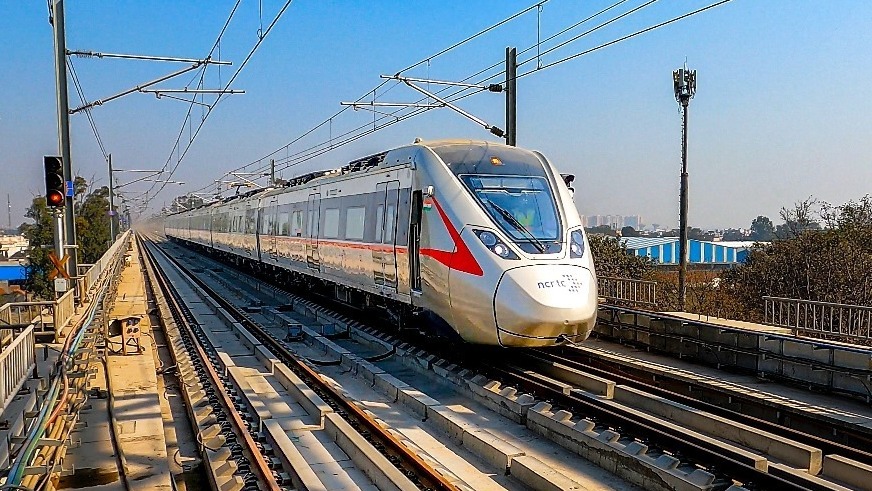
The Delhi-Ghaziabad-Meerut Namo Bharat RRTS has achieved a historic milestone by recording over 1 lakh (100,000) passengers on its first full day of operations across the entire 82-km corridor. This remarkable feat came on 23 February 2026, just one day after Prime Minister Narendra Modi inaugurated the complete Delhi-Meerut corridor along with the integrated Meerut Metro service on 22 February 2026.
Namo Bharat RRTS Breaks Records: Over 1 Lakh Passengers on First Full Day of Delhi-Meerut Corridor Operations
In a resounding endorsement of India’s push toward modern, high-speed regional transportation, the Namo Bharat Regional Rapid Transit System (RRTS) on the Delhi-Ghaziabad-Meerut corridor smashed expectations by surpassing 1 lakh passengers on its inaugural full day of seamless end-to-end operations. According to officials from the National Capital Region Transport Corporation (NCRTC), the ridership crossed the 100,000 mark by the departure of the last train at 10:00 PM on 23 February 2026. This achievement marks the highest single-day ridership ever recorded on the corridor, even surpassing previous phased operational highs, and underscores the massive public enthusiasm for fast, reliable, and affordable public transit linking Delhi with Meerut.
The excitement was palpable inside the air-conditioned coaches, where passengers—ranging from daily commuters and students to families—were heard chanting “Bharat Mata ki Jai” as they experienced the transformative service for the first time on the full stretch. Videos and reports from stations like Begumpul in Meerut captured the jubilant atmosphere, with crowds eagerly boarding the sleek, modern trains designed for speeds up to 180 km/h (operational at 160 km/h).
Historic Inauguration by PM Modi: Ushering in a New Era of Connectivity
Just 24 hours prior, on 22 February 2026, Prime Minister Narendra Modi flagged off the integrated Namo Bharat RRTS and Meerut Metro services from Shatabdi Nagar Namo Bharat Station in Meerut. The event also included the dedication of the remaining sections of the 82.15-km corridor to the nation, including a 5-km stretch in Delhi from Sarai Kale Khan to New Ashok Nagar and a 21-km extension from Meerut South to Modipuram in Uttar Pradesh.
This full operational launch completed years of phased development. The RRTS project began commercial services in October 2023 on a limited 17-km segment between Sahibabad and Duhai Depot, gradually expanding through 2024 and 2025 to cover more sections. By early 2026, prior expansions had already built momentum, with monthly ridership climbing steadily and single-day peaks reaching over 85,000 in previous months. However, the full corridor’s activation—connecting key urban centers like Sahibabad, Ghaziabad, Modinagar, and Meerut directly to Delhi—has elevated the system to unprecedented levels.
Prime Minister Modi described the moment as the dawn of a “new era of world-class infrastructure” for Uttar Pradesh and the entire country. He emphasized how the Namo Bharat RRTS, India’s first Regional Rapid Transit System, would make travel in the National Capital Region (NCR) “simpler, smoother, and more convenient.” The project, executed by NCRTC, integrates with the Meerut Metro, creating India’s fastest metro-rapid rail hybrid network in terms of operational efficiency.
One of the most touted benefits is the dramatic reduction in travel time. The end-to-end journey from Delhi to Meerut now takes approximately 55-60 minutes, compared to the 1.5-2 hours (or more during peak traffic) by road. This high-frequency service, with trains running every few minutes during rush hours, promises to decongest highways like NH-9 while promoting eco-friendly mobility with electric-powered trains.
Massive Parking Infrastructure: Over 8,000 Spaces for Seamless Last-Mile Connectivity
To accommodate the surge in users, authorities have developed extensive parking facilities totaling more than 8,000 spaces across stations. These are designed with commuter convenience in mind, featuring low parking fees through time-based slab systems.
- Ghaziabad Station boasts the largest four-wheeler parking, with capacity for 370 cars and 632 two-wheelers.
- Sahibabad Station provides 76 car spots and 223 two-wheeler bays.
- Guldhara Station offers 191 car spaces and 848 two-wheeler spots.
- Sarai Kale Khan Namo Bharat Station in Delhi has parking for 266 cars and 837 two-wheelers. Its strategic location—with direct links to bus stands, main railway stations, and metro lines—has quickly established it as a premier interchange hub.
- Anand Vihar Station also features robust parking arrangements.
- In Meerut, Meerut South Station accommodates 289 cars and 854 two-wheelers.
- Modipuram Station provides over 135 car spaces and more than 1,200 two-wheeler spots.
- Shatabdi Nagar Station offers around 120 car bays and 350 two-wheeler spaces.
At Uttar Pradesh stations, differentiated slabs apply for cycles, two-wheelers, and four-wheelers, while Delhi stations follow a similar structured fee model. These affordable rates, combined with ample capacity, encouraged heavy parking usage on day one, further highlighting the system’s user-centric design.
Namo Bharat Connect App and Last-Mile Integration: Enhancing User Experience
The dedicated Namo Bharat Connect app has been a game-changer, offering real-time features such as:
- Live parking availability updates
- Train tracking and schedules
- Station navigation and maps
- Ticket booking and fare details
To bridge the gap between stations and final destinations, last-mile connectivity options abound:
- E-rickshaws and auto-rickshaws stationed nearby
- Feeder buses integrated with the RRTS timetable
- Rental cycles and shared two-wheelers for short hops
These integrations make the Namo Bharat RRTS not just a train service but a comprehensive mobility ecosystem, addressing common pain points in urban commuting.
Why This Ridership Milestone Matters for NCR and Beyond
The overwhelming response on the first full day signals strong latent demand for efficient public transport in one of India’s most densely populated regions. The NCR, encompassing Delhi, Ghaziabad, and extending to Meerut, has long grappled with traffic congestion, pollution, and time lost in commutes. The Namo Bharat RRTS addresses these challenges head-on by offering air-conditioned comfort, high safety standards, Wi-Fi-enabled coaches, and priority seating.
Experts view this as a model for future RRTS corridors across India, including those planned in other high-density zones. The success also aligns with national goals for sustainable development, reducing reliance on private vehicles and cutting carbon emissions through mass rapid transit.
As ridership continues to grow—building on the phased momentum that already saw cumulative trips cross significant figures—the Delhi-Ghaziabad-Meerut corridor is poised to become a lifeline for lakhs of daily commuters. With features like extensive parking, smart apps, and seamless connectivity, the Namo Bharat RRTS is not just breaking records; it’s redefining how India moves.
This landmark day in February 2026 will be remembered as the moment when high-speed regional rail truly arrived in the NCR, proving that world-class infrastructure can win hearts and transform lives overnight.