Staff Reporter, Tinsukia, January 25 : As Assam’s political spotlight shone on Doomdooma on Sunday with the Chief Minister’s visit to commemorate 200 years of the tea industry, a quieter, deeply human story of service was unfolding a few kilometres away in Makum—without speeches, stages or applause.
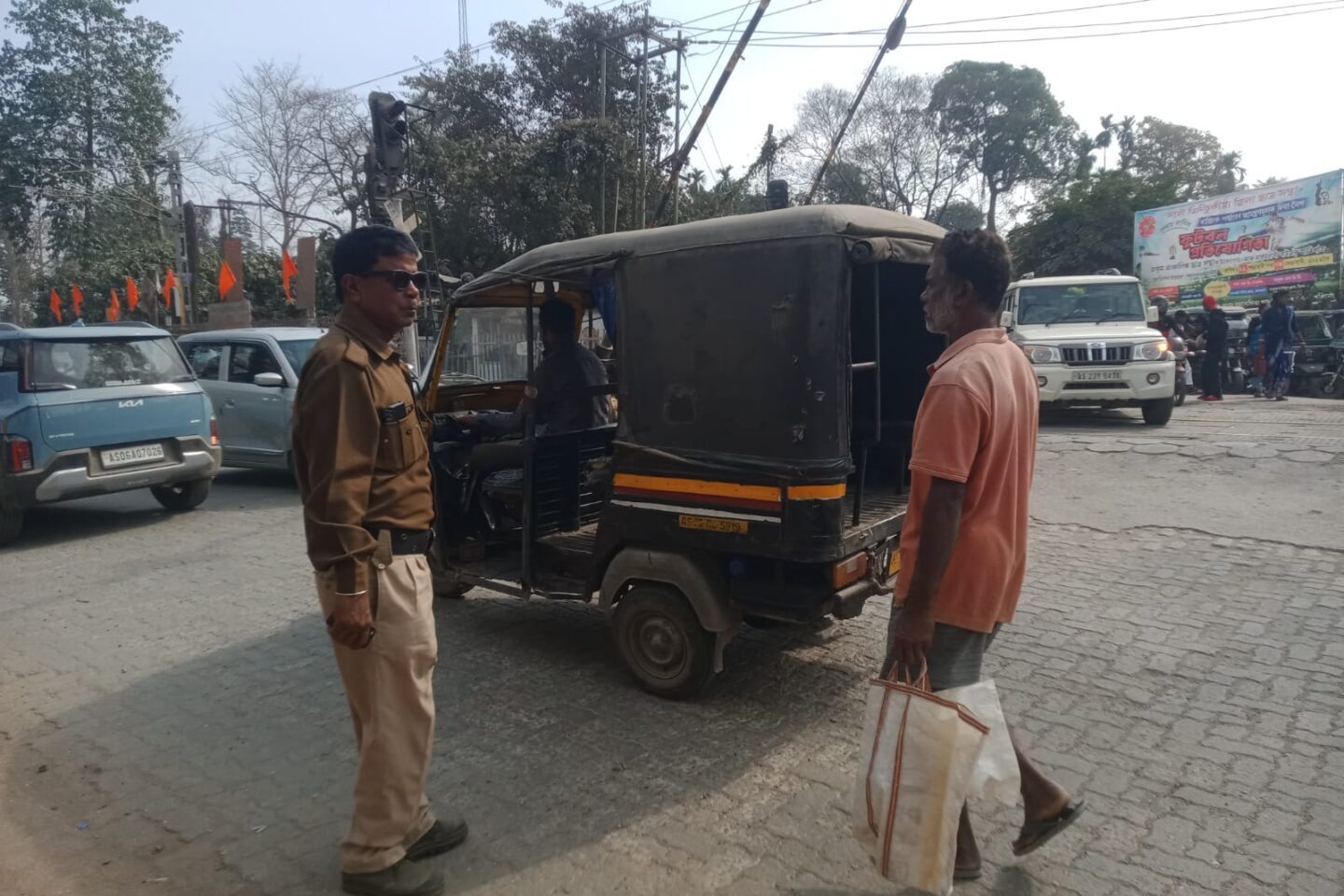
At the busy Makum police point near Digboi Road, amid honking vehicles and the Sunday market rush, 58-year-old Dipak Das stood watch, whistle in hand, calmly directing traffic. Clad in a faded khaki uniform, he blended seamlessly into the scene, a reassuring presence many locals have come to rely on for years. Few, however, know that Dipak Das is not a Home Guard or a police volunteer on record. By profession, he is a tailor.
Every morning, from around 8 am till late afternoon, Dipak Das sits behind a sewing machine on the veranda of a closed shop named Ambika Enterprises. Stitching shirts and trousers for modest wages, he earns just enough to support his family of four. As dusk approaches, the sewing machine falls silent. The needle rests. And Dipak Das steps into another role altogether.
From 7 pm till late evening—and often from early morning on congested days like Sundays—he voluntarily joins the Makum traffic police, helping regulate vehicles and guide pedestrians through one of the town’s most crowded intersections. For over two decades, this has been his routine.
“This is not something I did for a day or two,” he says softly. “I have been doing this for 20 to 22 years.”
The beginning, he recalls, was simple. Years ago, watching elderly people, schoolchildren and patients struggle to cross chaotic roads disturbed him deeply. One evening, he stepped forward to help. That moment of concern gradually turned into a lifelong commitment.
Originally from Mezenga in Sivasagar district, Dipak Das moved to Makum as a child after his father, a railway employee, took voluntary retirement due to illness. Makum grew into more than just a place to live—it became a responsibility he felt compelled to shoulder.
Today, it is hard to find anyone in Makum who does not recognise him. Many assume he is officially part of the Home Guards. In reality, he remains an unpaid and unregularised volunteer—steady, dependable and invisible to official records.
At home, Dipak Das is a proud father. His son Dipankar passed the HSLC examination last year with letter marks in two subjects, while his daughter Mohini is currently studying in Class VIII. His sense of service extends beyond the streets: he is an active member of the management and development committee of Makum GBC Higher Secondary School and has served two terms as president of the local primary school management committee.
Over the years, various organisations have felicitated him for his selfless contribution. Yet, official recognition from the government has remained elusive. Those close to him believe that regularising Dipak Das as a Home Guard would not merely honour his service—it would provide a modest but assured income, offering long-overdue security and dignity to a man who has given years of unpaid public service. “There is no big or small work,” Dipak Das believes. His life embodies that philosophy—a man who stitches clothes by day and holds a town together by night.
His dedication may not yet be recorded in official files, but on Makum’s streets, every eased traffic snarl and every safe crossing stands as quiet testimony to his devotion. And perhaps, someday, that devotion will find its way from the roadside into the government’s conscience—and into the recognition it so clearly deserves.