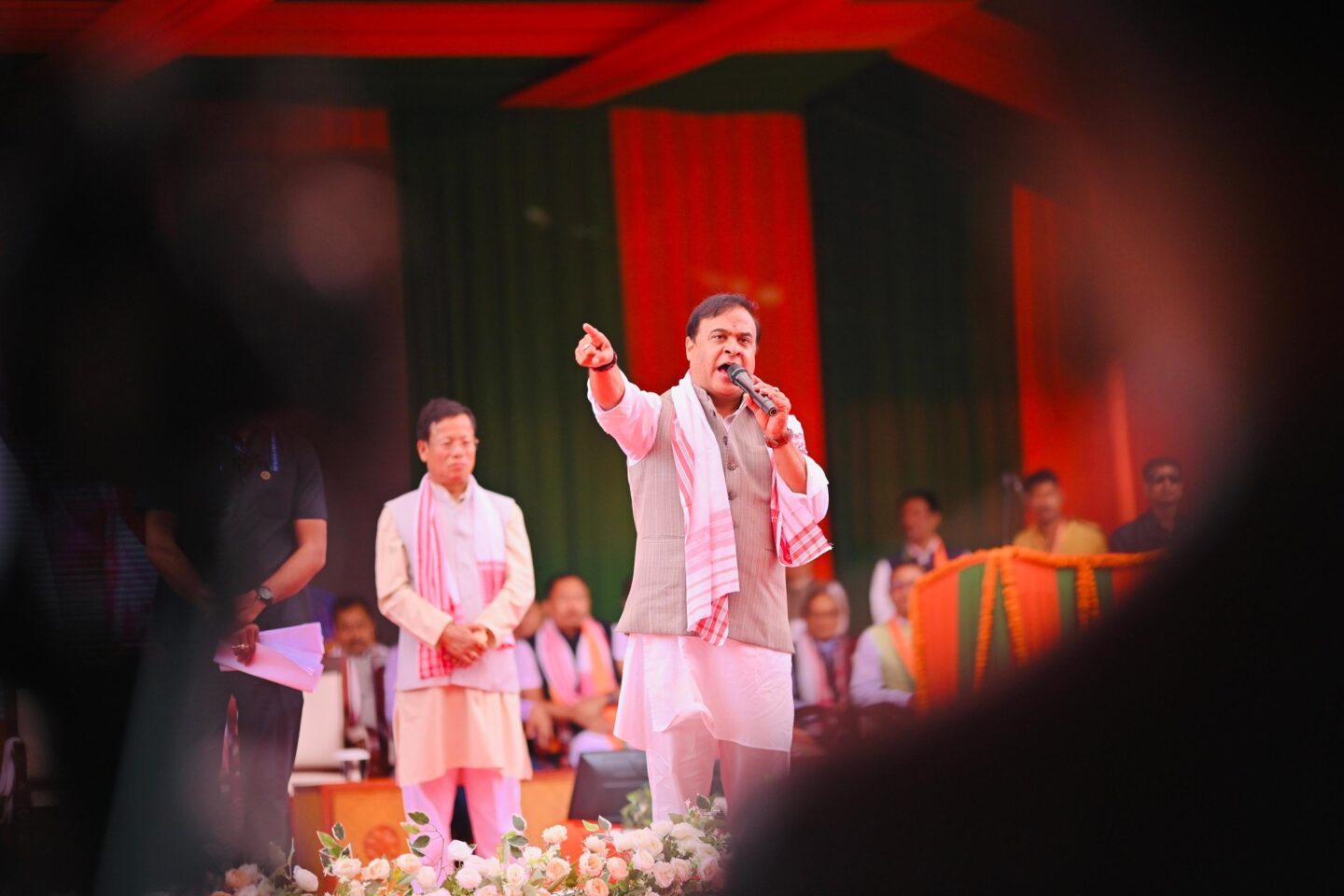
In a high-stakes political rally that underscored the Bharatiya Janata Party’s (BJP) aggressive push into Upper Assam, Chief Minister Himanta Biswa Sarma on Monday laid out an ambitious vision for the river island of Majuli. Campaigning for party candidate Bhuban Gam, the Chief Minister did not hold back, announcing a series of transformative projects aimed at repositioning Majuli as a premier educational and cultural destination in the Northeast.
From a new medical college to a Rs 250 crore investment in higher education, and from a massive riverbank protection initiative to a 2,000-seat auditorium, Sarma’s announcements signaled that Majuli—the world’s largest river island and a UNESCO World Heritage site—is at the center of the government’s development agenda. But beyond the promises of infrastructure, the Chief Minister launched a scathing political offensive against the Congress, accusing previous administrations of treating the constituency as a “burden.”
For voters in Upper Assam and particularly in Majuli, where the election battle is intensifying, these announcements carry significant weight. This article delves into the details of Sarma’s roadmap, the political messaging behind it, and what it means for the future of this culturally rich region.
A Medical College for Majuli: Transforming Healthcare Access
One of the most significant announcements made by Himanta Biswa Sarma during his rally was the commitment to establish a medical college in Majuli. For decades, residents of the river island have faced immense hardship when it comes to healthcare. During floods, which are annual occurrences, connectivity to the mainland is severed, leaving the population of nearly 1.67 lakh people with limited access to advanced medical facilities.
Currently, residents depend on the Majuli Civil Hospital or must travel to Jorhat town via the ferry, a journey that becomes perilous during the monsoon season. The establishment of a medical college is a game-changer.
“Healthcare is not just about curing diseases; it is about ensuring that no life is lost due to lack of infrastructure,” Sarma stated during the rally. The proposed medical college is expected to not only provide tertiary healthcare services but also create employment opportunities for local youth, offering courses in nursing, paramedical sciences, and eventually postgraduate specializations.
This announcement aligns with the state government’s broader vision to decentralize medical education. With existing medical colleges in Guwahati, Dibrugarh, and Jorhat, the addition of a facility in Majuli would mark a historic first for the island, ensuring that the most remote parts of Assam are no longer left behind in the healthcare revolution.
Educational Hub: Rs 250 Crore for Majuli University for Culture
In a move aimed at harnessing the intellectual and cultural capital of the region, Himanta Biswa Sarma announced a significant financial boost for Majuli University for Culture. The Chief Minister sanctioned Rs 250 crore to develop the institution into a full-fledged university, with a focus on modern disciplines alongside traditional knowledge.
“Our aim is to transform Majuli into an educational hub, with a focus on subjects like Artificial Intelligence, Economics, Political Science and more,” Sarma said.
This dual focus is particularly noteworthy. Majuli is historically known for its sattras (Vaishnavite monasteries) and its role as the cradle of Assamese culture. By blending high-tech subjects like AI with traditional humanities, the government is signaling an intent to make Majuli a destination for scholars from across the country.
The upgrade is expected to attract students from other parts of Assam and beyond, reducing the need for local students to migrate to urban centers like Guwahati or Delhi for higher education. For a community that has long felt geographically isolated, this represents a promise of connectivity—not just physical, but intellectual and economic.
Infrastructure and Culture: The 2,000-Seat Auditorium
Addressing a recurring complaint from residents, the Chief Minister acknowledged a glaring infrastructural gap in the district. Despite its status as a cultural capital, Majuli lacked a proper venue for large-scale performances, conferences, and community gatherings.
“Every time I visit Majuli, I realise there is no proper auditorium. We will construct an auditorium with a capacity of 2,000 people,” Sarma announced.
This auditorium is expected to serve multiple purposes. It will provide a dedicated space for the preservation and promotion of Borgeet (Vaishnavite hymns), Sattriya dance, and other traditional art forms that originated on the island. It will also serve as a venue for academic conferences, government programs, and cultural tourism events, potentially boosting the local economy by attracting tourists who stay longer to experience live performances.
Fighting Erosion: Protecting 45,000 Bighas of Farmland
Perhaps the most pressing concern for the people of Majuli is the existential threat posed by the Brahmaputra River. Erosion has been swallowing vast tracts of land for decades, displacing families and destroying livelihoods. Recognizing this, Himanta Biswa Sarma dedicated a significant portion of his speech to riverbank protection.
“We will be able to recover and protect nearly 45,000 bighas of farmland through geo-tube embankment development from upper to lower Majuli. This is crucial for farmers’ welfare,” he said.
The use of geo-tube technology—a modern method of embankment construction using geotextile tubes filled with sand—marks a departure from traditional, often ineffective, embankments. If implemented successfully, this project could reverse decades of land loss, providing security to farmers who have seen their ancestral lands washed away.
For the agrarian community of Majuli, which relies heavily on paddy cultivation and fishing, this promise directly addresses their economic survival. It also ties into the larger narrative of the BJP government’s focus on Kisan Kalyan (farmer welfare), a theme that resonates deeply in rural Assam.
Political Battle: Sarma’s Sharp Attack on Congress
While the development announcements formed the core of the rally, Himanta Biswa Sarma used the platform to draw a sharp ideological and political line between the BJP and the opposition Congress. The Chief Minister’s rhetoric was aimed at consolidating the indigenous Assamese vote base, which is crucial in Upper Assam.
“Majuli is an Ideal Constituency”
Sarma contrasted the BJP’s approach to governance with that of previous Congress governments. He alleged that for the Congress, Majuli was a “burden,” whereas for the BJP, it was an “ideal constituency.”
This statement is part of a broader strategy to position the BJP as the party that cares for Assam’s indigenous culture and heritage, while painting the Congress as indifferent to the region’s unique needs.
The Frequency of Visits
To underscore his commitment, Sarma offered a specific metric: the number of visits. “In the last five years, I have visited Majuli at least 15 times. The number of visits made by me and former Chief Minister Sarbananda Sonowal cannot be matched even if you add all visits made by previous Congress Chief Ministers,” he claimed.
By personalizing his connection with the constituency, Sarma sought to build a narrative of accessibility and responsiveness. In a region where voters often feel neglected by distant administrations, such personal outreach can be a powerful electoral tool.
The Immigration Angle
Escalating his criticism, Sarma touched upon one of the most sensitive issues in Assam politics: illegal immigration. He accused the Congress of prioritizing vote banks over indigenous concerns.
“They did not visit Majuli often, but went to areas where illegal Bangladeshi immigrants are more. For them, such people were more important,” he alleged.
This accusation taps into a deep-seated anxiety among indigenous Assamese communities about demographic changes. By framing the election as a choice between protecting indigenous identity and appeasing “infiltrators,” Sarma is attempting to consolidate the core BJP vote base while putting the Congress on the defensive.
An Ideological Choice: Sankardeva vs. “New Assam”
In the climax of his address, Himanta Biswa Sarma elevated the election discourse from mere development to ideology. He questioned the Congress’s narrative of a “new Assam,” asking the crowd to reflect on their cultural and historical roots.
“Is there any greater figure born on this land than Mahapurush Srimanta Sankardeva? Or a greater warrior than Sukapha? Do we want an Assam shaped by them or a new Assam shaped by the Congress?” he asked.
This rhetorical question serves a dual purpose. First, it invokes the revered figures of Srimanta Sankardeva (the 15th-16th century saint-scholar who founded the Vaishnavite movement) and Sukapha (the 13th-century founder of the Ahom kingdom), positioning the BJP as the guardian of Assamese heritage. Second, it dismisses the opposition’s vision as alien or rootless.
For the people of Majuli, where Srimanta Sankardeva established one of the first sattras, this message resonates deeply. The island is not just a piece of land; it is the spiritual heartland of Assamese culture. By aligning his development agenda with this cultural legacy, Sarma is crafting a narrative that appeals to both the heart and the mind of the voter.
What This Means for the Assembly Election
The rally in Majuli is a microcosm of the larger electoral strategy being deployed by the BJP in the Assam Assembly election. The party is relying on a combination of tangible development promises (medical colleges, infrastructure, erosion control) and a strong cultural-nationalist appeal.
For Himanta Biswa Sarma, this is a homecoming of sorts. Having consolidated his base in western Assam and the lower Brahmaputra valley, a strong performance in Upper Assam—particularly in constituencies like Majuli—is essential to achieving the ambitious 90-plus seat target set by Union Home Minister Amit Shah.
The Candidate: Bhuban Gam
While much of the focus was on the Chief Minister, the rally was also aimed at boosting the campaign of party candidate Bhuban Gam. In a constituency that has historically seen tight contests, the high-profile announcements are intended to create a wave of goodwill that translates into votes.
Frequently Asked Questions (FAQ)
1. What major development projects did Himanta Biswa Sarma announce for Majuli?
Chief Minister Himanta Biswa Sarma announced three major initiatives: a new medical college to improve healthcare access, Rs 250 crore for the development of Majuli University for Culture into a full-fledged university, and a geo-tube embankment project to protect 45,000 bighas of farmland from erosion. He also promised a 2,000-seat auditorium.
2. Why is Majuli significant in Assam politics?
Majuli is the world’s largest river island and a UNESCO World Heritage site. It is considered the cultural and spiritual heartland of Assam, being the birthplace of the Vaishnavite movement led by Srimanta Sankardeva. Politically, it represents a key constituency in Upper Assam where indigenous identity and development issues converge.
3. How does Himanta Biswa Sarma’s visit to Majuli compare to previous governments?
Sarma claimed during his rally that he has visited Majuli at least 15 times in the last five years. He asserted that the combined visits of the current and previous BJP administrations far exceeded those of all previous Congress chief ministers combined, using this to argue that the BJP treats the constituency as a priority.
4. What is geo-tube embankment technology and why is it important for Majuli?
Geo-tube embankment is a modern flood control method where geotextile tubes are filled with sand to create durable, erosion-resistant barriers. For Majuli, which loses vast tracts of land annually to Brahmaputra erosion, this technology offers a more effective solution than traditional embankments. Sarma claimed it could help recover 45,000 bighas of farmland.
5. What was the ideological message in Sarma’s Majuli rally?
Sarma positioned the election as a choice between an “Assam shaped by Mahapurush Srimanta Sankardeva and Sukapha” versus a “new Assam shaped by the Congress.” He invoked the island’s Vaishnavite heritage to argue that the BJP is the true guardian of indigenous Assamese culture, while accusing the Congress of prioritizing vote banks of illegal immigrants over local communities.
Conclusion: A High-Stakes Pledge to the Heartland
As Himanta Biswa Sarma wrapped up his rally in Majuli, the message was clear: the BJP is not only promising development but is staking its claim as the custodian of Assamese identity. The announcement of a medical college, the university upgrade, and the erosion control projects represent a substantial investment in the island’s future.
For the people of Majuli, who have long battled the dual challenges of geographical isolation and environmental fragility, these promises offer a glimmer of transformation. However, with the election approaching, the political battle is far from over. The opposition will likely scrutinize the timelines and funding mechanisms of these projects.
What’s Next?
If you are a resident of Majuli or Upper Assam, stay informed about the candidate profiles and the detailed election schedule. For the latest updates on campaign developments, project announcements, and ground reports from the Assam Assembly election, continue following Asom Barta for comprehensive coverage.