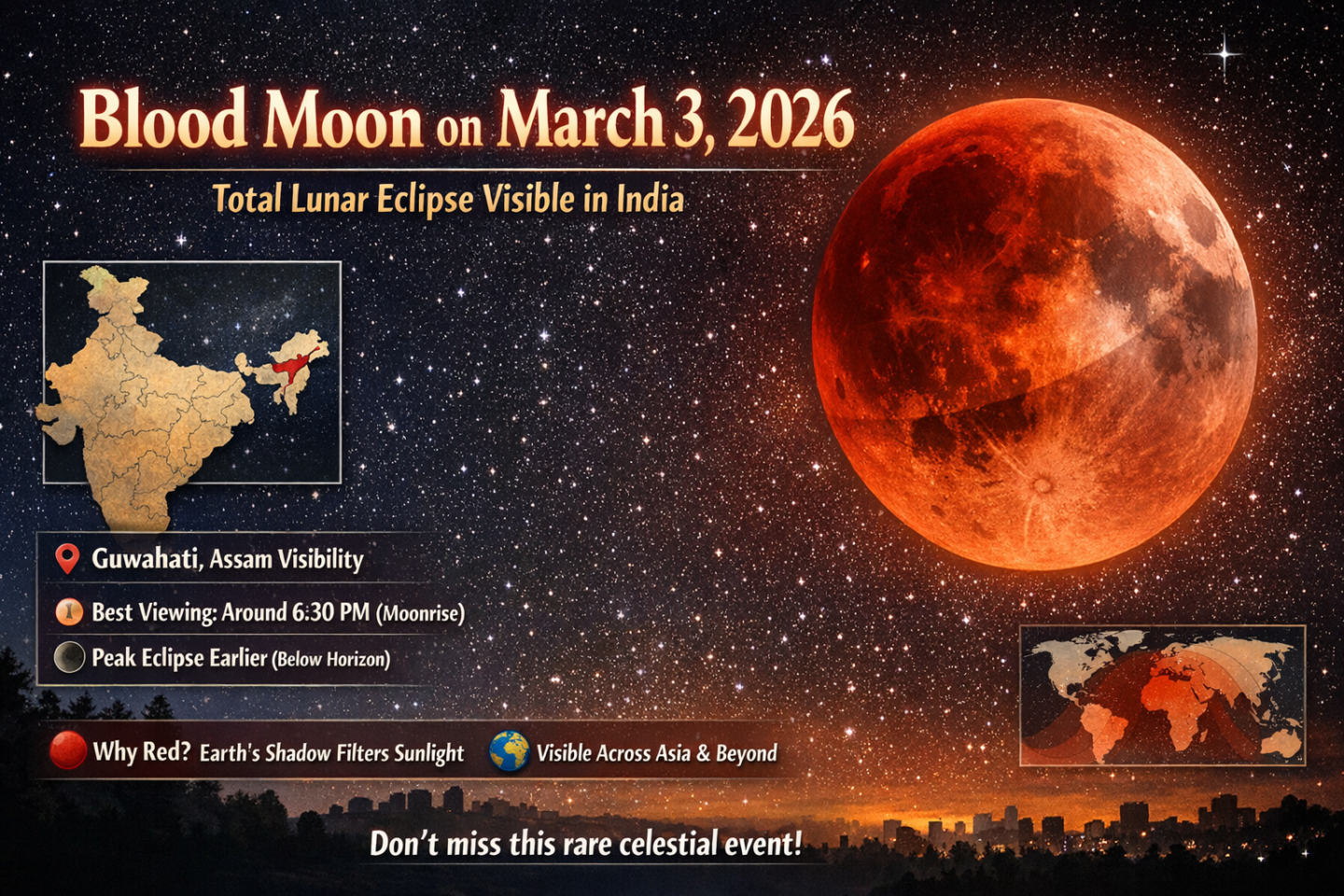
The upcoming total lunar eclipse on March 3, 2026, promises to be a breathtaking celestial event, often called the Blood Moon due to the Moon’s striking red-orange appearance during totality. As the first and only total lunar eclipse of 2026—and the last one until late 2028—this rare Blood Moon will captivate skywatchers across vast regions of the globe.
Total Lunar Eclipse March 3 2026: Blood Moon Visibility, Timings in India, and How to Watch the Rare Red Moon Event
Introduction to the Upcoming Total Lunar Eclipse and Blood Moon Phenomenon
Space enthusiasts worldwide are buzzing with excitement as a spectacular total lunar eclipse approaches on March 3, 2026. This event, popularly known as the Blood Moon, will transform the full Moon into a dramatic reddish hue for nearly an hour during its total phase. With the current date being February 27, 2026, skywatchers have just a few days left to prepare for this rare astronomical wonder—the first total lunar eclipse of the year and the last one for nearly three years until the New Year’s event in 2028-2029.
A total lunar eclipse occurs when the Sun, Earth, and Moon align perfectly, with Earth positioned directly between the Sun and the full Moon. The Moon passes through Earth’s shadow (umbra), blocking direct sunlight. Instead of disappearing completely, the Moon glows with a coppery-red color, earning its “Blood Moon” nickname. This phenomenon has fascinated cultures for centuries, often linked to folklore, myths, and even festivals in various regions.
NASA and other astronomical authorities confirm that this March 3, 2026, total lunar eclipse will deliver about 58 minutes of totality, with the maximum eclipse (deepest red phase) occurring at 11:33 UTC. The entire event spans over 5 hours, from penumbral start to end.
Why Does the Moon Turn Red During a Blood Moon? The Science Explained
The signature red color of a Blood Moon results from Rayleigh scattering—the same atmospheric effect that makes sunsets red and skies blue. Sunlight, appearing white, contains all visible wavelengths. As sunlight passes through Earth’s atmosphere during an eclipse, shorter blue wavelengths scatter away, while longer red and orange wavelengths bend (refract) and reach the Moon’s surface.
It’s like viewing every sunrise and sunset on Earth simultaneously projected onto the Moon. Dust, clouds, and pollution in the atmosphere can influence the shade—ranging from bright orange to deep brick red. During the March 3, 2026, event, expect a vivid coppery or rusty hue, especially if conditions are clear.
NASA’s explanations highlight that no special equipment is needed—no eclipse glasses required, unlike solar eclipses. Binoculars or a small telescope enhance details on the lunar surface, revealing craters bathed in eerie red light.
Exact Timings for the March 3, 2026 Total Lunar Eclipse (UTC and Key Phases)
According to reliable sources like NASA, TimeandDate.com, and Wikipedia:
- Penumbral eclipse begins: 08:44 UTC (March 3) – The Moon enters Earth’s faint outer shadow (penumbra).
- Partial eclipse begins: 09:50 UTC – The Moon starts entering the darker umbra.
- Totality begins (full Blood Moon phase): 11:04 UTC – The entire Moon is in the umbra.
- Greatest eclipse (maximum redness): 11:33 UTC – Peak of the event.
- Totality ends: 12:03 UTC – The Moon begins exiting the umbra.
- Partial eclipse ends: 13:17 UTC.
- Penumbral eclipse ends: 14:23 UTC.
Totality duration: 58 minutes and 19 seconds (approximately 58 minutes).
These times are universal (UTC). Adjust for your local time zone—for example, in India (IST = UTC+5:30), totality starts around 4:34 PM IST and ends around 5:33 PM IST, with maximum at about 5:03 PM IST.
Visibility of the Blood Moon: Where and How to See It Globally
This total lunar eclipse favors the Pacific region, Asia, Australia, and the Americas. Key visibility details:
- Fully visible totality (entire Blood Moon phase): Eastern Asia (e.g., Japan, China east), Australia, New Zealand (evening of March 3 or 4 depending on date line), central Pacific.
- Throughout the night: Pacific Ocean regions.
- Early morning/pre-dawn: North America (e.g., West Coast sees full totality around 3-4 AM PST; East Coast sees partial to totality at dawn, with Moon setting during it).
- Partial visibility: Central Asia, much of South America.
- Not visible at all: Europe, Africa, western Asia (Moon below horizon during key phases).
Nearly half the world’s population could catch at least part of this event. Interactive maps from TimeandDate.com show precise local timings and cloud cover forecasts.
Special Focus: Lunar Eclipse Visibility in India on March 3, 2026
For viewers in India, including Guwahati, Assam (your location), the total lunar eclipse presents unique regional variations due to the Moon’s position at moonrise.
- The eclipse begins in the afternoon IST (penumbral ~2:14 PM IST, partial ~3:20 PM IST).
- Totality occurs while the Moon is below the horizon for most of western and central India.
- In eastern and northeastern India (including Assam, Arunachal Pradesh, Meghalaya), the Moon rises during or near totality, allowing glimpses of the Blood Moon shortly after moonrise (around 6:00-6:30 PM IST depending on exact location).
- In Guwahati: Expect moonrise around 6:00-6:30 PM IST on March 3. The Moon may appear partially eclipsed or just exiting totality, turning reddish as it climbs. Full totality won’t be visible here, but the late partial phase and red tint at moonrise could be dramatic.
- Western India (e.g., Mumbai, Delhi): Only penumbral or very late partial at moonrise—less impressive.
- Northeastern spots like Itanagar or Shillong may catch more of the red phase.
Weather permitting, clear skies in Assam could offer a memorable view. Check local moonrise times and avoid light pollution by heading to open areas or hills.
In Hindu tradition, this Chandra Grahan (lunar eclipse) may involve observances like avoiding food during certain periods (Sutak timings vary by region and belief).
How to Best Observe and Photograph the Blood Moon Eclipse
No fancy gear needed, but tips enhance the experience:
- Find a dark location away from city lights.
- Use binoculars or a telescope for lunar details.
- For photography: Tripod, long exposure (several seconds), low ISO to capture the dim red light.
- Arrive early—track the gradual dimming.
- Apps like Stellarium or SkySafari help predict positions.
- If cloudy, live streams from NASA or observatories provide alternatives.
This event coincides near Holi in some calendars, adding cultural significance.
Why This Blood Moon Matters: Rarity and Future Eclipses
With no total lunar eclipse until December 31, 2028–January 1, 2029, this March 3, 2026, Blood Moon is a must-see. It reminds us of celestial mechanics and Earth’s place in the cosmos.
Prepare now—clear skies to all in Guwahati and beyond. Share your photos and experiences!